Table of Contents
- Introduction
- Understanding HTTP/2 Basics
- The Shift Toward HTTP/3
- How the QUIC Protocol Works
- Comparing HTTP/3 vs HTTP/2
- Head-of-Line Blocking Explained
- Security Improvements in Modern Protocols
- Performance Gains with HTTP/3
- When to Stick with HTTP/2
- Implementation Challenges
- Browser and Server Support
- The Future of Web Transport
- Conclusion
Introduction
Modern web development demands increasingly fast loading times to keep users engaged. As traffic patterns grow more complex, the underlying protocols that move data across the internet must evolve accordingly.
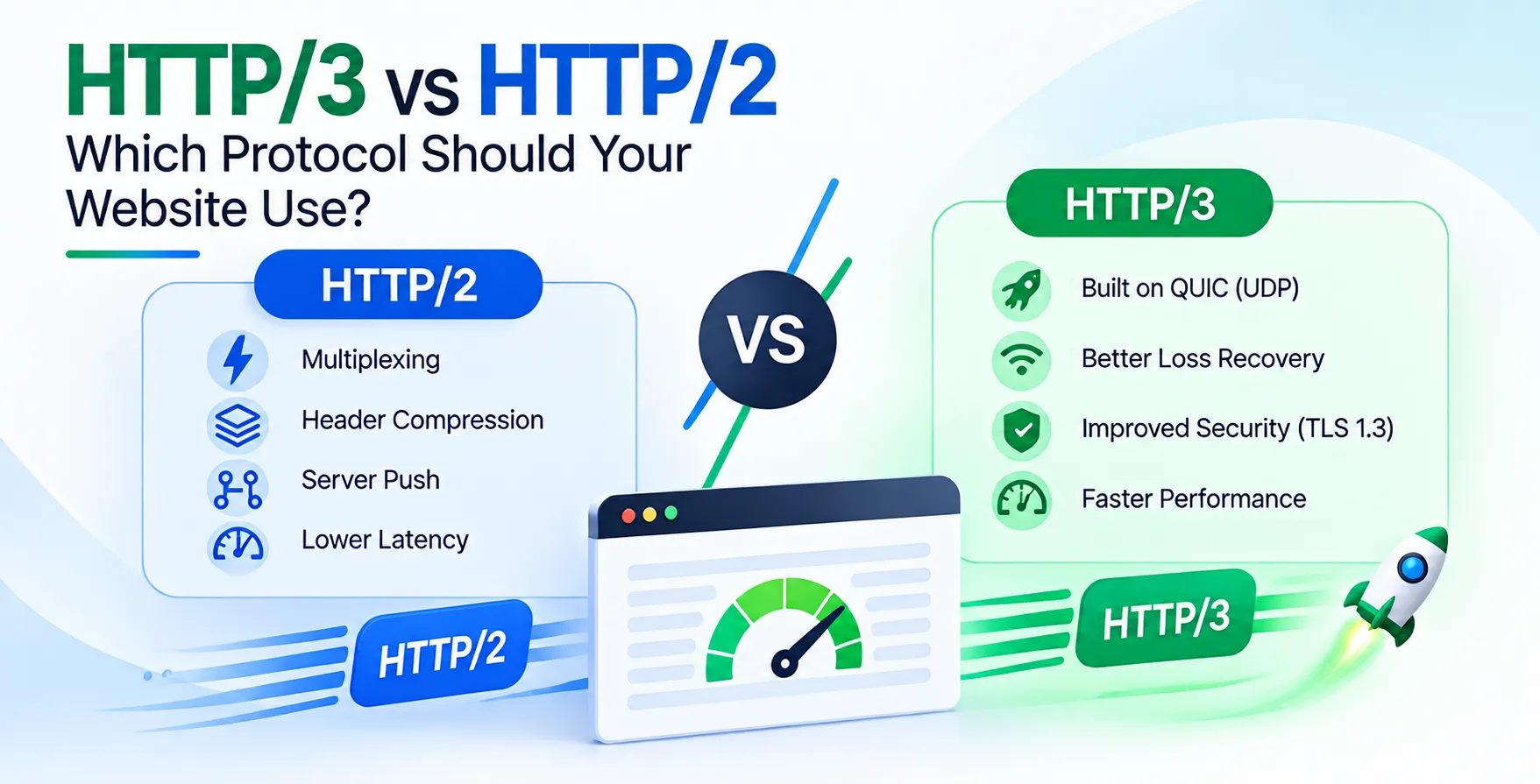
You have likely heard about the transition from HTTP/2 to the newer standard. Deciding on HTTP/3 vs HTTP/2 which protocol should your website use is a question many engineering teams now face.
Understanding HTTP/2 Basics
HTTP/2 was a significant leap over the original HTTP/1.1 standard. It introduced multiplexing, which allowed multiple requests and responses to occur over a single TCP connection.
This effectively solved many issues related to loading assets on a single page. It also enabled server push, where the server could send assets to the browser before they were explicitly requested.
However, HTTP/2 is still bound by the limitations of the underlying TCP transport layer. While it improved concurrency, it did not solve the fundamental issues of packet loss affecting the entire stream.
- Reduced latency for modern websites
- Efficient header compression techniques
- Stream multiplexing capabilities
- Improved resource loading prioritization
The Shift Toward HTTP/3
HTTP/3 represents a fundamental shift in how we think about web transport. It moves away from the traditional TCP model entirely to embrace a more modern approach.
This protocol was designed to be faster, more reliable, and more secure by default. By utilizing a new transport layer, it addresses specific bottlenecks that have plagued the web for years.
As developers continue to refine web performance optimization strategies, adopting this standard has become a priority. It is not just an incremental update but a complete architectural change.
- Built for unreliable network conditions
- Optimized for mobile device connectivity
- Reduced dependency on legacy infrastructure
- Enhanced privacy via encryption
How the QUIC Protocol Works
The core innovation behind HTTP/3 is the QUIC protocol. Unlike TCP, which is implemented in the operating system kernel, QUIC runs in user space over UDP.
This allows for faster iteration and deployment of protocol updates. It also enables connection migration, meaning a user can switch from Wi-Fi to cellular data without dropping their active session.
QUIC handles congestion control and error recovery much more efficiently than TCP. It treats every stream independently, ensuring that one lost packet does not stall the entire connection.
- Faster connection establishment times
- Resilient to packet loss issues
- Improved stream-level flow control
- Built-in encryption from the start
Comparing HTTP/3 vs HTTP/2
When looking at HTTP/2 vs HTTP/3, the primary difference lies in the transport layer. HTTP/2 relies on TCP, while HTTP/3 operates on QUIC.
This fundamental difference dictates how each protocol handles congestion and stream management. While both support multiplexing, they achieve it through very different underlying mechanisms.
| Feature |
HTTP/2 (TCP) |
HTTP/3 (QUIC) |
| Transport |
TCP |
UDP |
| Connection Time |
Multiple round trips |
Zero to one round trip |
| Multiplexing |
Stream-based |
Independent streams |
| Packet Loss |
Blocks all streams |
Blocks only the affected stream |
| Migration |
Not supported |
Supported natively |
Head-of-Line Blocking Explained
Head-of-line blocking is a classic performance killer in web networking. In TCP, if one packet is lost, the entire stream must wait for retransmission before any other data can be processed.
This creates a bottleneck that slows down the delivery of critical resources. Even if subsequent packets have arrived, the receiver cannot use them until the missing piece is filled.
HTTP/3 effectively eliminates this problem because each stream is independent. If a packet is lost, only the specific stream containing that data is impacted, allowing others to continue flowing.
- Prevents entire connection stalls
- Improves overall page load consistency
- Reduces perceived latency for users
- Optimizes throughput on congested networks
Security Improvements in Modern Protocols
Security is baked into the design of HTTP/3 rather than being an add-on. Every connection requires encryption by default, ensuring that data integrity is maintained throughout the transfer.
This removes the possibility of unencrypted connections that plagued earlier versions of the web. It also simplifies the process for developers who no longer need to manage complex handshake configurations.
By integrating TLS 1.3 natively, the protocol reduces the time required for security handshakes. This contributes to the overall speed benefits that users experience when visiting a site.
Performance Gains with HTTP/3
The real-world performance gains of HTTP/3 are most visible on high-latency or unstable mobile networks. In these environments, TCP often struggles to maintain a consistent flow of data.
By reducing the handshake time to zero or one round trip, the protocol allows for faster content delivery. This is essential for maintaining the Core Web Vitals that impact your search rankings.
Teams focused on aggressive website performance optimization will find that this upgrade pays dividends. It is particularly effective for users in regions with spotty network coverage.
- Faster time to first byte
- Reduced connection overhead
- Improved mobile user experience
- More efficient resource delivery
When to Stick with HTTP/2
There are valid reasons to continue using HTTP/2 in specific scenarios. Some legacy infrastructure might not be ready to handle the overhead of UDP traffic.
If your current load balancers or firewalls are not configured for modern protocols, you might encounter unexpected issues. Transitioning requires careful testing to ensure that your traffic flows correctly.
Most web servers now support both protocols simultaneously. You can enable both and let the client decide which one to use, providing a fallback mechanism that ensures compatibility.
Implementation Challenges
Switching protocols is not always a simple toggle in your configuration files. It often requires updating your networking stack to support the newer standards.
You may need to ensure your CDN, reverse proxy, and application servers are all compatible. Misconfigurations can lead to performance degradation rather than the expected improvements.
Testing is a critical part of the process. You must verify that your assets are delivered correctly and that your security headers remain intact during the migration.
- Upgrading infrastructure components
- Monitoring for compatibility issues
- Validating security configurations
- Testing across multiple browsers
Browser and Server Support
Global support for these protocols has grown rapidly over the last few years. Almost all modern browsers and major server platforms now support the newer standards out of the box.
Checking your current server logs can reveal how much of your traffic is already utilizing these technologies. You might be surprised to find that a significant portion of your users are already benefiting from it.
As support continues to mature, the barriers to entry are becoming lower than ever before. There is little reason to delay testing these improvements on your staging environment.
The Future of Web Transport
The evolution of networking protocols is far from finished. We are moving toward a web that is more resilient and capable of handling massive amounts of concurrent data.
As edge computing for web applications becomes more common, the efficiency of our transport layers will become even more critical. These protocols provide the backbone for the next generation of digital experiences.
Stay informed about updates and best practices as these technologies continue to evolve. Your commitment to staying current will directly impact the speed and reliability of your online presence.
Conclusion
Choosing between these protocols depends heavily on your current infrastructure and performance goals. While HTTP/2 remains a reliable standard, the benefits of HTTP/3 are becoming impossible to ignore for most modern applications.
If you prioritize speed and mobile performance, moving to the newer standard is a logical next step. Start by testing in a controlled environment to ensure your stack can handle the transition smoothly.


 In collaboration with