Table of Contents
- Introduction
- Understanding the CDN
- Key Functions of a CDN
- What is a Reverse Proxy?
- Primary Roles of a Reverse Proxy
- Comparing CDN vs Reverse Proxy
- When to Use a CDN
- When to Use a Reverse Proxy
- Architectural Synergy
- Common Implementation Challenges
- Performance and Security Considerations
- The Role of Edge Computing
- Final Thoughts
Introduction
Managing modern web infrastructure requires a clear understanding of how data moves across networks. Engineers frequently debate the roles of various intermediary layers, especially when discussing CDN vs reverse proxy differences and use cases.
Both technologies sit between the user and the origin server, yet they serve fundamentally different purposes. Choosing the right tool is essential for effective web traffic routing and maintaining high availability.
Understanding the CDN
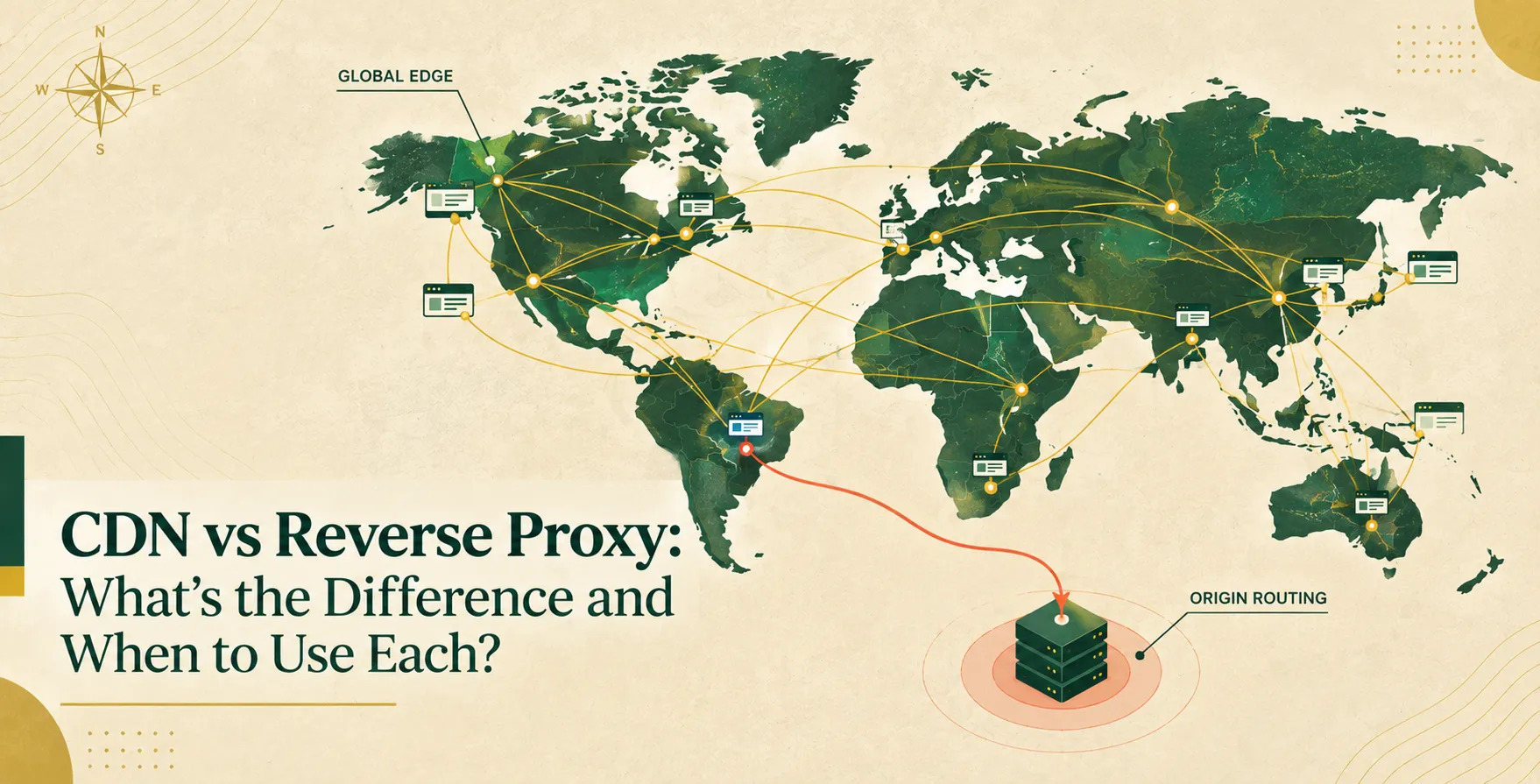
A CDN (Content Delivery Network) is a geographically distributed group of servers designed to deliver content quickly. By caching static files closer to the user, it significantly reduces latency and improves overall site speed.
Think of it as a global storage layer for your website's assets. When a user requests a page, the CDN serves the heavy content from an edge location rather than pulling it from your origin.
- Reduces bandwidth costs
- Decreases latency for global users
- Handles massive traffic spikes
- Improves website loading speed
Key Functions of a CDN
The primary goal of a CDN is to shorten the physical distance between the data and the end-user. This is critical for any serious strategy aimed at website performance optimization.
Beyond caching, modern providers offer additional layers of protection. They filter out malicious traffic before it ever reaches your infrastructure, acting as a first line of defense.
- Static asset caching
- Dynamic content acceleration
- DDoS mitigation
- SSL termination at the edge
- Real-time traffic analytics
What is a Reverse Proxy?
A reverse proxy is a server that sits in front of one or more web servers and intercepts requests from clients. Unlike a CDN, which focuses on distribution, the reverse proxy focuses on backend management and request handling.
It acts as a gateway for your internal services. By centralizing entry points, it allows developers to manage backend complexity without exposing internal architecture directly to the public internet.
Primary Roles of a Reverse Proxy
Reverse proxies are essential for managing internal traffic flow and security. They provide a layer of abstraction that is crucial for robust web development services.
Load Balancing
Load balancing ensures that no single server becomes overwhelmed by too many requests. It distributes incoming traffic across multiple backend instances to maintain stability.
- Distributes load evenly
- Prevents server crashes
- Improves application reliability
Security and Encryption
By handling SSL/TLS termination, the reverse proxy offloads the compute-heavy encryption process from the application servers. This allows your backend to focus purely on business logic.
- Manages SSL certificates
- Hides internal server structure
- Provides centralized logging
Comparing CDN vs Reverse Proxy
| Feature |
CDN |
Reverse Proxy |
| Primary Goal |
Latency Reduction |
Traffic Management |
| Deployment |
Globally Distributed |
Centralized or Local |
| Content Handling |
Static/Dynamic Caching |
Request Routing/Balancing |
| Primary Location |
Network Edge |
Inside Data Center |
| Visibility |
Public Facing |
Internal Facing |
| Use Case |
Asset Delivery |
Backend Orchestration |
When to Use a CDN
You should deploy a CDN when your primary concern is the speed at which users download your files. If you have an international audience, the geographical benefits of edge caching are undeniable.
It is also the correct choice when your origin server is struggling to handle high volumes of concurrent requests for static content. By offloading these requests, you preserve your origin's resources for critical dynamic tasks.
When to Use a Reverse Proxy
A reverse proxy is necessary when you need to manage multiple backend services under a single domain. It is a standard component of professional deployment services, especially when using containerization.
Use it when you need to implement complex routing rules, modify headers, or handle authentication before a request reaches your application. It provides the control necessary for sophisticated microservices traffic management.
Architectural Synergy
In many enterprise setups, you do not choose between them; you use both. The CDN handles the global delivery of static files, while the reverse proxy manages the specific routing and load balancing of dynamic requests.
This hybrid approach is common in scalable web development. It allows for a layered defense and performance strategy that satisfies both global users and backend requirements.
Common Implementation Challenges
Misconfiguration is a common issue when combining these layers. Cache invalidation is particularly tricky, as you must ensure the CDN purges outdated assets when you update your site.
Furthermore, complex setups can lead to debugging headaches. You need robust monitoring to trace a request through the CDN, the reverse proxy, and finally, the application server.
- Complex cache invalidation logic
- Header modification conflicts
- Increased debugging complexity
- SSL certificate synchronization
- Latency introduced by extra hops
Performance and Security Considerations
Security is a shared responsibility between these layers. While the CDN provides broad protection against network-level attacks, the reverse proxy secures the application layer.
Properly configuring your headers is vital for maintaining security. Always ensure that the reverse proxy correctly passes client IP information so your application can perform accurate logging.
The Role of Edge Computing
The boundary between these two technologies is blurring with the rise of edge computing for web applications. Modern CDNs now allow you to run code at the edge, effectively turning them into distributed reverse proxies.
This shift enables developers to perform logic closer to the user than ever before. It is a powerful way to further reduce website load time without increasing the burden on the origin server.
Final Thoughts
Understanding the distinction between a CDN and a reverse proxy is fundamental for any DevOps professional. One optimizes content delivery, while the other orchestrates backend traffic.
By leveraging both effectively, you can build resilient, high-performance systems. Keep your architecture simple, monitor your traffic flows, and always prioritize the user experience in your design decisions.


 In collaboration with