Table of Contents
- Introduction
- Understanding the Ingress Resource
- Limitations of Traditional Ingress
- What is the Kubernetes Gateway API?
- Key Differences in Architecture
- Kubernetes Gateway API vs Ingress which should you use
- Performance and Scalability Considerations
- Handling Complex Traffic Requirements
- Role-Based Access Control
- Comparing Configuration Models
- When to Stick with Ingress
- Transitioning to Gateway API
- Choosing the Right Tool
- Conclusion
Introduction
Managing traffic inside a cluster requires robust tools that can handle routing effectively. For years, developers have relied on the standard resource for external access.
As cluster complexity grows, new standards have emerged to address older limitations. Engineers now face a choice between long-standing solutions and modern alternatives.
Understanding the Ingress Resource
The Ingress resource has been the standard way to expose services to the outside world for a long time. It acts as a collection of rules that allow inbound connections to reach cluster services.
It typically works by sitting in front of your services and routing traffic based on hostnames or paths. This simplicity made it popular for basic web applications and internal testing.
- Provides simple HTTP and HTTPS routing
- Supports path-based and host-based rules
- Integrates with many load balancer controllers
- Offers a standardized way to define external access
Most teams start their journey here when setting up their first cluster. It is easy to understand and provides immediate value for basic routing needs.
Limitations of Traditional Ingress
While Ingress was revolutionary, it suffers from significant limitations in complex environments. It often lacks the granular control required for enterprise-grade microservices vs monolithic architecture setups.
Different implementations often rely on custom annotations to support advanced features. This leads to vendor lock-in where switching controllers requires significant configuration rewrites.
- Inconsistent behavior across different controller implementations
- Limited support for advanced traffic splitting
- Lack of standardized API for complex scenarios
- Heavy reliance on proprietary annotations
These issues create friction during maintenance and scaling. Teams often find themselves writing custom scripts just to manage traffic flows across multiple environments.
What is the Kubernetes Gateway API?
The **Kubernetes Gateway API** is a collection of resources that model service networking in Kubernetes. It aims to be more expressive, extensible, and role-oriented than its predecessor.
By utilizing custom resource definitions, it provides a unified way to manage traffic. It is designed to handle sophisticated needs like multi-tenancy and advanced traffic splitting.
The API treats infrastructure as code, which fits perfectly into a modern GitOps infrastructure management workflow. It empowers developers to define traffic policies without needing deep knowledge of the underlying infrastructure.
Key Differences in Architecture
The core shift lies in how the API handles different components. Instead of a single resource, it separates the concerns into distinct objects like Gateways, GatewayClasses, and Routes.
This separation allows for a cleaner division of labor. Network administrators can manage the infrastructure while developers manage the routing rules for their specific services.
| Feature |
Ingress |
Gateway API |
| Abstraction |
High |
Very High |
| Customization |
Annotations |
CRDs |
| Role-based |
No |
Yes |
| Extensibility |
Low |
High |
| Traffic Splitting |
Limited |
Native |
This architectural change provides more flexibility for complex cloud deployment environments. It creates a clearer separation between infrastructure provisioning and application routing.
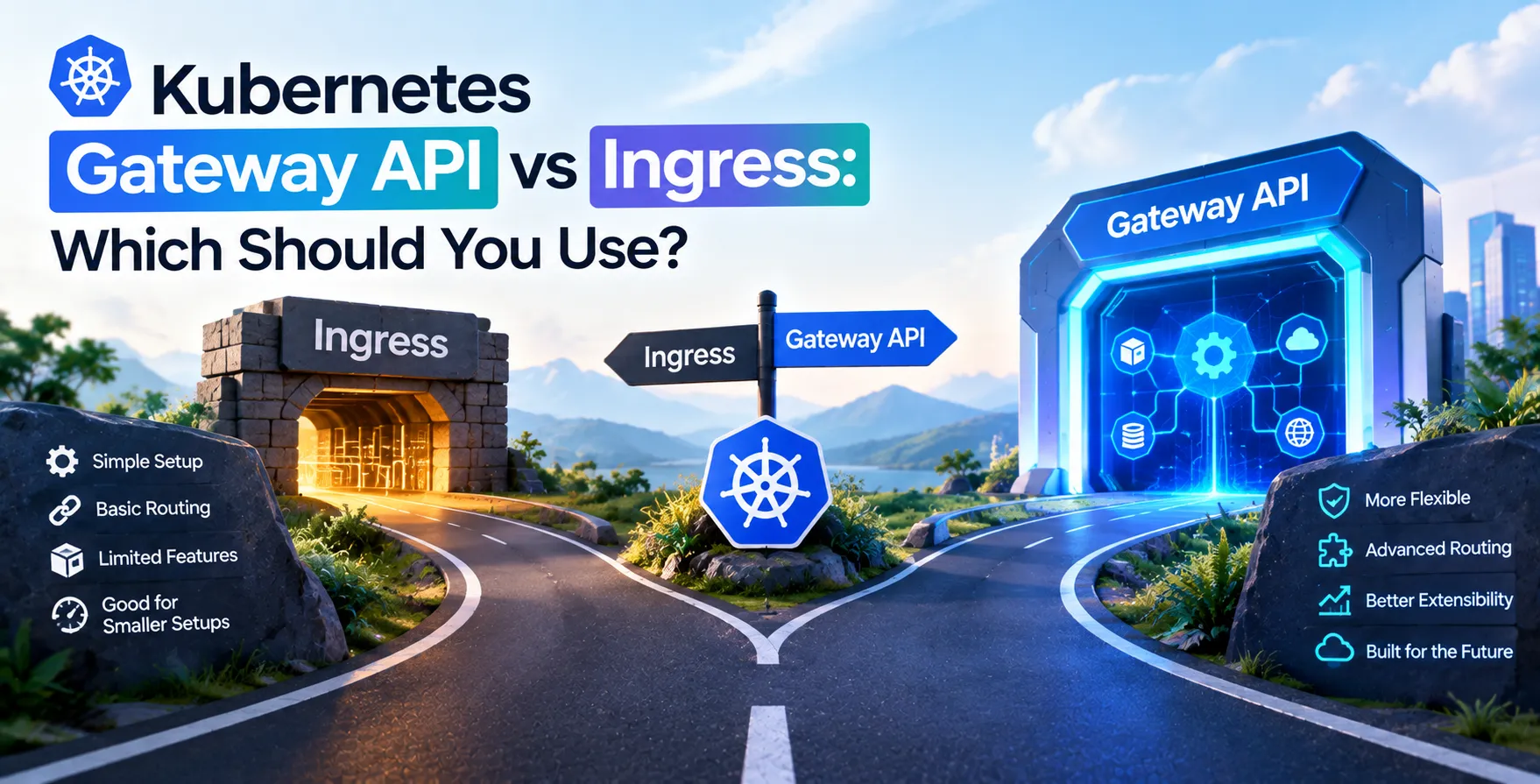
Kubernetes Gateway API vs Ingress which should you use
Deciding between these options depends heavily on your current infrastructure needs. If you are managing simple static sites, the classic resource remains an easy choice.
However, if your organization is scaling toward a complex microservices architecture, the modern standard is superior. It provides the necessary hooks for advanced traffic management that Ingress simply cannot handle natively.
- Assess the complexity of your routing needs
- Consider the long-term maintainability of your configuration
- Evaluate if you need native traffic splitting support
- Look at the support provided by your cloud provider
Most modern teams are moving toward the newer standard. It prevents the need for hacks and workarounds that often plague legacy setups.
Performance and Scalability Considerations
Performance is always a concern when dealing with traffic routing. The newer API standard is designed to be more efficient by reducing the overhead of processing complex rules.
Because it relies on native CRDs rather than parsing thousands of annotations, the controller loop runs much faster. This leads to quicker updates and better overall cluster stability.
Effective traffic management requires consistent performance metrics. Using the right tool ensures that your cluster remains responsive even under high load.
Handling Complex Traffic Requirements
Advanced routing scenarios often require features like header manipulation, weight-based routing, and protocol-specific handling. These are difficult to achieve with standard Ingress.
The newer API includes these capabilities out of the box through HTTPRoute objects. This means you can implement sophisticated strategies without relying on third-party plugins.
- Native support for header-based routing
- Easy implementation of canary deployments
- Seamless integration with service mesh vs API gateway tools
- Flexible protocol support for gRPC and WebSockets
This level of control is essential for teams practicing continuous deployment. It allows for safer releases and more granular traffic control during updates.
Role-Based Access Control
One of the most powerful aspects of the newer API is how it handles different personas. It allows cluster operators to define gateways while letting application teams manage their own routes.
This delegation prevents the common bottleneck where a single team owns all traffic configuration. It empowers developers to move faster and reduces the risk of misconfiguration.
By defining clear boundaries, you can ensure that teams only touch the resources they need. This promotes better security and operational efficiency across the organization.
Comparing Configuration Models
The configuration model for Ingress is flat and often cluttered. You end up with long files full of annotations that are hard to read and debug.
In contrast, the newer approach is hierarchical. You define a Gateway, then attach various Routes to it. This structure is much easier to manage over time.
- Hierarchical structure improves readability
- Simplified debugging process with descriptive resources
- Clearer separation of concerns for team collaboration
- Easier to automate with CI/CD pipeline tools
This improvement in configuration quality is a major win for DevOps teams. It reduces the cognitive load required to understand how traffic flows through the system.
When to Stick with Ingress
There are still scenarios where the older approach is perfectly fine. If you have a stable, simple cluster that does not require advanced traffic management, stay with what you know.
Migrating to a new API requires time and testing. If your current system is not broken, the cost of migration might outweigh the benefits.
Transitioning to Gateway API
If you decide to upgrade, start by experimenting in a non-production environment. Map out your current rules and see how they translate into the new structure.
Many modern controllers support both standards simultaneously. This allows for a gradual migration path rather than a big-bang approach.
- Deploy the new controller in a test namespace
- Verify traffic flow with dummy services
- Migrate one application at a time
- Monitor performance and error rates closely
Take your time with the transition. Ensure that all your teams are trained on the new patterns before moving critical production services.
Choosing the Right Tool
The choice between these two tools is ultimately about matching your technology to your business requirements. Simple setups benefit from simplicity, while complex systems need robust standards.
As you evaluate various Kubernetes ingress alternatives, look for tools that prioritize interoperability. Your infrastructure should be built to last and support future growth.
Conclusion
Choosing the right traffic management tool is a critical step for any cluster administrator. While the traditional resource has served us well, the industry is clearly moving toward more expressive and extensible standards.
By understanding the strengths of each, you can make an informed decision for your team. Whether you stick with the legacy approach or adopt the newer standard, focus on building maintainable and scalable systems.


 In collaboration with