Table of Contents
- Introduction to Zero Trust
- Core Principles of Zero Trust
- Building a Zero Trust SaaS Architecture
- Implementing Identity-Centric Security
- Data Protection at Scale
- Managing Access with Least Privilege
- Securing SaaS Supply Chains
- Monitoring and Observability
- Zero Trust vs Traditional Perimeters
- Common Implementation Challenges
- Automation in Security Workflows
- Aligning with Regulatory Standards
- Conclusion
Introduction to Zero Trust
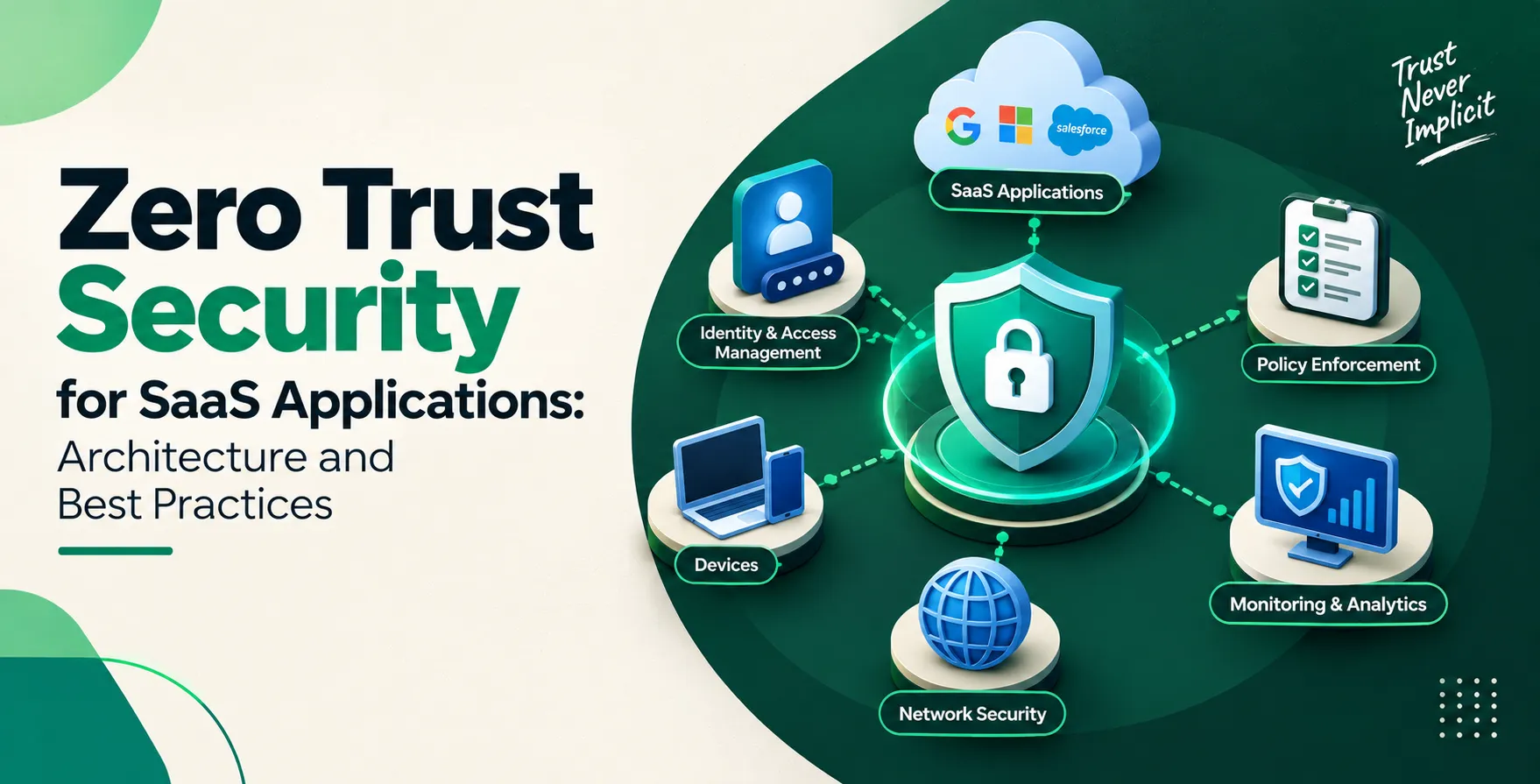
Modern software delivery has moved beyond the traditional corporate firewall. As applications shift to the cloud, the old perimeter-based defense models no longer suffice. We must now assume that threats exist both inside and outside our networks.
Adopting Zero Trust security means verifying every request regardless of its origin. This approach forces developers and security teams to treat every access attempt as potentially malicious until proven otherwise.
- Eliminates implicit trust models
- Focuses on granular verification
- Secures remote and cloud workflows
Core Principles of Zero Trust
At its heart, the Zero Trust mindset shifts focus from location to identity and behavior. You no longer trust a user or device just because they are on your corporate VPN. Instead, you validate specific context before granting access.
This framework requires continuous monitoring of every request. By inspecting traffic patterns, you can identify anomalies that suggest a compromised account or a malicious internal actor. It requires a fundamental shift in how we build and manage cloud infrastructure.
- Never trust, always verify
- Assume breach scenarios
- Verify explicitly for every request
- Use least privilege principles
Building a Zero Trust SaaS Architecture
Designing a Zero Trust SaaS architecture involves breaking down monolithic perimeters into micro-perimeters. Each service or data resource becomes its own protected zone, requiring specific authentication and authorization for entry.
This architecture relies heavily on identity providers to manage user credentials. You must integrate these providers directly into your application stack to ensure that every API call is authenticated. It also involves securing communication between services within your infrastructure.
- Segment networks into micro-zones
- Enforce mTLS between internal services
- Centralize identity management
- Use short-lived session tokens
Implementing Identity-Centric Security
Identity is the new perimeter in modern software development. Without robust identity management, you cannot enforce granular access policies across your distributed platform. You must ensure that users, service accounts, and API clients are uniquely identifiable.
This requires moving away from static credentials like simple API keys. Instead, implement robust flows that enforce multi-factor authentication and device posture checks. Ensure your authentication strategy handles session expiration and token rotation effectively.
- Use phishing-resistant MFA
- Enforce device health checks
- Implement centralized identity providers
- Automate user lifecycle management
Data Protection at Scale
Protecting sensitive customer information is the primary goal of any security strategy. In a multi-tenant environment, you must ensure that one customer cannot access the data belonging to another. This is where robust database isolation becomes critical.
Encrypting data at rest and in transit is a baseline requirement. However, true security comes from managing who can decrypt that data and when. Use fine-grained access control to restrict database queries to only the necessary fields.
- Encrypt all sensitive data
- Implement tenant-level data isolation
- Rotate encryption keys regularly
- Audit all data access logs
Managing Access with Least Privilege
The concept of least privilege SaaS security dictates that users and services should have the minimum access necessary to perform their jobs. Granting broad permissions creates a massive attack surface that is difficult to secure.
You should review permissions regularly to remove unused access rights. This practice is especially important for third-party integrations and administrative accounts. Automated tools can help identify over-privileged entities within your system.
| Access Level |
Risk Profile |
Mitigation Strategy |
| Admin |
High |
Strict MFA and session limits |
| Developer |
Medium |
Role-based access controls |
| Guest |
Low |
Restricted sandbox environments |
| Service |
Medium |
Short-lived dynamic credentials |
Securing SaaS Supply Chains
Software supply chain security is a growing concern for all cloud-native organizations. You must secure the libraries, CI/CD pipelines, and infrastructure as code templates that build your applications. If your build environment is compromised, your production code is at risk.
Implement automated scanning for vulnerabilities in your dependencies. You should also sign your build artifacts to ensure they have not been tampered with before deployment. Maintaining a software bill of materials helps track what is actually running in your production environment.
- Scan dependencies for vulnerabilities
- Sign all container images
- Restrict CI/CD pipeline access
- Use immutable infrastructure patterns
Monitoring and Observability
You cannot secure what you cannot see. Effective security monitoring requires collecting logs from every layer of your application stack, including network traffic, identity provider events, and database queries. This data is essential for detecting threats in real-time.
Building an observability pipeline allows you to create alerts for suspicious behavior. When an anomaly is detected, your security team needs the context to respond immediately. This proactive stance is a cornerstone of a mature security posture.
- Centralize all security logs
- Automate anomaly detection alerts
- Visualize traffic flow patterns
- Conduct regular incident drills
Zero Trust vs Traditional Perimeters
Traditional security relied on keeping attackers out of the internal network. Once someone was inside, they had much more freedom to move laterally between systems. This model is insufficient for modern cloud environments.
Zero Trust assumes the perimeter has already been breached. It forces every interaction to be authenticated, authorized, and encrypted, regardless of where it originates. This creates a much more resilient defense against both external and internal threats.
- Perimeter-based systems use firewalls
- Zero Trust uses identity-based gates
- Legacy models trust internal users
- Modern models verify all users
Common Implementation Challenges
Transitioning to a Zero Trust model is a journey, not a single project. Many teams struggle with the complexity of retrofitting existing monolithic applications to support granular authentication. It often requires significant refactoring of core service communication patterns.
Cultural change is another major hurdle. Developers often view security as a blocker to speed. You must demonstrate that secure practices actually enable safer, more reliable deployments in the long run.
- High initial architectural complexity
- Legacy system integration difficulties
- Potential performance overhead
- Need for organizational buy-in
Automation in Security Workflows
Manual security checks are slow and prone to human error. You must automate as much of your security posture as possible. This includes policy enforcement, credential rotation, and access requests.
Infrastructure as code allows you to define security policies in version control. When you deploy new resources, the infrastructure is automatically provisioned with the correct security settings. This ensures consistency across development, staging, and production environments.
- Policy as code enforcement
- Automated credential rotation
- Self-service access workflows
- CI/CD integration for security
Aligning with Regulatory Standards
Security is not just about protection; it is also about compliance. Many industries require adherence to strict standards regarding data handling and access control. A well-designed security framework makes achieving these certifications much simpler.
By documenting your identity controls and access policies, you simplify the audit process. You should map your security controls directly to the requirements of your target industry. This ensures you are always prepared for compliance reviews.
- Automated compliance reporting
- Standardized audit logs
- Regular security posture assessments
- Data privacy by design
Conclusion
Implementing Zero Trust security for SaaS applications is essential for protecting modern digital businesses. By focusing on identity and least privilege, you create a robust defense that adapts to the realities of cloud-native development.
Start by securing your highest-risk assets and gradually expand your coverage. Remember that security is a continuous process of improvement and verification. Stay proactive, monitor your traffic, and prioritize the safety of your customer data above all else.


 In collaboration with