Table of Contents
- Introduction to the Modern Framework Landscape
- Understanding the Core Philosophy of Astro
- Deep Dive into the Next.js Ecosystem
- Architectural Differences in Rendering
- Astro vs Next.js Performance Metrics
- Evaluating Astro vs Next.js SEO Capabilities
- Developer Experience and Tooling
- Component Architecture and Reusability
- When to Choose Astro for Your Project
- When Next.js Is the Right Strategic Choice
- Comparing Data Fetching Patterns
- The Future of Frontend Development
- Final Thoughts
Introduction to the Modern Framework Landscape
The web development world is witnessing a significant shift in how we build interfaces. For years, the industry was dominated by monolithic choices that forced a single way of doing things.
Now, developers have more specialized tools at their disposal. The debate over Astro vs Next.js has become central to many technical discussions in modern web development.
Understanding which tool fits your specific project needs is no longer just about preference. It is about architectural alignment and long-term maintainability.
Understanding the Core Philosophy of Astro
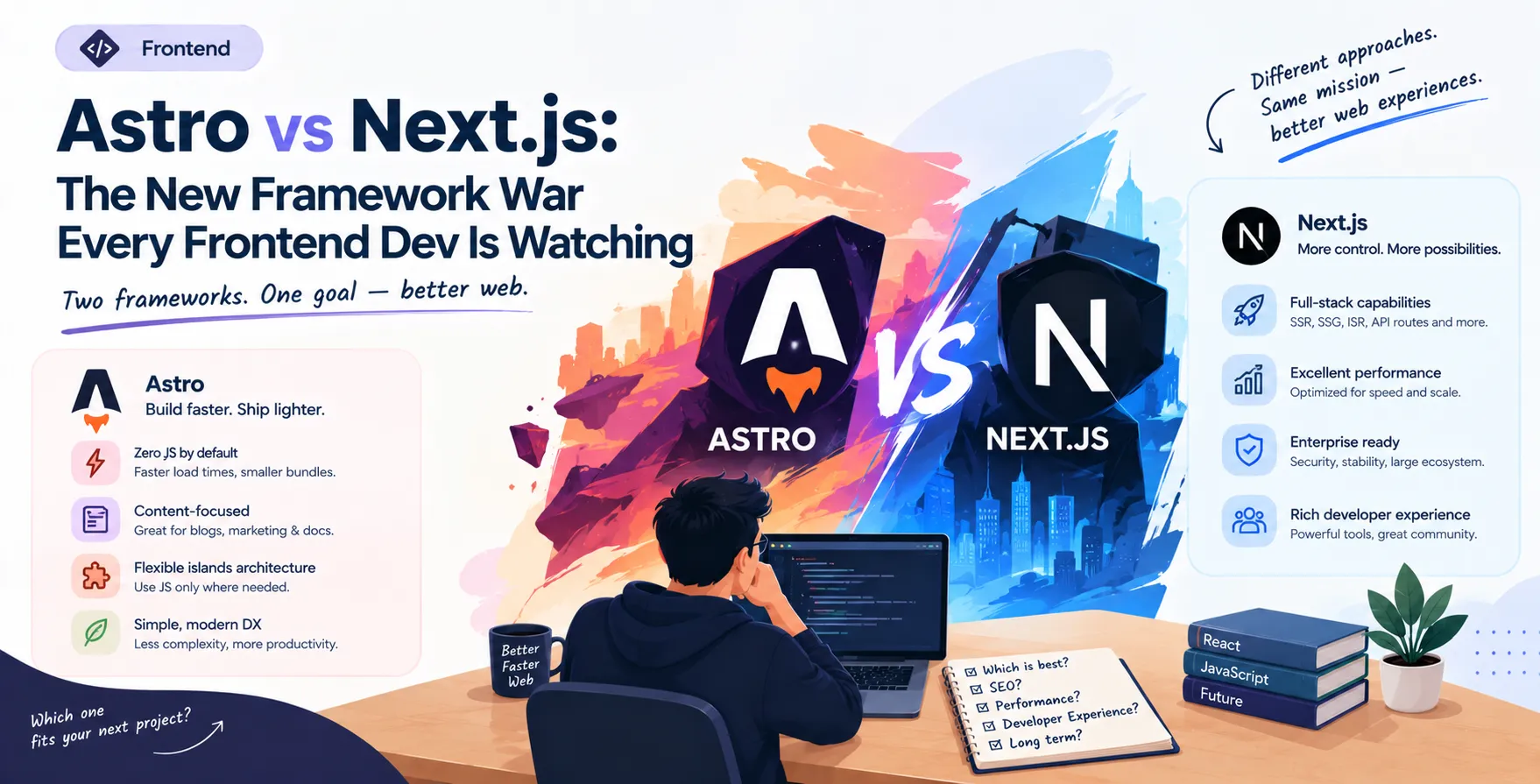
Astro arrived with a bold promise to change how we think about static site generation. It focuses on shipping zero JavaScript by default to the client side.
This approach treats websites as content-first experiences rather than application-first shells. By isolating components and only hydrating what is necessary, it solves the problem of bloated bundles.
It allows developers to use their favorite libraries while keeping the final output clean and fast. This unique island architecture is changing the game for static site performance.
- Ships zero JavaScript by default
- Supports island architecture for partial hydration
- Framework-agnostic component support
- Content-driven design philosophy
Deep Dive into the Next.js Ecosystem
Next.js remains the gold standard for full-stack React framework development. It provides a comprehensive suite of features that simplify complex application requirements.
The framework excels in scenarios where you need dynamic, server-rendered pages and complex API integrations. It is built to scale alongside growing business needs.
Because it is a powerful React framework, it benefits from a massive ecosystem of plugins and community support. You get a batteries-included experience that handles routing and optimization out of the box.
- Strong server-side rendering capabilities
- Integrated API route support
- Advanced middleware and caching
- Extensive Vercel deployment ecosystem
Architectural Differences in Rendering
The fundamental divide lies in how these tools handle the browser experience. Next.js leans heavily into server-side rendering and static site generation for dynamic React applications.
Astro, conversely, prioritizes the delivery of static HTML. It only adds interactivity when explicitly requested by the developer through specific components.
This contrast defines the boundary between a heavy-duty app and a highly optimized content portal. Choosing between them requires knowing whether you need an application shell or a content-first deliverable.
Rendering Approaches
The way each framework processes data on the server dictates how users perceive load times.
- Next.js uses dynamic server-side rendering
- Astro optimizes for static content delivery
- Next.js manages complex state hydration
- Astro uses progressive hydration for specific zones
These architectural choices directly influence how you structure your build pipeline and deployment strategy.
Astro vs Next.js Performance Metrics
When analyzing Astro vs Next.js performance, the results often favor Astro for content-heavy sites. Its default zero-JS strategy ensures that pages remain lightweight and fast.
Next.js requires careful tuning of component bundles to achieve similar results. You often need to leverage advanced techniques to keep the JavaScript footprint low in a React-heavy project.
However, Next.js provides better performance for highly interactive dashboards. The trade-off is almost always between static speed and application state complexity.
| Feature |
Astro |
Next.js |
| Default JS |
Zero bytes |
React runtime included |
| Hydration |
Partial |
Full application |
| Best Use Case |
Content-focused |
Application-focused |
| Caching |
Static-first |
Server-first |
| Build Time |
Very fast |
Depends on scale |
Evaluating Astro vs Next.js SEO Capabilities
When it comes to Astro vs Next.js SEO, both frameworks are excellent choices. They prioritize server-rendered HTML, which ensures crawlers can index your content immediately.
The differences arise in how they handle large-scale sites. Astro makes it trivial to maintain clean, fast-loading pages that delight search engines.
Next.js offers better tools for dynamic SEO, such as handling metadata for thousands of unique, user-generated pages. Your choice depends on the scale and nature of your dynamic content.
- Server-side rendering for indexable content
- Easy meta tag management
- Fast initial load times
- Structured data support
Developer Experience and Tooling
Next.js provides a seamless experience for those already embedded in the React ecosystem. You get consistent patterns for routing, data fetching, and state management.
Astro provides flexibility that feels refreshing for developers tired of complex React configurations. It allows you to build with the tools you know while staying focused on the end product.
Both frameworks offer high-quality documentation and active communities. The learning curve is relatively gentle for anyone familiar with modern JavaScript development.
Component Architecture and Reusability
Astro excels at integrating different technologies within a single project. You can mix and match components from various libraries while maintaining a consistent design system.
This brings us closer to a future where we leverage web components for truly reusable interface elements. It allows for a framework-agnostic approach that reduces vendor lock-in for your UI library.
Next.js focuses on maintaining a unified React-based codebase. This is often preferred in large organizations that want to strictly control their tech stack and component lifecycle.
When to Choose Astro for Your Project
Selecting the right framework requires an honest assessment of your project requirements. You should lean toward Astro if your primary goal is speed and content delivery.
It is an ideal choice for documentation sites, blogs, and marketing landing pages. These projects benefit significantly from the reduced browser overhead.
If you need to iterate quickly without fighting the framework, Astro offers a path of least resistance. It keeps the development process simple and predictable.
- High-performance marketing sites
- Documentation-heavy platforms
- Content-driven web experiences
- Projects requiring multiple framework integration
When Next.js Is the Right Strategic Choice
Next.js is the better candidate for complex, state-heavy applications. If you are building a dashboard, a SaaS product, or a social network, you need the power of a mature React framework.
The ecosystem is vast, meaning you can find pre-built solutions for almost any challenge. This saves time and resources in the long run for enterprise projects.
It is designed to handle the complexity of user sessions, authentication, and database-driven content. These features are standard in the framework and well-documented.
Comparing Data Fetching Patterns
Data fetching is where the two frameworks diverge in their tactical execution. Astro encourages fetching data at build time, which results in lightning-fast response times for end users.
Next.js offers a more flexible approach, allowing for server-side fetches on every request or incremental static regeneration. This is vital for data that changes frequently, like stock prices or live feeds.
Choosing between them involves mapping your data refresh requirements to the framework's capabilities. A static site won't serve real-time data well, and a server-heavy app might be overkill for a static blog.
The Future of Frontend Development
Frontend development trends 2026 are pointing toward more specialized tools rather than general-purpose ones. We are seeing a move away from one-size-fits-all frameworks.
Developers are now choosing tools based on the specific constraints of the page they are building. This modular approach is becoming the standard for modern web development.
Staying updated with these shifts allows you to make better architectural decisions. The goal is to build software that is both performant and maintainable over the long term.
Final Thoughts
The competition between these frameworks has only served to make the ecosystem better for everyone. We have more options than ever to optimize our web presence.
Whether you choose the static power of Astro or the dynamic capabilities of Next.js, you are building on a strong foundation. Prioritize the needs of your users and the complexity of your data.
Ultimately, both frameworks provide the tools necessary to build successful products. Focus on the architecture that supports your long-term vision.


 In collaboration with