Table of Contents
- Introduction
- Understanding Real-Time Communication
- What is a WebSocket?
- What are Server-Sent Events?
- Key Differences at a Glance
- When to Choose WebSockets
- When to Choose Server-Sent Events
- Performance and Scalability Considerations
- Integration and Browser Compatibility
- Security Implications for Real-Time Apps
- Building Scalable Real-Time Architectures
- Operational Maintenance and Monitoring
- Final Thoughts
Introduction
Modern users demand instant updates, from live sports scores to collaborative editing tools. When building these experiences, selecting the right transport protocol is a fundamental architectural decision.
Developers often find themselves choosing between WebSocket and Server-Sent Events for their projects. Both technologies enable server-to-client communication, but they operate with different strengths and trade-offs.
Understanding Real-Time Communication
Real-time web applications rely on pushing data from the server to the client without the client needing to request it repeatedly. Traditional HTTP requests are insufficient for this because they follow a request-response cycle.
To achieve true interactivity, you must maintain an open connection or use efficient polling strategies. Choosing the right tool depends heavily on the direction of your data flow and your specific latency requirements.
What is a WebSocket?
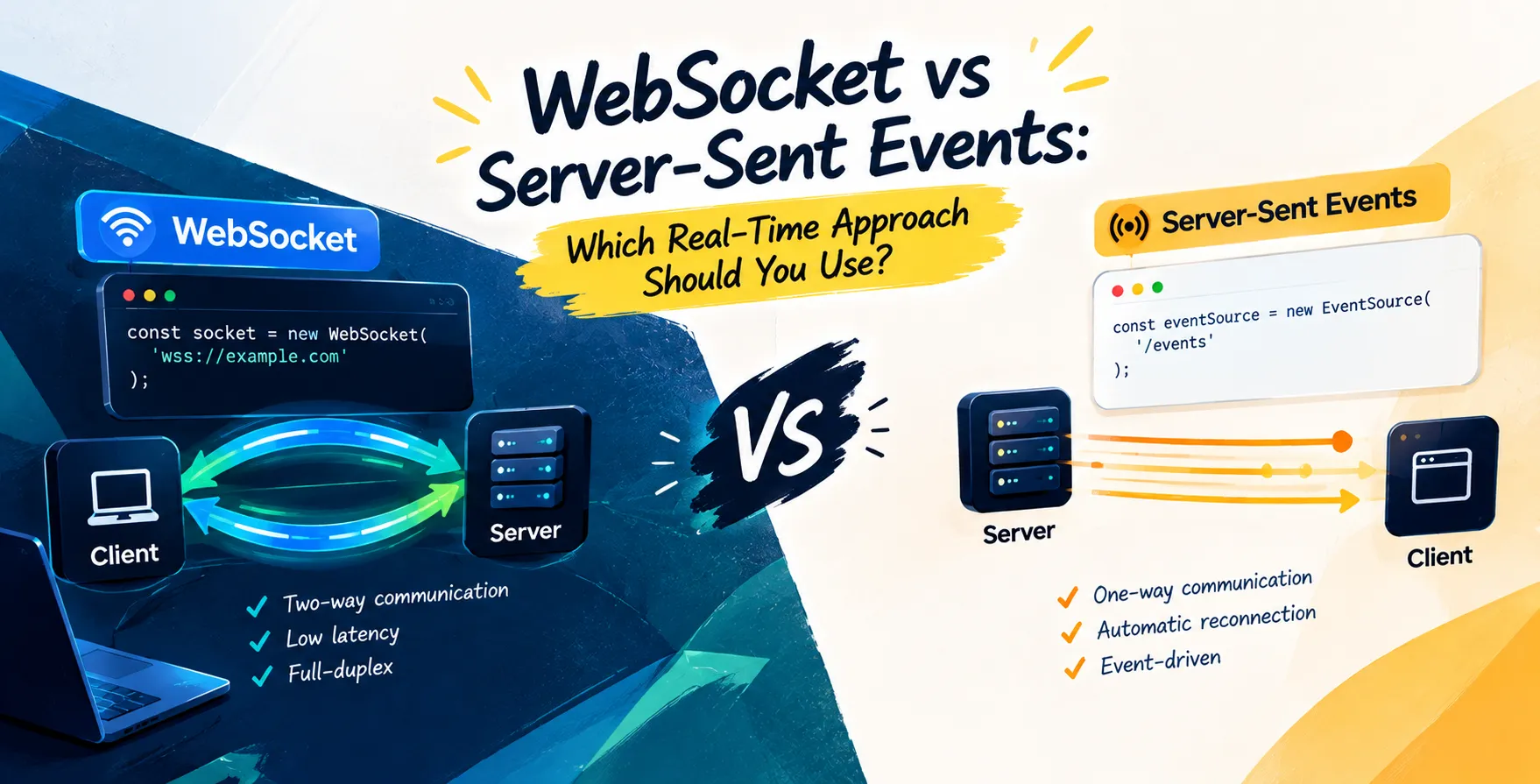
A WebSocket provides a full-duplex communication channel over a single, long-lived TCP connection. It allows the client and server to send data back and forth simultaneously at any time.
This protocol is ideal for applications where low latency is critical. Once the initial handshake is complete, the connection remains open until explicitly closed by either party.
- Enables bidirectional data transfer
- Minimal overhead after initial handshake
- Works well for gaming platforms
- Supports complex messaging patterns
What are Server-Sent Events?
Server-Sent Events allow servers to push data to web pages over HTTP. Unlike WebSockets, this is a unidirectional communication model where the server is the primary initiator of data updates.
The browser automatically handles the connection and reconnection logic, which simplifies development. It is a lightweight standard specifically designed for streaming text-based data updates.
- Built on standard HTTP protocol
- Automatic reconnection by the browser
- Simplifies server-side state management
- Well-suited for live news feeds
Key Differences at a Glance
| Feature |
WebSocket |
Server-Sent Events |
| Direction |
Full-duplex |
Unidirectional |
| Protocol |
Custom WS |
Standard HTTP |
| Complexity |
High |
Low |
| Binary Data |
Native Support |
Limited Support |
| Reconnection |
Manual |
Automatic |
When to Choose WebSockets
You should reach for this technology when your application requires constant, high-frequency interaction. If your UI needs to send updates to the server as often as it receives them, this is the standard choice.
It is particularly effective for collaborative environments where multiple users modify data concurrently. You must be prepared to handle the infrastructure overhead of maintaining thousands of persistent connections.
High Interaction Use Cases
Applications that require instant state synchronization across clients benefit significantly from this approach. These scenarios often involve complex logic on both the client and the server.
- Collaborative document editing tools
- Multiplayer browser-based games
- Financial trading dashboards
- Interactive chat applications
These use cases demand minimal delay between user action and visual confirmation.
When to Choose Server-Sent Events
This approach is the perfect fit if your primary requirement is pushing server-side updates to the client. If your client only needs to receive notifications, data streams, or log updates, the simplicity of this protocol wins.
It leverages existing HTTP infrastructure, meaning it plays nicely with load balancers and firewalls. You avoid the complexities of managing non-HTTP protocols at the edge of your network.
Efficient Monitoring Use Cases
When you need to stream events or status updates to a dashboard, this protocol provides a robust and reliable foundation. It keeps your architectural footprint small and manageable.
- Real-time analytics dashboards
- Live notification systems
- Stock price tickers
- System status monitoring
These applications prioritize reliability and ease of implementation over bidirectional signaling.
Performance and Scalability Considerations
Scaling persistent connections requires careful planning regarding server resources and memory. Every open connection consumes system file descriptors and memory, regardless of which protocol you choose.
With bidirectional channels, you often face higher resource consumption due to the complexity of managing state. Conversely, unidirectional streaming is generally easier to cache and distribute via proxy layers.
Integration and Browser Compatibility
Both protocols enjoy widespread support in modern web browsers, making them viable for production environments. However, legacy systems might require polyfills or fallbacks to ensure a consistent experience.
If you are planning your api development and integration, ensure your gateway layers recognize these connection types. Improper configuration at the proxy level is the most common cause of connection drops.
Security Implications for Real-Time Apps
Security is paramount when keeping connections open for extended periods. You must implement robust authentication during the handshake phase to verify the identity of the client.
Cross-site request forgery and other common web vulnerabilities must be addressed systematically. Never assume that a persistent connection is inherently safer than a standard RESTful interaction.
Building Scalable Real-Time Architectures
To scale, you should decouple your message producers from your consumers using a message queue. This architecture ensures that your application remains responsive even during traffic spikes.
Consider implementing proper api observability with OpenTelemetry for production to track connection health. Visibility into the lifecycle of these connections is essential for identifying bottlenecks in large-scale deployments.
Operational Maintenance and Monitoring
Maintaining long-running connections involves more than just keeping the server alive. You must monitor for orphaned connections that fail to close gracefully after a client disconnects.
Log all connection events to debug intermittent issues in your production environment. A proactive monitoring strategy prevents small connectivity glitches from becoming systemic failures for your users.
Final Thoughts
The choice between these technologies depends on your application's specific communication patterns. If you need bidirectional low-latency data, opt for the robustness of a full-duplex protocol.
If your needs are simpler and focused on pushing updates from the server, the standard HTTP-based approach is often sufficient. Take time to evaluate your specific requirements before committing to a long-term architecture.


 In collaboration with