Table of Contents
- Introduction
- What is Test-Driven Development (TDD)?
- The Evolution of TDD in Software Development
- How Modern AI Tools Impact TDD
- The Core Red-Green-Refactor Cycle
- Key Benefits of TDD in 2026
- TDD vs Traditional Testing
- Common Challenges and Misconceptions
- TDD in API Development
- Practical Steps to Implement TDD Today
- TDD for Startups and Fast-Paced Teams
- Role of QA Teams in a TDD Environment
- Final Thoughts
Software engineering standards change rapidly as modern automation tools reshape daily workflows. Developers now rely on artificial intelligence assistants to draft logic and refactor functions in seconds.
This rapid change leaves many engineering leaders questioning long-standing methodologies. Assessing TDD in 2026 helps engineering teams decide if test-first workflows remain worth the investment.
What is Test-Driven Development (TDD)?
Test Driven Development is an engineering discipline where software design starts with test specifications. Developers write automated unit tests before writing the actual feature code.
This approach flips traditional programming habits completely upside down. Instead of testing finished features later, code exists solely to satisfy pre-written test assertions.
Practicing TDD in software development ensures that every piece of logic serves a proven business requirement. It acts as both a precise design framework and a reliable safety net.
The Evolution of TDD in Software Development
Over the past decade, application architecture moved toward distributed systems and cloud microservices. Testing strategies had to evolve alongside these complex infrastructure changes.
- Shift from manual checks to continuous pipeline integration
- Transition from monolithic platforms to decoupled microservices
Modern build frameworks execute unit suites in fractions of a second. Instant execution speed makes test-driven routines practical for everyday engineering.
How Modern AI Tools Impact TDD
Artificial intelligence has transformed how programmers draft software modules. Modern developments like vibe coding allow rapid feature creation, yet automated verification remains essential.
AI-Assisted Test Generation
Generative assistants convert user stories directly into runnable test suites. Engineers review these generated assertions before generating actual application logic.
- Generates edge case coverage automatically
- Speeds up initial test creation phase
- Reduces repetitive boilerplates
Guardrails for AI Code
Generative models often produce subtle logic flaws or outdated library methods. Pre-written test suites establish strict boundaries for generated code outputs.
- Prevents silent software regressions
- Validates model suggestions instantly
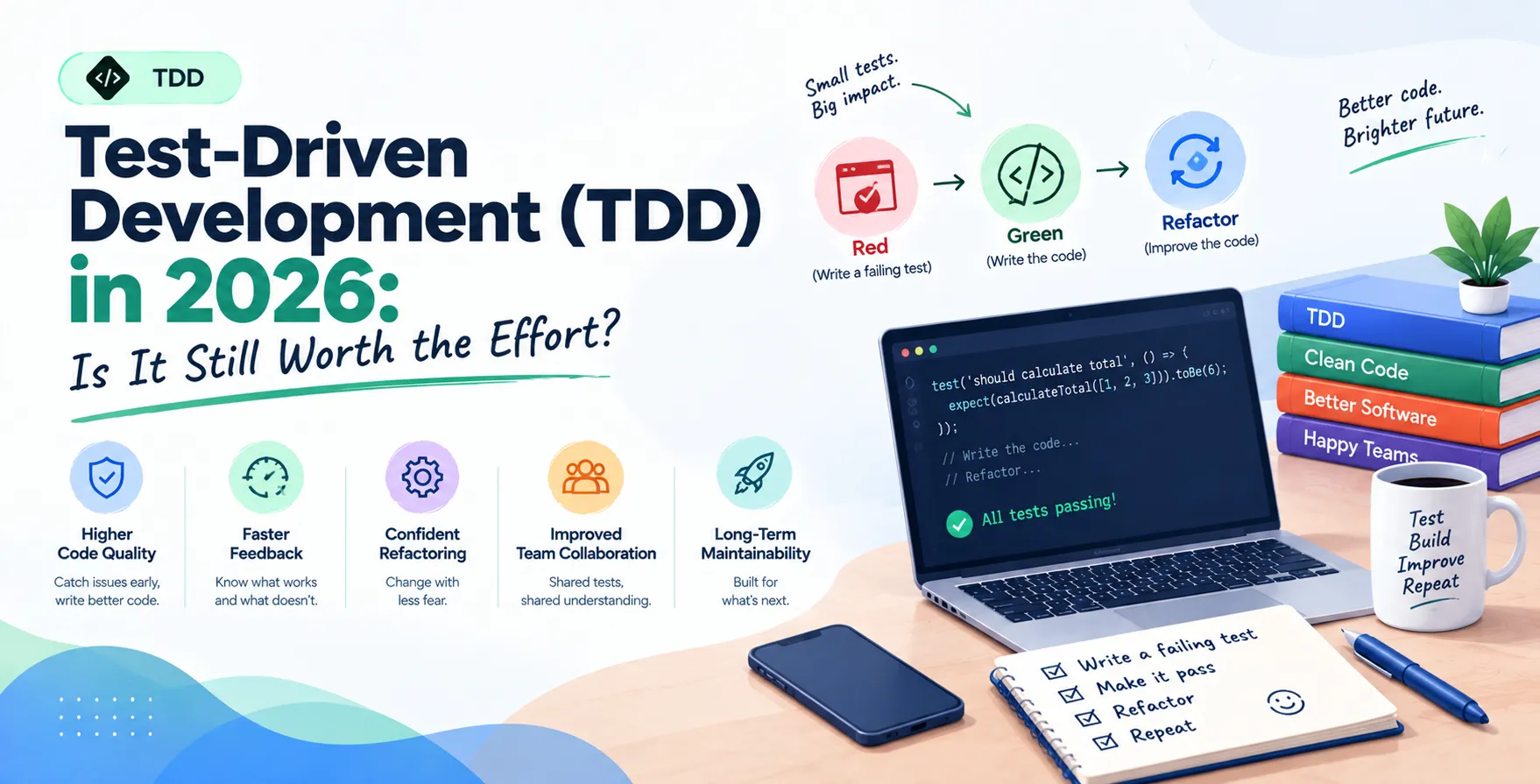
The Core Red-Green-Refactor Cycle
At the center of the methodology lies a strict three-phase loop. Executing this disciplined sequence guarantees steady progress and robust application architecture.
- Write a failing unit test that defines desired feature behavior
- Write minimal logic required to pass the active test assertion
- Refactor internal structure while keeping all tests passing green
Following this continuous loop keeps codebases clean while preventing unnecessary over-engineering.
Key Benefits of TDD in 2026
Adopting test-first workflows offers tangible technical and financial advantages for modern businesses. Understanding these test driven development benefits clarifies its long-term corporate value.
- Drastically reduces severe bugs in production environments
- Serves as living executable documentation for engineering teams
- Forces clean software architecture and loosely coupled modules
- Lowers technical debt in software development over time
- Enables confident daily code updates and refactoring
- Accelerates developer onboarding on enterprise applications
TDD vs Traditional Testing
Comparing test-first development with conventional post-implementation testing highlights major operational differences in software quality control.
| Factor |
Test-Driven Development |
Traditional Post-Testing |
| Execution Timing |
Tests written before implementation code |
Tests written after feature completion |
| Primary Purpose |
Software design guide and specification |
Defect detection and verification |
| Debugging Overhead |
Minimal due to isolated code changes |
High due to complex stack traces |
| Test Coverage |
Near complete coverage by design |
Variable coverage based on time |
| Code Coupling |
Promotes modular independent interfaces |
Risk of tightly coupled structures |
Common Challenges and Misconceptions
Many developers believe writing tests first slows down initial feature release velocity. Constructing assertions beforehand requires upfront discipline that can feel repetitive during early prototyping.
Another misconception is that unit tests replace integration or end-to-end quality checks. Relying solely on isolated logic leaves real-world boundary conditions unverified.
Engineering managers must strike a balance between clean code vs fast code to avoid build maintenance bottlenecks.
TDD in API Development
Modern backend platforms rely heavily on stable endpoints and clear data exchange formats. Applying test-first principles integrates seamlessly with API-First Development strategies.
- Validates request payloads against structural schemas
- Guarantees expected HTTP status codes and responses
- Simplifies mock data creation for frontend engineers
- Ensures backward compatibility during endpoint revisions
- Simplifies automated regression checks across deployments
Practical Steps to Implement TDD Today
Transitioning to a test-first strategy requires clear guidelines across your engineering organization.
- Define clear functional requirements before writing code
- Draft a single failing unit test for one edge case
- Write minimal code required to pass that test
- Integrate API testing in CI/CD pipeline automated builds
TDD for Startups and Fast-Paced Teams
Early-stage software companies often skip test writing to push features to market faster. However, missing automated test suites creates severe friction when scaling product features.
Startups delivering custom software development can apply selective test-first methodologies on core domain logic. Protecting critical business operations prevents costly downtime during growth spurts.
Balancing rapid initial iterations with targeted unit tests maintains high engineering velocity for years.
Role of QA Teams in a TDD Environment
Adopting test-first workflows shifts how quality engineers partner with core software developers. QA roles evolve from reactive defect hunting toward proactive quality engineering architecture.
- Collaborate with developers on initial test specifications
- Guide overall software testing & qa services strategies
- Focus heavily on complex security and performance checks
- Maintain global automation framework stability
This cross-functional partnership enables engineering teams to build resilient software products confidently.
Final Thoughts
Is test-first development still worth the effort in 2026? The short answer is an emphatic yes, especially when combined with modern AI tools and automated delivery pipelines.
While AI generates raw code faster than ever, TDD supplies the verification harness that ensures stability and correctness. It converts software testing from a delayed chore into a proactive design tool.
By keeping test-first habits alive, modern engineering organizations protect their systems, empower developers, and deliver robust applications reliably.


 In collaboration with