Table of Contents
- Introduction
- Understanding Clean Code
- Understanding Fast Code
- The Core Conflict: Readability vs Speed
- When Clean Code Takes Priority
- When Fast Code Is Mandatory
- Structural Trade-Offs in Software Development
- Measuring Performance Before Optimizing
- Strategic Techniques for Balancing Both
- Clean Code vs Fast Code Comparison
- Managing Technical Debt
- Conclusion
Software engineers often face a tough decision during development. They must choose between writing maintainable architecture or raw execution speed.
Striking the right balance determines how easily a system grows. It also affects server costs and user satisfaction over time.
Introduction
Every software project begins with choices about architecture and standards. Developers constantly balance delivery speed, system readability, and execution efficiency.
Choosing between Clean Code and high execution velocity shapes your whole project. Unclear choices lead to buggy systems or slow user experiences.
Understanding when to choose readability over performance is essential. This guide explains how to balance both effectively in modern projects.
Understanding Clean Code
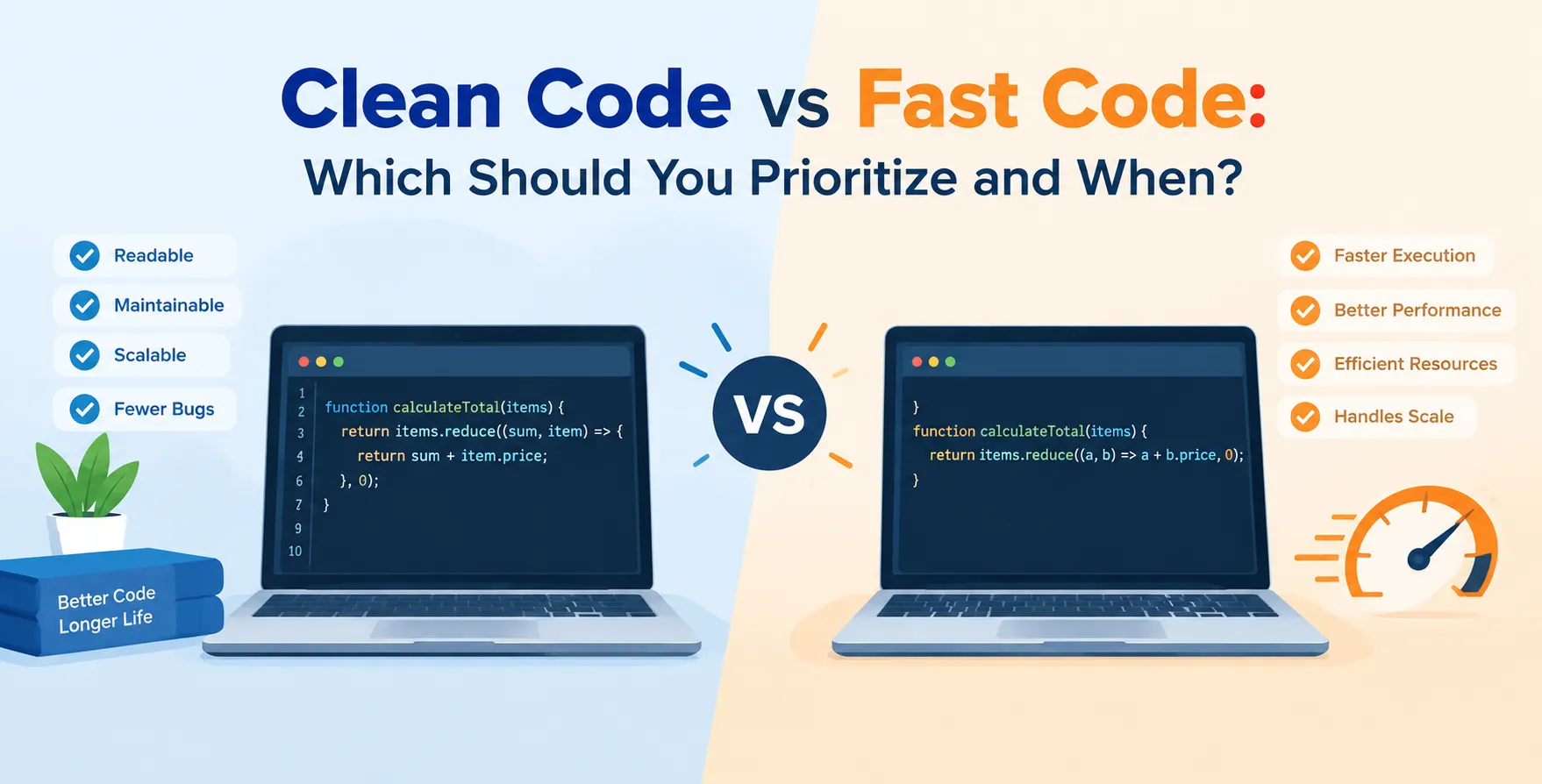
Clean code focuses on human readability and ease of long-term maintenance. It relies on clear naming conventions, modular functions, and minimal complexity.
When developers prioritize maintainability, onboarding new team members becomes effortless. The codebase remains adaptable to changing business requirements.
Main characteristics of clear software design include:
- Easy for developers to read
- Simple to maintain over time
- Follows consistent naming standards
- Reduces long-term software bugs
- Simplifies future feature development
By focusing on clarity, teams spend less time fixing unexpected bugs. This discipline keeps software projects stable for years.
Understanding Fast Code
Fast code focuses entirely on execution efficiency and execution speed. It minimizes CPU cycles and memory allocations to deliver rapid responses.
Achieving maximum speed often requires specialized algorithms and custom memory management. Developers may trade clear abstractions for direct hardware efficiency.
Key traits of execution-focused code include:
- Executes with low latency
- Minimizes memory usage
- Handles high concurrent traffic
- Optimizes hardware resource consumption
Focusing on Code Optimization delivers instant response times under heavy loads. This approach is critical for high-throughput applications.
The Core Conflict: Readability vs Speed
The tension between readability and speed arises from opposing technical design goals. Clean abstractions add layer boundaries that introduce minor execution overhead.
Removing these abstractions often makes code faster but significantly harder to understand. Unwrapped loops and bitwise tricks confuse future developers.
Finding balance requires knowing your application targets. Premature tuning leads to fragile systems that are painful to modify.
When Clean Code Takes Priority
Most business applications benefit more from maintainable architectures than micro-optimizations. High readability lowers operational costs and speeds up team velocity.
Enterprise Application Development
Enterprise systems built through custom software development change frequently as business requirements evolve. Readable design allows developers to add features without breaking existing logic.
- Reduces feature delivery time
- Simplifies team onboarding
Focusing on standard patterns ensures predictable growth across large engineering teams.
Long-Term Maintenance Projects
Projects intended for years of operation require ongoing application maintenance. Readable structures allow teams to update dependencies safely.
- Lowers long-term support costs
- Prevents architectural regression
- Simplifies automated testing setups
- Facilitates safe code refactoring
Clear code reduces the risk of breaking critical systems during routine updates.
When Fast Code Is Mandatory
Certain software domains demand maximum execution speed to function correctly. In these environments, even minor latency spikes cause severe system failures.
Executing operations within tight time constraints requires targeted performance tuning. Abstractions are intentionally removed to save precious processing cycles.
Critical scenarios requiring extreme execution speed include:
- Real-time financial trading systems
- High-frequency gaming servers
- Critical medical monitoring devices
- Low-latency video streaming pipelines
- Large-scale search indexing engines
- Embedded hardware systems
In these specialized fields, achieving peak efficiency justifies higher code complexity. Speed is the primary product feature.
Structural Trade-Offs in Software Development
Every engineering choice involves explicit technical trade-offs. Prioritizing pure speed often creates complex code that increases technical debt in software development.
Conversely, over-engineering for abstract clean design can degrade execution performance. Deeply nested class hierarchies add unwanted call overhead.
Evaluating Clean Code vs Performance helps teams choose the right architectural pattern. Sound decision-making keeps systems manageable and responsive.
Measuring Performance Before Optimizing
Optimizing code without accurate metrics is a common engineering mistake. Developers must profile running systems to identify real execution bottlenecks.
Guessing where slowness occurs usually leads to wasted engineering effort. Targeted website performance optimization requires profiling exact execution paths and memory consumption.
Essential steps for effective performance measurement include:
- Profile application execution CPU usage
- Measure real memory allocation spikes
- Identify database query bottlenecks
- Analyze network request latencies
Strategic Techniques for Balancing Both
Engineers do not have to choose strictly between clean or fast solutions. Modern development strategies allow teams to achieve both readability and performance.
The best practice is writing clear code first to establish correctness. Developers then apply targeted Code Performance Optimization strictly where bottlenecks exist.
Recommended strategies for balancing clarity and execution speed:
- Isolate performance-critical algorithms
- Write clean code first always
- Optimize bottlenecks after profiling
- Document complex performance hacks
- Maintain robust automated tests
This balanced approach preserves overall readability while satisfying strict performance benchmarks.
Clean Code vs Fast Code Comparison
Comparing these two software approaches highlights their primary differences and optimal use cases. The table below outlines key technical tradeoffs.
| Aspect |
Clean Code |
Fast Code |
| Primary Goal |
Developer readability |
Maximum execution speed |
| Main Benefit |
Easy long-term maintenance |
Low response latency |
| Development Speed |
Faster initial delivery |
Slower implementation |
| Maintenance Effort |
Low resource demand |
High engineering cost |
| Primary Use Case |
Business applications |
Real-time processing systems |
| Refactoring Risk |
Low risk of bugs |
High risk of regression |
Managing Technical Debt
Uncontrolled performance hacks introduce technical debt that slows future feature delivery. Teams must actively manage low-level tweaks to maintain system health.
Establishing strict code reviews prevents unnecessary micro-optimizations from entering main repositories. Clean foundations make future enhancements straightforward.
Key practices for controlling system technical debt:
- Refactor unreadable quick fixes early
- Establish clear team coding standards
- Track technical debt during sprints
- Schedule regular codebase maintenance
Proper debt management ensures long-term stability without sacrificing necessary speed.
Conclusion
Choosing between clean code and fast code depends on your specific system requirements. Most business software thrives on clear, maintainable logic that supports rapid feature iterations.
When tight performance constraints arise, targeted optimizations should follow thorough profiling. Isolating complex performance logic keeps the rest of your codebase readable.
By prioritizing maintainability first and tuning critical paths second, engineering teams build sustainable systems. Balance readability and execution speed to deliver lasting software value.


 In collaboration with