Table of Contents
- Introduction to Idempotency
- What are Idempotent APIs?
- The Core Problem of Network Failures
- Understanding Idempotency Keys
- Implementing Idempotency in REST APIs
- State Management and Storage
- Handling Concurrent Requests
- Best Practices for API Retries
- Designing Error Responses
- Testing Idempotency in Development
- Monitoring Idempotent Operations
- Common Pitfalls to Avoid
- Conclusion
Introduction to Idempotency
Distributed systems are inherently unreliable. When your client sends a request to a server, there is always a chance the connection drops before the client receives a confirmation.
If that request was a payment or a database write, you face a dilemma. You do not know if the action succeeded on the server or if it never reached its destination at all.
This is where idempotency becomes essential for modern software architecture. It ensures that repeating an operation multiple times has the same effect as executing it once.
What are Idempotent APIs?
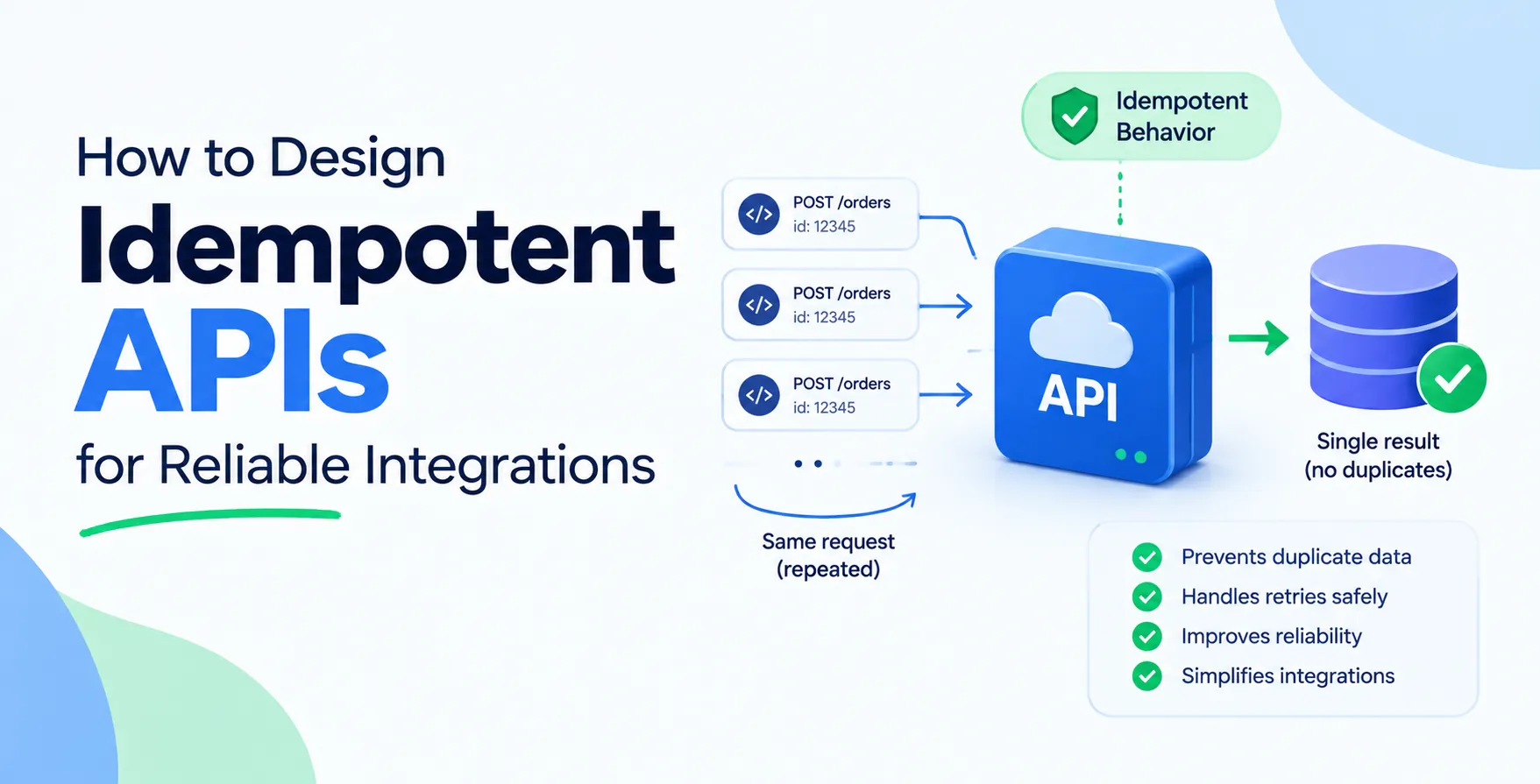
Idempotent APIs are designed to handle duplicate requests gracefully. Regardless of how many times a request is processed, the final state of the system remains identical after the first successful execution.
In a truly robust architecture, these APIs provide a safety net for unstable network conditions. They allow clients to safely retry operations without worrying about unintended side effects like duplicate charges or duplicate record creation.
Building these systems effectively is a cornerstone of professional api development. It turns potentially catastrophic failures into manageable routine events.
- Prevents accidental duplicate processing
- Provides consistent system state
- Enables safe automated retry logic
- Reduces manual cleanup requirements
The Core Problem of Network Failures
Network timeouts, load balancer hiccups, and service restarts can interrupt an API call mid-flight. The client often times out, leading to ambiguity about the server's internal state.
Without a mechanism to verify if the server processed the initial request, the client may feel forced to retry. If the server does not support idempotency, the second request will often create a duplicate record or trigger a second transaction.
This is why understanding how to design idempotent APIs for reliable integrations is critical for engineers. It shields the end user from infrastructure-level instability.
Understanding Idempotency Keys
The standard way to implement this is through the use of unique idempotency keys. A client generates a unique identifier—usually a UUID—and includes it in the request header.
The server stores this key alongside the result of the initial operation. If a subsequent request arrives with the same key, the server recognizes it as a duplicate and returns the original response instead of re-executing the logic.
Key Characteristics
These keys act as a transaction fingerprint for your API endpoints. They must be unique enough to distinguish between different operations while remaining persistent across retries.
- Generated by the client side
- Must be unique per transaction
- Stored in a database or cache
- Used to identify repeat requests
Lifecycle Management
You must also manage the lifecycle of these keys to prevent storage bloat. Storing every key forever is not feasible for high-volume services.
- Store keys with a time-to-live limit
- Delete records after a reasonable duration
- Use fast lookups like Redis
Implementing Idempotency in REST APIs
When working with RESTful architectures, idempotency is often handled using specific HTTP methods. While GET, PUT, and DELETE are naturally idempotent, POST requests are not.
For POST endpoints that perform critical writes, you should implement the idempotency key pattern. This allows your API to behave like a safe operation even when the underlying action is state-changing.
Always document your idempotency requirements in your API documentation to ensure developer-friendly integration. Clear documentation helps consumers understand when and how to provide these keys.
| HTTP Method |
Default Idempotency |
Requirement |
| GET |
Yes |
None |
| POST |
No |
Idempotency Key Required |
| PUT |
Yes |
None |
| DELETE |
Yes |
None |
| PATCH |
No |
Idempotency Key Recommended |
State Management and Storage
To implement this effectively, your backend must be able to perform atomic operations. The process of checking for a key and saving the result should be indivisible to prevent race conditions.
Using a distributed lock or a transactional database update is necessary here. If two identical requests arrive simultaneously, only one should proceed to execute the business logic.
The second request should either wait for the first to finish or receive a status message indicating the operation is currently in progress. This level of control ensures your data remains clean and predictable.
Handling Concurrent Requests
Concurrency is the biggest challenge in distributed systems. When two requests with the same key hit your cluster at the exact same millisecond, you need a robust strategy to handle the collision.
Optimistic locking is a great way to manage this. By using a "processing" state for the key, you can inform the second caller that the request is already being handled.
This prevents redundant processing and saves server resources. It also provides a better experience for the client by providing immediate feedback on the operation's status.
- Use atomic database operations
- Implement a processing status flag
- Block or throttle duplicate incoming requests
- Return 429 or 409 status codes
Best Practices for API Retries
Effective API retry best practices are just as important as the idempotency logic itself. Clients should not spam your servers with retries immediately after a failure.
Implement an exponential backoff strategy combined with jitter. This prevents a thundering herd problem where many clients retry at the exact same interval, potentially overwhelming your infrastructure.
Always ensure that the client uses the exact same idempotency key for every retry attempt. Changing the key during retries defeats the purpose of the mechanism.
- Use exponential backoff intervals
- Add jitter to retry timing
- Limit the maximum number of retries
- Use consistent keys for retries
Designing Error Responses
When a client sends a duplicate request, your API should respond clearly. Do not simply return a 200 OK without context if the action was not re-performed.
Returning the original response is the standard approach. If the initial request failed, the retry should also fail with the same error, allowing the client to handle the problem correctly.
If the process is still ongoing, a 202 Accepted status is appropriate. This informs the client that the system is working on the request and no further action is needed.
Testing Idempotency in Development
Testing these features requires specific focus. You need to simulate network failures during your automated tests to verify that your system behaves correctly.
Injecting artificial delays and dropping connections during your testing suite can reveal hidden race conditions. This is where high-quality testing services prove their value.
Automated integration tests that specifically target retry scenarios are vital. They ensure your idempotency logic holds up under stress before you deploy to production.
Monitoring Idempotent Operations
Monitoring is crucial to ensure your implementation is functioning correctly. You should track how often idempotency keys are used and if any collisions are causing unexpected errors.
Observability tools can help you visualize the flow of requests and identify patterns of failure. Seeing exactly how many requests are retries versus new operations gives you insight into your network health.
If you see a spike in retries, it might indicate a deeper problem in your backend services. Proactive monitoring helps you catch these issues before they impact your users.
Common Pitfalls to Avoid
Developers often struggle with key generation logic or storage retention. Forgetting to clear old keys is a frequent mistake that leads to database growth over time.
Another issue is using weak keys that collision easily. Always ensure your keys are cryptographically secure or sufficiently random to avoid accidental overlaps.
- Failing to set expiration on keys
- Using non-unique client identifiers
- Ignoring race conditions during writes
- Returning inconsistent error codes
Conclusion
Designing idempotent APIs is a fundamental skill for building reliable, distributed systems. By implementing these patterns, you protect your infrastructure from the unpredictability of the internet.
Focus on using unique identifiers to track operations and maintain consistent state across your services. When combined with smart retry strategies, you create a seamless experience for your API consumers.
Start small by adding idempotency to your most critical write operations. Over time, these practices will lead to much more stable and maintainable software integrations.


 In collaboration with