Table of Contents
- Introduction
- Understanding the Evolution
- What is Swagger 2.0?
- What is OpenAPI 3.1?
- Key Differences at a Glance
- JSON Schema Compatibility
- Improved Webhooks Support
- Handling Data Types
- The Path to OpenAPI Migration
- Tooling and Ecosystem Support
- Best Practices for API Design
- Common Challenges for Teams
- Ensuring Future-Proof APIs
- Conclusion
Introduction
API development is a fast-paced field where standards define the quality of communication between services. Many teams still rely on older specifications while newer versions offer significantly better tooling and precision.
Understanding the gap between Swagger 2.0 and OpenAPI 3.1 is critical for modernizing your infrastructure. This guide covers why the transition matters and how you can approach it effectively.
Understanding the Evolution
The transition from Swagger to the OpenAPI Specification marked a massive shift in how we document RESTful services. Originally, Swagger was a proprietary format that eventually became the foundation for the open standard we use today.
While many legacy systems still function using the old Swagger 2.0 format, they often lack the expressive power required for modern microservices architectures. Developers today need specifications that are not just readable, but also highly interoperable across various programming languages.
What is Swagger 2.0?
Swagger 2.0 was the industry standard for several years. It provided a consistent way to describe REST APIs, allowing teams to generate documentation and basic client stubs automatically.
It helped bridge the gap between backend logic and frontend consumption. However, its limitations regarding complex data structures and polymorphism became apparent as systems grew in complexity.
- Simplified API definition
- Wide legacy tooling support
- Standardized documentation output
- Easier initial setup for teams
What is OpenAPI 3.1?
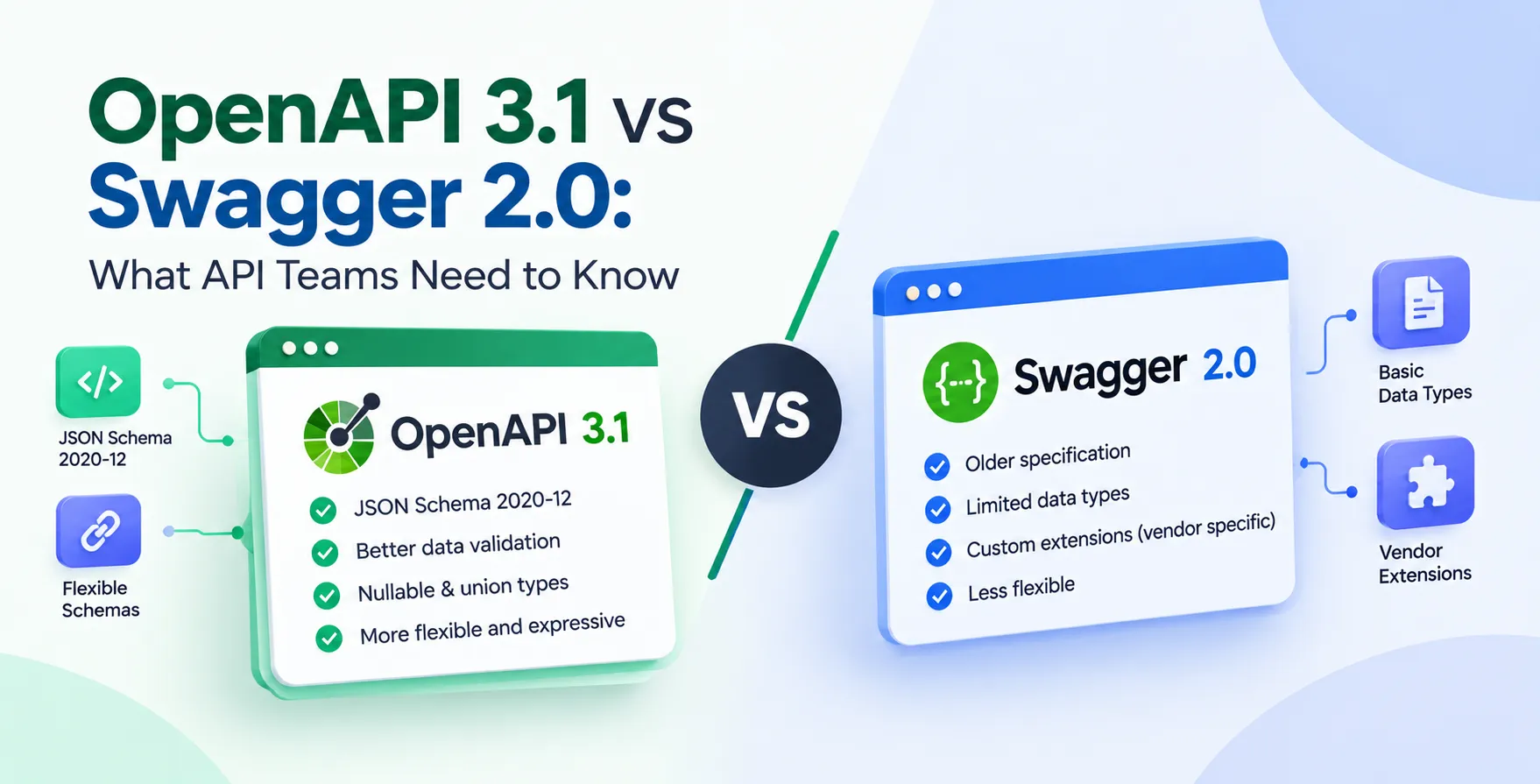
OpenAPI 3.1 represents the latest iteration of the specification, offering full compatibility with the JSON Schema standard. This change alone makes it significantly more powerful for teams needing strict data validation and complex object modeling.
It also brings better support for webhooks and improved handling of diverse data formats. For teams focusing on high-quality API development, upgrading to this version is almost always the right move.
- Complete JSON Schema integration
- Enhanced support for webhooks
- Better handling of multiple content types
- Improved security scheme definitions
Key Differences at a Glance
| Feature |
Swagger 2.0 |
OpenAPI 3.1 |
| JSON Schema |
Partial/Proprietary |
Full Compatibility |
| Webhooks |
Not Supported |
Native Support |
| License |
Swagger Specific |
Open Standard |
| Data Types |
Limited |
Extensive/Flexible |
JSON Schema Compatibility
The most important improvement in the latest version is the alignment with JSON Schema. This ensures that your API definitions are not just documentation, but also executable contracts that can be validated against incoming requests.
Before this change, teams had to write custom validation logic that often drifted from the documentation. Now, the spec itself serves as the source of truth for both documentation and runtime validation.
- Strict data type validation
- Reusable schema fragments
- Better interoperability with tools
- Reduced manual validation effort
Improved Webhooks Support
Modern applications rely heavily on event-driven architectures. OpenAPI 3.1 introduces a dedicated way to describe webhooks, which was entirely missing in the older Swagger 2.0 format.
Teams can now document callback endpoints directly within their main API file. This makes it much easier for consumers to understand how to handle incoming events from your service.
Handling Data Types
Working with complex data is now much easier. The latest specification supports various formats, including nullable types and more granular control over integer or string constraints.
This reduces the ambiguity that often led to integration bugs in the past. It effectively forces developers to be explicit about what the API expects and what it produces.
- Explicit nullability handling
- Better format validation
- Flexible array definitions
- Clearer object composition
The Path to OpenAPI Migration
Performing an OpenAPI migration from legacy files can seem daunting, but it is necessary for long-term health. Start by assessing your current endpoints and identifying where data validation is currently failing or unclear.
Use automated conversion tools to generate a baseline version, then manually refine the definitions. Ensure that your CI/CD pipeline validates every change against the new schema version to prevent regressions.
- Inventory existing API endpoints
- Use automated conversion scripts
- Validate schema against specifications
- Update documentation portals
Tooling and Ecosystem Support
The ecosystem surrounding the latest standard is vast. Most modern API testing tools now prioritize the 3.1 specification, offering features that simply do not work with older formats.
By sticking to outdated specs, you are essentially limiting your access to the latest generation of automated testing and deployment tools. Investing in the newer standard unlocks better developer experience and faster release cycles.
Best Practices for API Design
Effective design starts with clear contracts. Regardless of the version, your documentation should be human-readable and machine-executable.
Focus on descriptive parameter names and clear error codes. When you treat your API definition as a core product artifact, your entire development process becomes more predictable and easier to maintain.
- Design first approach
- Clear error definitions
- Comprehensive security scopes
- Consistent naming conventions
Common Challenges for Teams
The biggest hurdle for most teams is the sheer volume of legacy documentation. Converting every single endpoint at once is rarely feasible for large, mature systems.
Instead, adopt an incremental approach. Upgrade individual services as you perform maintenance or feature updates, rather than attempting a company-wide migration overnight.
Ensuring Future-Proof APIs
Technology changes rapidly, and your API infrastructure needs to be resilient. Using the latest standard ensures that your services remain compatible with the tools that will emerge in the coming years.
Do not let technical debt in your documentation process accumulate. Prioritize the transition to keep your development velocity high and your integration risks low.
Conclusion
The shift from Swagger 2.0 to OpenAPI 3.1 is not just about version numbers. It is about embracing a more robust, standard-driven approach to API development that benefits both producers and consumers.
By leveraging better data validation, improved webhook support, and broader tool compatibility, your team can build higher-quality integrations. Start your transition today to ensure your systems remain scalable and reliable for the future.


 In collaboration with