Table of Contents
- Introduction to Async Django
- Understanding the Async ORM
- The Reality of SynchronousOnlyOperation Django
- Why Transactions Are Tricky in Async
- Using sync_to_async for Database Operations
- Handling Django Transactions in Async Views
- The Role of Database Connection Pooling
- Common Pitfalls with Async ORM
- Testing Async Database Logic
- Best Practices for Async Performance
- When to Use Sync vs Async
- Maintaining Scalable Database Code
- Final Thoughts
Introduction to Async Django
Modern web development increasingly demands high concurrency to handle thousands of simultaneous connections. Django has evolved significantly to support asynchronous programming, allowing developers to write non-blocking views and tasks.
However, integrating database operations into this model is not always straightforward. When you attempt to run blocking database calls inside an asynchronous context, you quickly run into issues that can crash your application.
Understanding how the framework handles these threads is essential for building stable backends. Mastering these patterns is the first step toward robust application maintenance.
Understanding the Async ORM
The Django async ORM allows you to interact with your models without blocking the event loop entirely. By providing asynchronous methods like aget and afilter, the framework bridges the gap between traditional blocking code and the modern async ecosystem.
These methods are designed to be safe and efficient within an async context. They prevent the event loop from stalling while waiting for the database to return results.
Using these built-in tools is the recommended approach for most data retrieval tasks. They handle the underlying thread management internally so you do not have to worry about the complexities.
- Use aget for single object retrieval
- Leverage afilter for asynchronous queries
- Utilize acreate for non-blocking insertions
- Access async properties with aget_or_create
The Reality of SynchronousOnlyOperation Django
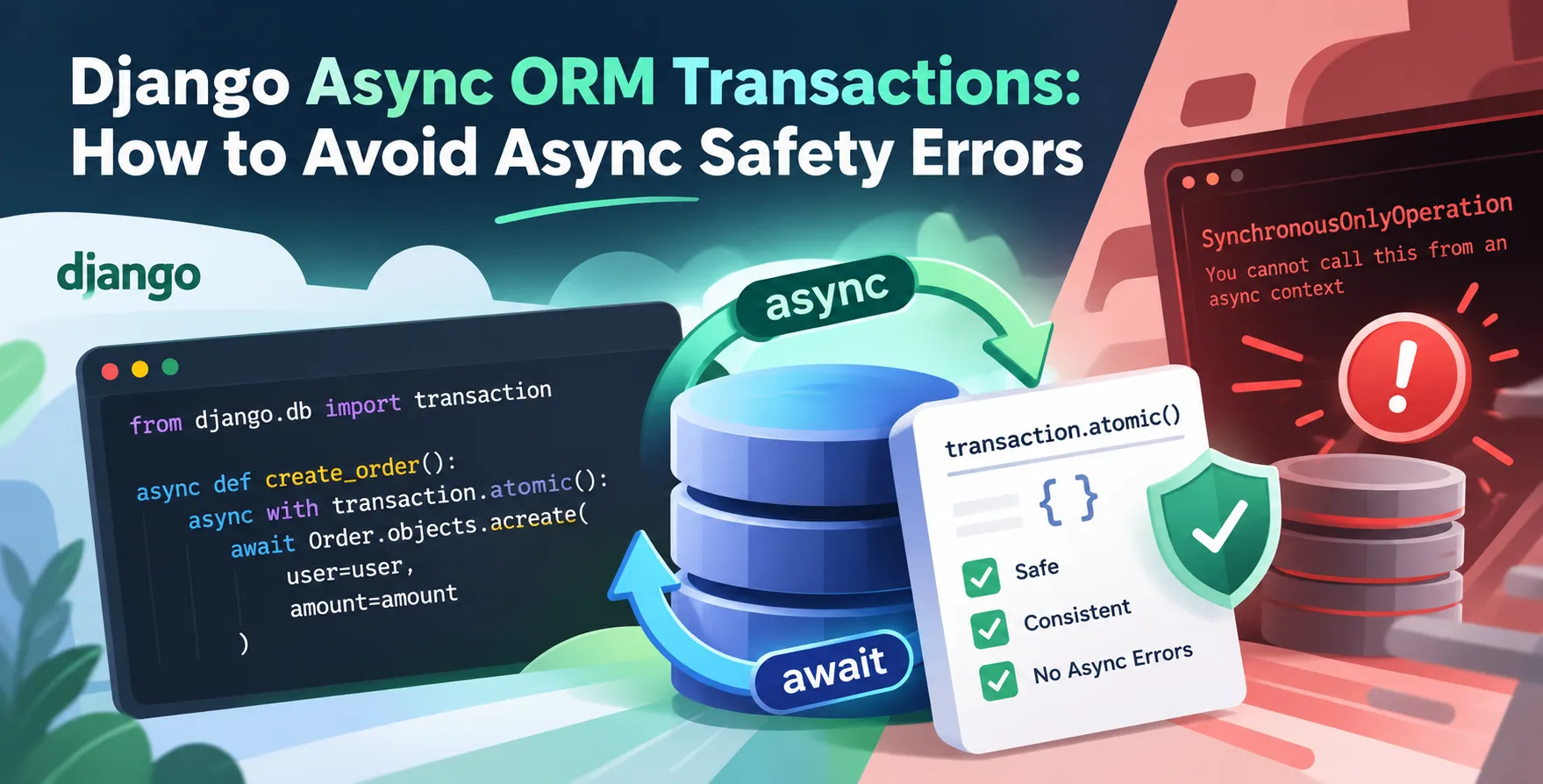
When you accidentally invoke a blocking database call inside an async function, Django raises the SynchronousOnlyOperation Django error. This is a deliberate design choice meant to protect your application from hidden latency.
The framework detects that you are trying to execute a synchronous database query within a thread that cannot afford to wait. This prevents a single slow query from freezing your entire server process.
Debugging this often requires a deep look at your stack trace. You must identify exactly where the blocking call is originating and wrap it in the appropriate async utility.
Why Transactions Are Tricky in Async
Database transactions are inherently stateful and tied to a specific database connection. In a synchronous view, the transaction remains active for the duration of the request on a single thread.
Async views, however, may switch tasks while awaiting an operation. This can cause the database connection associated with a transaction to become detached or reused by another task.
Managing Django transactions in async views requires careful coordination to ensure data integrity. You cannot simply rely on standard decorators if they are not explicitly designed for the async event loop.
Using sync_to_async for Database Operations
When you need to execute complex logic that the async ORM does not support, you can use the sync_to_async wrapper. This utility allows you to run synchronous code in a separate thread, safely returning the result to your async function.
This is particularly useful for legacy codebases or complex operations that perform multiple database writes. It ensures that the blocking operations do not interfere with the event loop's availability.
You should use this sparingly, as spawning threads adds overhead to your request cycle. Balance is key to achieving optimal performance.
- Wrap blocking logic in sync_to_async
- Ensure thread safety in your wrappers
- Handle exceptions from the wrapped function
- Use thread_sensitive=True for connection consistency
Handling Django Transactions in Async Views
To safely perform operations inside a transaction block in an async view, you must use the transaction.atomic context manager correctly. This often involves wrapping the entire block within a sync_to_async call to ensure the transaction state is maintained.
This approach keeps the database connection bound to the specific thread handling the transaction. It prevents the connection from being closed or switched during the middle of the operation.
If you fail to do this, you risk partial commits or deadlocks. Always verify your transaction boundaries when dealing with complex data modifications.
| Approach |
Sync View |
Async View |
| Database Queries |
Standard ORM |
Async ORM methods |
| Transactions |
atomic decorator |
sync_to_async atomic |
| Performance |
Moderate |
High concurrency |
| Complexity |
Low |
High |
The Role of Database Connection Pooling
High traffic applications often require robust connection management to stay performant. When your application scales, you might need to know how to configure PostgreSQL connection pooling with PgBouncer for high traffic to avoid connection exhaustion.
Without proper pooling, each async task might attempt to open a new database connection. This can quickly exceed your database's connection limit and cause significant downtime.
Ensure your infrastructure supports the load your application is expected to handle. A well-configured pool is the foundation of any reliable database architecture.
Common Pitfalls with Async ORM
Developers often struggle with subtle bugs when mixing sync and async code. It is easy to forget that a seemingly simple property access on a related model can trigger a blocking database query.
Always be mindful of what your code is doing under the hood. Even standard model methods can sometimes trigger unexpected synchronous behavior if they are not optimized for async execution.
- Accidental foreign key access
- Misconfigured connection settings
- Ignoring thread safety in loops
- Blocking calls in middleware
- Overusing sync_to_async
Testing Async Database Logic
Testing your async database logic is just as important as writing the code itself. You must use the appropriate test runners that support asynchronous execution to ensure your transactions are actually behaving as expected.
Mocking database calls is not enough to catch concurrency issues. Real integration tests against a temporary database are necessary to verify that your transaction boundaries hold up under pressure.
Document your test results and keep them updated as your models evolve. Reliable testing is the only way to prevent regressions in complex async workflows.
Best Practices for Async Performance
Optimizing your database queries is paramount for keeping your application fast. Implementing PostgreSQL indexing best practices for web applications will ensure your queries complete quickly, reducing the time your async tasks remain blocked.
Avoid executing heavy processing logic inside your transaction blocks. Keep your transactions as short as possible to minimize lock contention and improve overall throughput.
Monitor your application's performance metrics regularly. Use tools that provide insights into your database query times and thread utilization to identify bottlenecks.
When to Use Sync vs Async
Not every part of your application needs to be asynchronous. Synchronous code is often easier to read and debug for simple CRUD operations.
Use async views for endpoints that deal with high concurrency or long-running IO-bound tasks. Stick to standard synchronous views for heavy background processing or complex data analytics that do not benefit from non-blocking execution.
The choice should be based on your specific performance requirements. Do not force async where it does not provide a clear benefit to your users.
Maintaining Scalable Database Code
As your application grows, you must keep your database maintainable. This includes regular cleanup tasks, such as understanding PostgreSQL VACUUM best practices to keep databases fast to prevent table bloat from slowing down your queries.
Consistent code review is essential for catching potential async safety issues before they reach production. Encourage your team to understand the underlying threading model of the framework.
Building scalable systems is an iterative process. Stay informed about new features and updates to ensure your architecture remains modern and efficient.
Final Thoughts
Mastering Django async ORM transactions is a journey that requires patience and practice. You must understand both the benefits of concurrency and the risks of blocking the event loop.
By following established patterns and using the right utilities, you can build powerful, scalable applications. Always prioritize data integrity and thread safety in your design.
With the right approach, you can successfully navigate the complexities of asynchronous development. Keep building, testing, and refining your code for a better user experience.


 In collaboration with