Table of Contents
- Introduction to Pod Scheduling
- The Role of Pod Anti-Affinity
- How Pod Anti-Affinity Works
- Limitations of Pod Anti-Affinity
- Introducing Topology Spread Constraints
- When to Use Topology Spread Constraints
- Comparing Scheduling Approaches
- Configuring Pod Distribution Across Availability Zones
- Handling Failures and Constraints
- Best Practices for High Availability
- Common Pitfalls in Scheduling
- Advanced Scheduling Patterns
- Conclusion
Introduction to Pod Scheduling
Managing how containers land on nodes is a core challenge in cluster administration. You want to ensure that if a node fails, your application stays online.
Achieving true high availability requires distributing your workload across different failure domains. Kubernetes provides built-in mechanisms to enforce these requirements during the scheduling process.
The Role of Pod Anti-Affinity
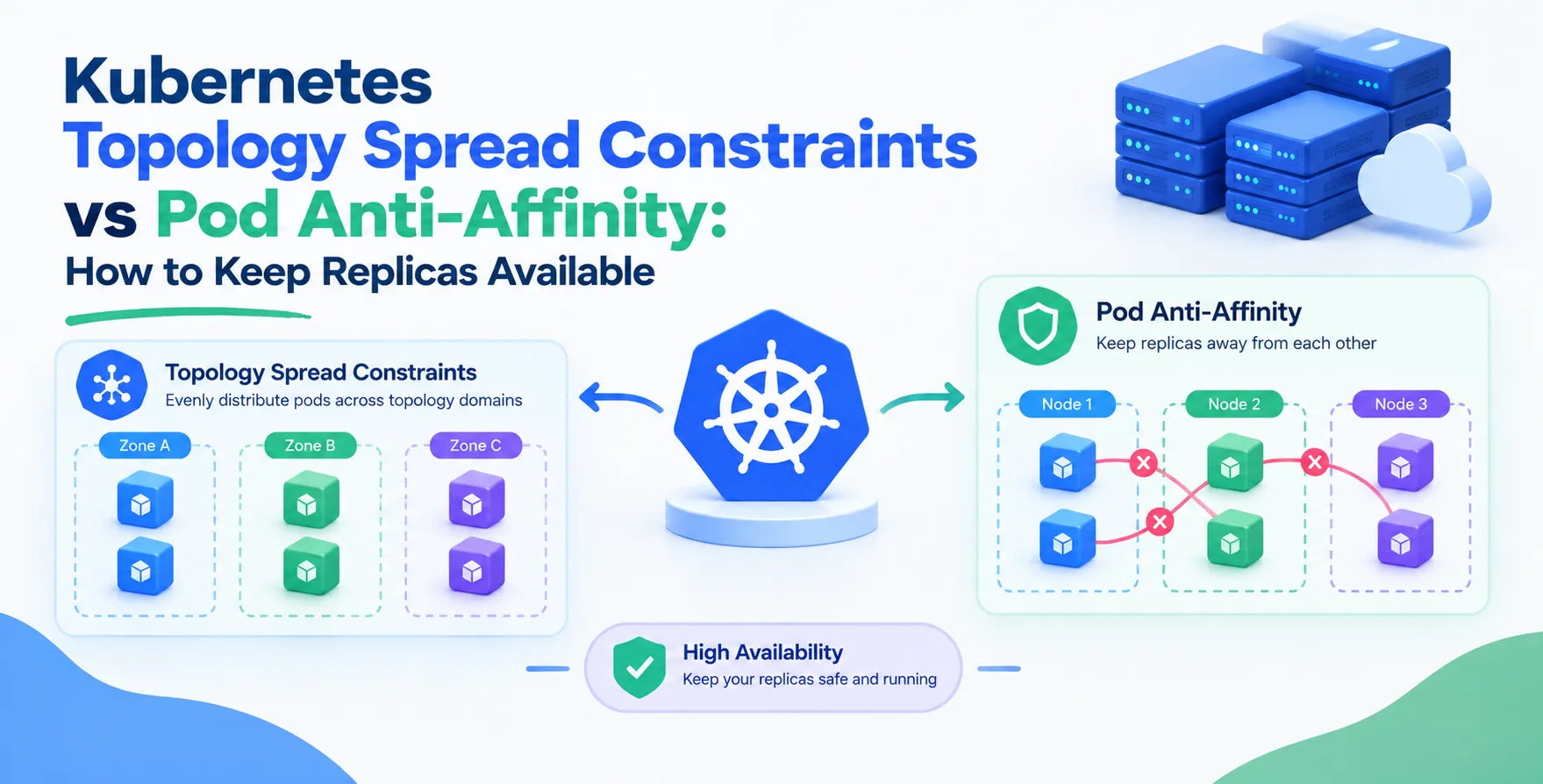
Pod anti-affinity is a powerful tool for preventing resource contention. It instructs the scheduler to keep specific pods away from each other on the same node or zone.
This is essential for services that are memory-intensive. You don't want two resource-heavy replicas crashing the same physical host simultaneously.
- Prevents co-location of similar pods
- Reduces the impact of single-node failures
- Improves overall service reliability
How Pod Anti-Affinity Works
The scheduler uses labels to identify which pods belong to the same service. It then checks these labels against the node where a new pod is being placed.
You can define hard or soft requirements. Hard rules strictly forbid placement, while soft rules prioritize it but allow exceptions if necessary.
Hard Constraints
Hard constraints are mandatory for the scheduler to satisfy. If no node fits the criteria, the pod remains in a pending state indefinitely.
- Uses requiredDuringSchedulingIgnoredDuringExecution
- Guarantees strict separation
- Risk of scheduling failure
Soft Constraints
Soft constraints are preferred but not required. They offer the scheduler flexibility when cluster resources are tight or fragmented.
- Uses preferredDuringSchedulingIgnoredDuringExecution
- Balances flexibility with preference
- Prevents pods from staying pending
Limitations of Pod Anti-Affinity
While effective, anti-affinity can become complex and brittle at scale. Managing intricate rules for dozens of services leads to high computational overhead for the scheduler.
As your cluster grows, the scheduler takes longer to evaluate these rules. This latency can delay your deployments and slow down reaction times to events like node reboots.
Introducing Topology Spread Constraints
Kubernetes topology spread constraints provide a more modern and flexible way to balance pods. They allow you to define how pods should be spread across failure domains.
Instead of just saying "don't put them together," you define a target distribution. This ensures your workload is evenly distributed across your infrastructure.
- Ensures even pod distribution
- Supports arbitrary topology keys
- Handles skewed distribution scenarios
When to Use Topology Spread Constraints
Use these constraints when you need predictable performance across your entire cluster. They are particularly useful for microservices that require balanced traffic load.
They also simplify management across multi-zone setups. By defining a single rule, you eliminate the need for complex, nested anti-affinity configurations that are hard to audit.
Comparing Scheduling Approaches
| Feature |
Pod Anti-Affinity |
Topology Spread |
| Primary Goal |
Avoidance |
Balance |
| Complexity |
High |
Low |
| Flexibility |
Limited |
High |
| Scheduler Overhead |
Significant |
Minimal |
| Scaling Behavior |
Static |
Dynamic |
Configuring Pod Distribution Across Availability Zones
Achieving Kubernetes pod distribution across availability zones is critical for regional resilience. You want to ensure that a localized data center issue doesn't take down your entire application.
Topology spread constraints make this simple. You define the topology key as the zone label, and the scheduler automatically keeps replica counts balanced.
- Distributes replicas across zones
- Prevents single-zone outages
- Improves disaster recovery readiness
Handling Failures and Constraints
When nodes go offline, the scheduler must re-balance pods to meet your constraints. This is where your chosen strategy significantly impacts recovery time.
If you rely on hard anti-affinity, pods might stay stuck if no healthy nodes are available to meet the criteria. Topology constraints offer more graceful degradation by allowing you to define how skewed the distribution can be during transient issues.
Best Practices for High Availability
Always combine your scheduling rules with proper health checks. Even a perfectly placed pod is useless if it isn't healthy.
Ensure your Kubernetes pod anti-affinity rules do not conflict with other constraints. Overlapping rules can lead to unexpected behavior and hard-to-debug scheduling issues.
- Set appropriate replica counts
- Monitor node utilization
- Use pod disruption budgets
- Review scheduling events
Common Pitfalls in Scheduling
A common mistake is forgetting that constraints only apply during initial scheduling. Once a pod is running, it doesn't move just because the cluster state changes.
Another issue is using overly restrictive labels. If your labels are too narrow, the scheduler cannot find a valid node, leaving your deployment stuck in a pending state.
Advanced Scheduling Patterns
Sometimes you need to combine techniques. You might use anti-affinity to keep specific components apart, while using topology spread to ensure global zone balance.
This multi-layered approach provides the highest level of resilience. It guards against both localized contention and catastrophic regional failure.
Conclusion
Choosing between these two methods depends on your specific resilience requirements. While anti-affinity is powerful for simple avoidance, topology spread offers better scaling and balance.
Most modern clusters benefit from prioritizing topology spread for general distribution. By carefully configuring your constraints, you keep your services available regardless of underlying hardware failures.


 In collaboration with