Table of Contents
- Introduction to Workflow Orchestration
- Understanding GitHub Actions Reusable Workflows
- The Power of GitHub Composite Actions
- Core Differences in Execution Context
- Comparing Scope and Flexibility
- When to Use Reusable Workflows
- When to Choose Composite Actions
- Structuring Your CI/CD Pipeline
- Managing Secrets and Inputs
- Maintaining Shared Logic
- Comparing Performance and Scalability
- Best Practices for Workflow Reuse
- Conclusion
Introduction to Workflow Orchestration
Modern development teams constantly look for ways to reduce duplication in their CI/CD processes. As your organization scales, managing hundreds of identical YAML files becomes a significant burden.
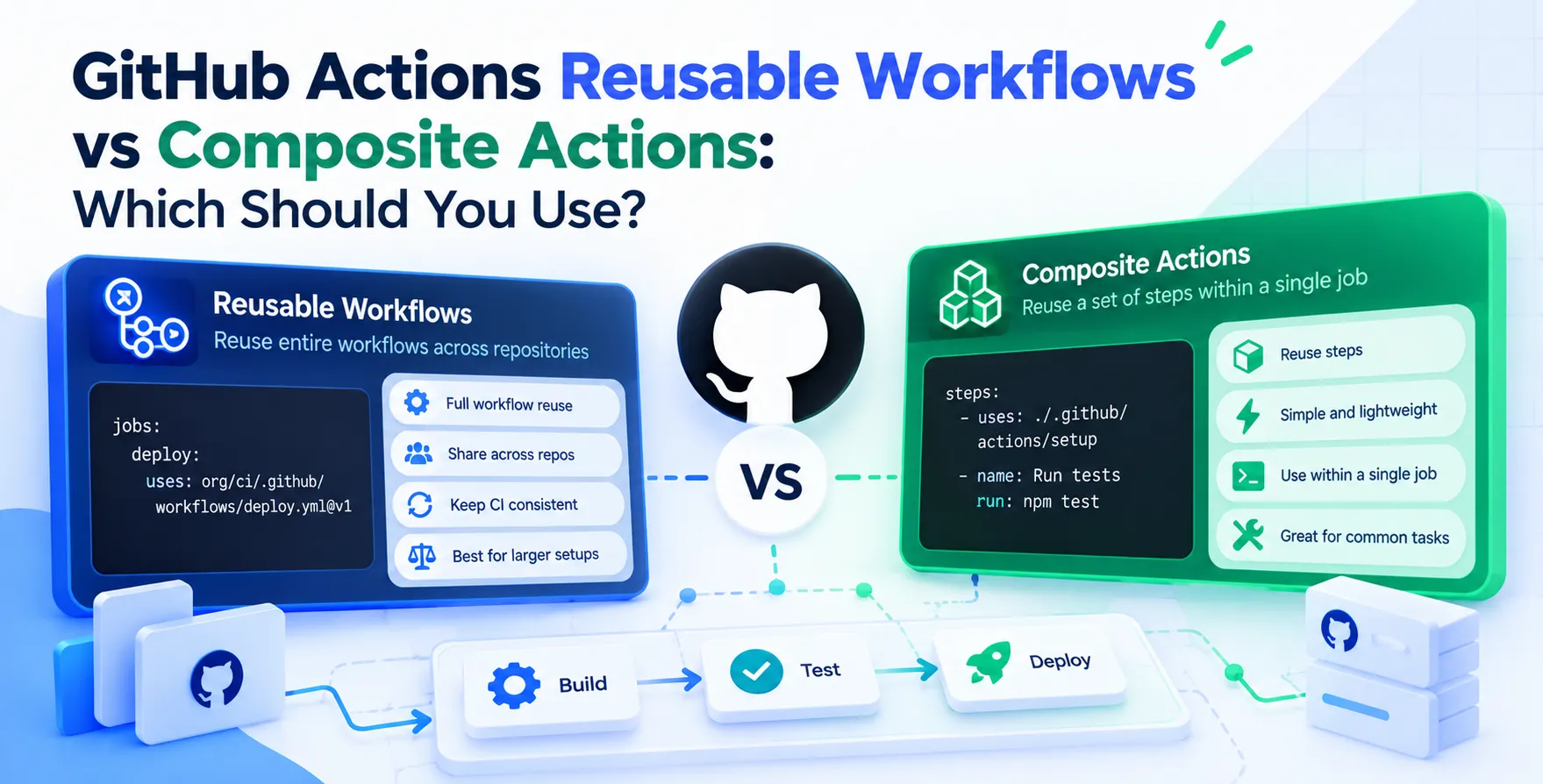
GitHub provides two primary mechanisms to solve this: GitHub Actions reusable workflows and GitHub composite actions. Both offer ways to modularize logic, but they serve different architectural needs.
Understanding GitHub Actions Reusable Workflows
Reusable workflows allow you to call an entire workflow from another workflow file. This is highly effective for maintaining consistent standards across dozens of repositories.
When you trigger a reusable workflow, it executes in its own isolated environment. This separation of concerns simplifies debugging and allows you to enforce organizational security policies globally.
- Centralizes complex CI/CD logic
- Enforces standard compliance across teams
- Supports multi-stage pipeline execution
- Enables clear separation of concerns
The Power of GitHub Composite Actions
Composite actions are essentially a collection of workflow steps bundled into a single unit. They are perfect for wrapping frequently used shell commands or specific build tasks.
Unlike workflows, composite actions run as a single step within an existing job. This design choice makes them incredibly fast and lightweight for simple, repetitive tasks.
- Bundles multiple shell steps
- Runs within the host job context
- Simplifies complex script execution
- Reduces total YAML configuration size
Core Differences in Execution Context
The biggest technical distinction lies in how these tools interact with the runner. Reusable workflows operate as separate jobs, meaning they require their own environment initialization.
Composite actions share the environment of the caller job. This allows them to access environment variables and filesystem changes made in preceding steps within the same job.
Workflow Isolation
Reusable workflows require explicit input and secret passing. They do not inherit the parent context, which ensures they remain strictly decoupled from the calling repository.
- Requires explicit input mapping
- Maintains strict security boundaries
- Prevents accidental context leakage
Step Integration
Composite actions are treated as native workflow steps. They can read outputs generated by previous actions in the same job, making them ideal for complex, multi-step tasks.
- Inherits job-level environment variables
- Shares the local workspace filesystem
- Accesses previous step outputs directly
Comparing Scope and Flexibility
| Feature |
Reusable Workflows |
Composite Actions |
| Execution |
Separate workflow run |
Single job step |
| Complexity |
High, full pipelines |
Low, specific tasks |
| Inputs |
Strict schema required |
Flexible properties |
| Environment |
Isolated |
Shared with host job |
| Flexibility |
High for CI/CD |
High for task scripts |
When to Use Reusable Workflows
You should prioritize reusable workflows when you have a complete, end-to-end process to share. For instance, if you need a standard deployment pipeline for all microservices, this is your best path.
They provide the strongest boundaries for teams. By forcing input definitions, you ensure that every team uses your shared pipelines in a predictable, stable manner.
- Standardizing deployment patterns
- Enforcing security scanning gates
- Managing full CI/CD lifecycles
When to Choose Composite Actions
Composite actions are the right choice for small, functional units. If you find yourself copying the same five lines of shell script across multiple workflows, wrap them in a composite action.
They feel like native GitHub Actions. Because they are integrated into the step lifecycle, they provide a cleaner experience for developers working within a single repository's pipeline.
- Standardizing build environment setup
- Wrapping repetitive shell command blocks
- Abstracting complex CLI tool configurations
Structuring Your CI/CD Pipeline
Effective GitHub Actions workflow reuse requires a deliberate strategy. You should not attempt to force every piece of automation into a reusable workflow or a composite action.
Instead, use composite actions to handle low-level tasks and reusable workflows to handle high-level orchestration. This hierarchy keeps your automation maintainable and easy to document.
Managing Secrets and Inputs
Secrets management is a critical factor in your choice. Reusable workflows require you to explicitly pass secrets, which provides a clear audit trail of what each pipeline can access.
Composite actions have access to all secrets defined in the host job. While this is convenient, it requires more caution to ensure that sensitive information is not exposed unnecessarily.
- Reusable workflows: Explicit secret injection
- Composite actions: Implicit job access
- Both: Follow security best practices
Maintaining Shared Logic
Centralizing shared logic is essential for long-term health. When you update a composite action, you immediately propagate those changes to all workflows that consume that specific version tag.
However, testing these changes is different for both. You can test composite actions locally or in isolation more easily than full-scale reusable workflows, which often require a full pipeline run.
Comparing Performance and Scalability
Performance overhead is usually minimal, but it exists. Reusable workflows must spin up a new job context, which adds a small amount of latency to your total pipeline time.
Composite actions are essentially free in terms of overhead. They run in the same process as the rest of your job, making them the superior choice for high-frequency, low-latency build tasks.
Best Practices for Workflow Reuse
Always version your shared logic using git tags. Never rely on the main branch for production workflows, as unexpected changes can break your entire CI/CD infrastructure overnight.
Document your inputs clearly. Since these components will likely be used by other teams, providing a clear schema helps reduce frustration and prevents common integration errors.
- Always use semantic versioning
- Provide clear readme documentation
- Include example YAML configurations
- Test in a dedicated repository
Conclusion
Deciding between GitHub Actions reusable workflows vs composite actions which should you use comes down to the scope of your automation. Reusable workflows offer high-level orchestration and strict isolation, making them perfect for standardizing enterprise pipelines.
Composite actions provide high-performance, flexible task bundling for individual jobs. By understanding these differences, you can build a more robust and maintainable automation strategy for your team.


 In collaboration with