Table of Contents
- Introduction to Secret Management
- Understanding Kubernetes Secrets
- The Challenge of Credential Updates
- Manual vs Automated Rotation
- Strategies for Zero-Downtime Rotation
- Using Secret Store CSI Driver
- External Secret Operators
- Handling Application Reloads
- Best Practices for Security
- Monitoring and Auditing
- Impact on Deployment Pipelines
- Common Pitfalls to Avoid
- Conclusion
Introduction to Secret Management
Managing sensitive data within a cluster is a fundamental task for any DevOps engineer. When you store passwords, API keys, or certificates, you must ensure they remain secure while remaining accessible to your workloads.
Effective Kubernetes secrets management requires more than just storing data in etcd. You need a robust plan for updating these values periodically without interrupting your running services.
Understanding Kubernetes Secrets
At their core, Kubernetes secrets are objects that store small amounts of sensitive data. They allow you to decouple sensitive configuration from your application images and code.
By default, these objects are stored in the cluster database as base64-encoded strings. While this offers basic organization, it does not inherently provide encryption at rest or automatic rotation capabilities.
- Separation of configuration and code
- Reduced risk of credential leakage
- Easier environment-specific management
- Centralized sensitive data control
The Challenge of Credential Updates
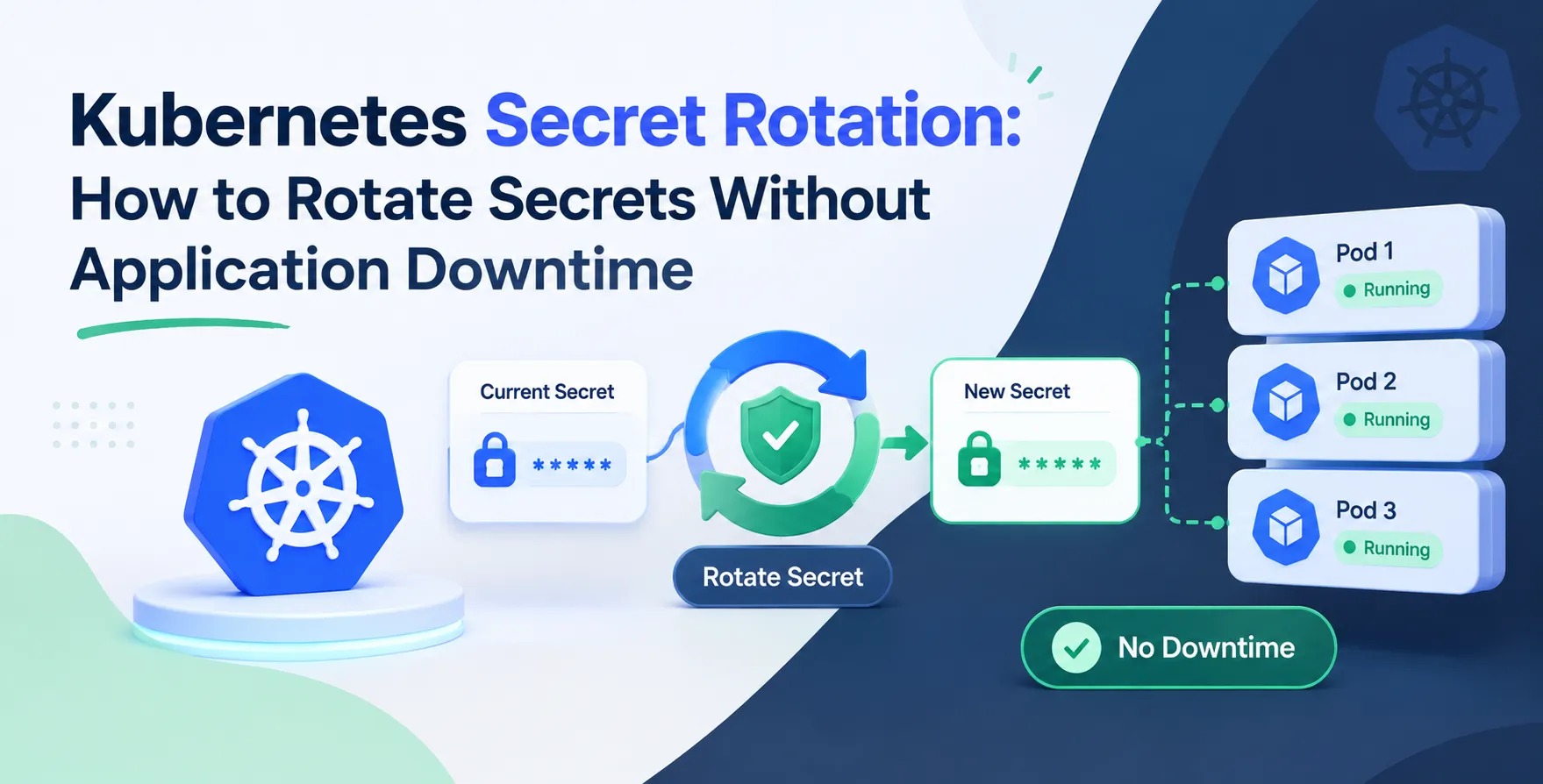
Updating a secret often requires restarting pods to pick up the new values. This manual intervention is the primary cause of service interruption during maintenance windows.
If your application does not natively support hot-reloading of configuration files, a restart is unavoidable. Achieving zero-downtime credential rotation requires architectural adjustments to how your applications consume these secrets.
Manual vs Automated Rotation
Manual updates are prone to human error and difficult to scale across large environments. Automating this process removes the burden from engineering teams and improves overall system security.
| Method |
Complexity |
Reliability |
| Manual kubectl edit |
Low |
Low |
| CI/CD Triggered |
Medium |
Medium |
| External Secret Operator |
Medium |
High |
| CSI Secret Store |
High |
High |
Strategies for Zero-Downtime Rotation
To avoid outages, your application must be designed to handle dynamic configuration changes. You can achieve this by implementing sidecar containers or using mount propagation to update files in real-time.
Another effective strategy involves versioning your secrets. By keeping both the old and new versions available for a short window, you ensure the application remains functional during the propagation phase.
- Implementing file-based watcher patterns
- Utilizing sidecar containers for injection
- Staging new credentials alongside existing ones
- Leveraging Kubernetes native volume mounts
Using Secret Store CSI Driver
The Secret Store CSI driver allows you to mount secrets stored in external vaults directly into your pods as volumes. This integration is a powerful tool for Kubernetes secret rotation.
Because the driver manages the mounting process, it can automatically update the files within the container as soon as the secret changes in the underlying vault. Your application simply watches the file system for changes.
Configuring the Provider
You must define a SecretProviderClass resource that tells the driver where to fetch data. This ensures your cluster remains synced with your external secret management system.
- Define the vault connection parameters
- Specify the secret objects to sync
- Set up automatic rotation intervals
- Assign identities for secure access
Once configured, the driver handles the heavy lifting of keeping files current.
External Secret Operators
External Secrets Operator is another industry-standard tool for managing sensitive data. It reads information from external APIs and automatically creates Kubernetes secrets in your namespace.
It acts as a bridge between your cloud provider's vault and your cluster. When a secret is updated in the cloud, the operator updates the corresponding Kubernetes object immediately.
Automating the Lifecycle
The operator continuously polls the external source to ensure consistency. It removes the need for manual intervention during the lifecycle of a sensitive key.
- Polls external secret stores
- Updates local cluster objects
- Supports multiple cloud providers
- Reduces manual sync effort
This approach is highly scalable for complex microservices architectures.
Handling Application Reloads
Even with automated updates, the application logic must be aware of the change. Simply updating a file on disk is not enough if the application cached the previous value at startup.
Developers should implement a signaling mechanism to trigger a reload. A common approach is to send a SIGHUP signal to the application process when the secret file changes.
Best Practices for Security
Security is the primary reason for implementing a rotation policy. You should treat secret rotation as a critical component of your standard deployment procedures.
Limit the blast radius by using fine-grained RBAC policies. Only authorized service accounts should have access to read sensitive data within the cluster.
- Enforce principle of least privilege
- Encrypt data at rest in etcd
- Rotate credentials at regular intervals
- Use short-lived dynamic secrets
Monitoring and Auditing
You cannot secure what you cannot observe. Keep a detailed log of every time a secret is accessed or modified within your environment.
Use native audit logs to track changes to secret objects. This helps identify unauthorized access attempts and verifies that rotation cycles are occurring as scheduled.
Impact on Deployment Pipelines
Your CI/CD pipeline should be decoupled from the secret rotation process. Relying on pipeline redeployments to update secrets leads to unnecessary overhead and potential service gaps.
Focus on a GitOps workflow where infrastructure changes are version-controlled. This keeps your environment state predictable and reproducible across different clusters.
Common Pitfalls to Avoid
Many teams fail because they attempt to rotate secrets too quickly. Allow enough buffer time for the new secret to propagate to all nodes before invalidating the old one.
Failing to update application code to handle dynamic reloads is another major hurdle. Without a robust strategy to refresh secrets, you will inevitably face downtime during your next rotation cycle.
- Rushing the rotation cycle
- Hardcoding secrets in application code
- Neglecting to test rotation logic
- Ignoring secret propagation latency
Conclusion
Mastering secret rotation is a vital skill for maintaining a secure and stable cluster. By moving away from manual updates and embracing automated operators or CSI drivers, you can significantly reduce the risk of outages.
Remember that the technical implementation is only half the battle. Your application code must also be prepared to consume updated credentials gracefully without requiring a full restart.


 In collaboration with