Table of Contents
- Introduction
- Understanding the FHIR Bulk Data Standard
- The Role of Asynchronous Workflows
- Designing for High Throughput
- Security Considerations for Large Data Sets
- Handling Massive Resource Volumes
- Optimizing Storage and Retrieval
- Managing API Rate Limits
- Monitoring and Performance Metrics
- Challenges in Scaling Healthcare APIs
- Comparing Batch vs Bulk Approaches
- Implementing Effective Retries
- Conclusion
Introduction
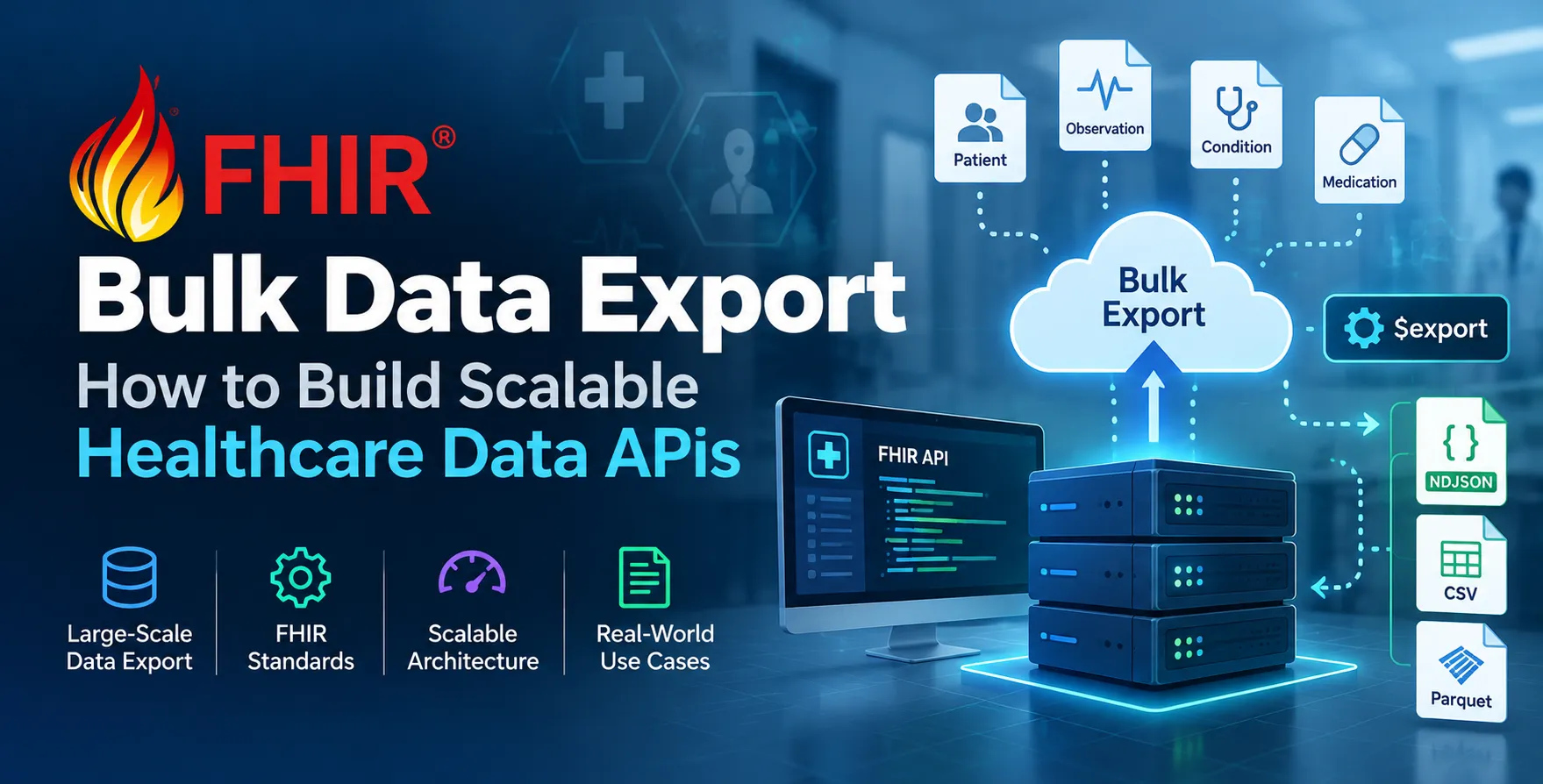
Modern healthcare interoperability demands efficient ways to move massive amounts of patient information between systems. The FHIR Bulk Data Export standard provides a robust framework to address this, allowing providers and insurers to extract data sets in a reliable, standardized format.
Building a healthcare data API that supports this requires careful planning, as traditional synchronous requests will fail under the weight of millions of clinical records. This guide explores the architectural patterns required to implement this at scale.
Understanding the FHIR Bulk Data Standard
The FHIR Bulk Data specification defines how to export large volumes of data using an asynchronous pattern. Unlike standard REST API calls that return immediate payloads, bulk export relies on a request-poll-download lifecycle that decouples the client from the server’s processing load.
Adopting this standard ensures your system remains compliant with current interoperability mandates while providing a consistent interface for downstream consumers. It essentially shifts the burden of data transformation from the request time to the background processing phase.
- Standardizes large-scale data extraction
- Uses asynchronous processing patterns
- Reduces server-side memory pressure
- Ensures predictable system performance
The Role of Asynchronous Workflows
Asynchronous operations are the backbone of any scalable FHIR bulk export API. When a client initiates a request, the server returns a 202 Accepted status and a status URL, allowing the client to check for completion later.
This pattern prevents long-running HTTP connections that often lead to timeouts in cloud environments. It also enables the server to queue jobs and process them during off-peak hours, preserving resources for real-time traffic.
- Improves overall API responsiveness
- Facilitates background job scheduling
- Prevents common connection timeouts
- Enables efficient resource utilization
Designing for High Throughput
To handle massive data volumes, you must move away from single-process architectures. You need a distributed task runner that can partition data into manageable chunks before writing them to persistent storage.
Partitioning by resource type or patient population allows multiple workers to run in parallel. This design ensures that a single large request does not block the entire infrastructure from processing smaller, urgent tasks.
Parallel Processing Strategies
Splitting large data requests into smaller units allows for horizontal scaling. You can spin up additional workers based on the current queue depth without impacting the primary application server.
- Implement distributed task queues
- Parallelize database query execution
- Utilize localized caching layers
- Scale workers independently of APIs
These strategies ensure that your system maintains high availability even during periods of heavy data export demand.
Security Considerations for Large Data Sets
Security remains paramount when dealing with sensitive health information at scale. Every step of the export process must adhere to strict FHIR Bulk Data privacy requirements, ensuring that only authorized clients gain access to the resulting files.
Implementing robust authentication is non-negotiable. Using OAuth2 scopes specifically tailored for bulk access prevents accidental over-sharing of data. You must also ensure that the generated files are encrypted at rest and accessible only via signed, time-limited URLs.
| Security Control |
Implementation Strategy |
| Authentication |
OAuth2 with system scopes |
| Access Control |
Role-based data filtering |
| Data Protection |
Encryption at rest and transit |
| Audit Trails |
Comprehensive logging for compliance |
| Link Security |
Time-limited pre-signed URLs |
Handling Massive Resource Volumes
Managing the memory footprint of large exports is a common challenge for developers. Instead of serializing entire sets into memory, you should stream records directly to the file system or object storage bucket.
Streaming reduces latency and prevents memory overflow errors during peak periods. This approach is essential for maintaining a stable environment when dealing with millions of clinical resources.
- Use stream-based serialization
- Chunk data into defined sizes
- Avoid full object instantiation
- Compress output files dynamically
Optimizing Storage and Retrieval
Choosing the right storage backend impacts the speed of your exports significantly. High-performance object storage serves as the ideal destination for bulk files, offering high availability and durability for large data sets.
You should also implement lifecycle policies to clean up older exports automatically. This keeps storage costs predictable while ensuring that sensitive data is not retained longer than necessary, supporting your overall data governance strategy.
Managing API Rate Limits
Scalable healthcare data APIs must implement intelligent traffic management to protect downstream dependencies. While FHIR Bulk Data Export how to build scalable healthcare data APIs focuses on throughput, you must also prevent resource exhaustion.
Dynamic throttling allows you to adjust limits based on current system load. This protects your core database from being overwhelmed by simultaneous large-scale export requests, ensuring consistent performance for all API consumers.
- Apply per-client rate limits
- Monitor queue saturation levels
- Implement global traffic throttling
- Prioritize critical system traffic
Monitoring and Performance Metrics
You cannot optimize what you do not measure. Implementing detailed observability allows you to identify bottlenecks in your export pipeline, such as slow database queries or inefficient serialization logic.
Track the time taken from request initiation to file availability, as well as the success rates of background jobs. These metrics help you fine-tune your infrastructure and provide better service level agreements to your stakeholders.
Challenges in Scaling Healthcare APIs
Scaling in healthcare involves unique constraints compared to other industries. You must balance the need for speed with the requirement for clinical accuracy and strict data provenance.
Data consistency remains a significant hurdle when dealing with long-running exports. Ensuring that the exported data reflects a point-in-time state requires careful snapshotting or versioning strategies within your backend database.
- Maintaining clinical data integrity
- Managing point-in-time snapshots
- Handling complex schema mapping
- Ensuring interoperability compliance
Comparing Batch vs Bulk Approaches
While batching is useful for smaller updates, it is often insufficient for comprehensive data migrations. Bulk export offers a more efficient path for large-scale synchronization, reducing the total number of round-trips between client and server.
Choosing between these depends on your specific use case. If you need to export an entire patient population, bulk is the industry standard. If you only need to sync recent changes, batching may suffice.
Implementing Effective Retries
Network failures are inevitable when moving large amounts of data. Your API client should implement exponential backoff strategies when polling for status updates or downloading exported files.
The server should also be resilient, allowing jobs to resume from the last successful point of failure. This level of robustness is essential for building production-grade healthcare systems that users can rely on for critical operations.
Conclusion
Building a scalable FHIR bulk data export solution requires a deep understanding of asynchronous patterns and efficient data handling. By focusing on streaming, parallel processing, and robust security, you can create a reliable system that meets the demands of modern healthcare.
Invest time in robust monitoring and testing to ensure your infrastructure remains resilient under pressure. Following these architectural best practices will help you deliver high-performance data exchange capabilities that empower providers and improve patient outcomes.


 In collaboration with