Table of Contents
- Understanding AWS Lambda Cold Starts
- The Mechanics of Initialization Latency
- What Is Provisioned Concurrency?
- When to Use Provisioned Concurrency
- What Is SnapStart?
- How SnapStart Works
- Comparing Key Performance Indicators
- Lambda SnapStart vs Provisioned Concurrency Comparison
- Choosing the Right Strategy for Your Workload
- AWS Lambda cold start optimization Strategies
- Managing Cloud Costs Effectively
- Best Practices for Serverless Architecture
- When to Consider Alternatives
- Conclusion
Understanding AWS Lambda Cold Starts
Serverless architecture offers incredible scalability without managing infrastructure. However, developers often encounter the infamous cold start issue when functions are triggered after inactivity.
A cold start occurs when AWS initializes a new execution environment for your function code. This process introduces AWS Lambda initialization latency that can impact user experience in real-time applications.
Understanding how to mitigate this delay is essential for maintaining high performance. You must weigh the trade-offs between different solutions to keep your system responsive.
The Mechanics of Initialization Latency
Initialization latency happens because AWS needs to spin up a container, download your code, and start the runtime. If your application has heavy dependencies, this process takes even longer.
Frameworks like Spring Boot or heavy Python libraries often exacerbate this problem. These environments require significant setup time before the first request can be processed.
Optimizing this phase is a core part of AWS Lambda cold start optimization. By minimizing package sizes and lazy-loading dependencies, you can reduce the impact of these delays.
- Container provisioning
- Runtime environment setup
- Application framework initialization
- Library and dependency loading
What Is Provisioned Concurrency?
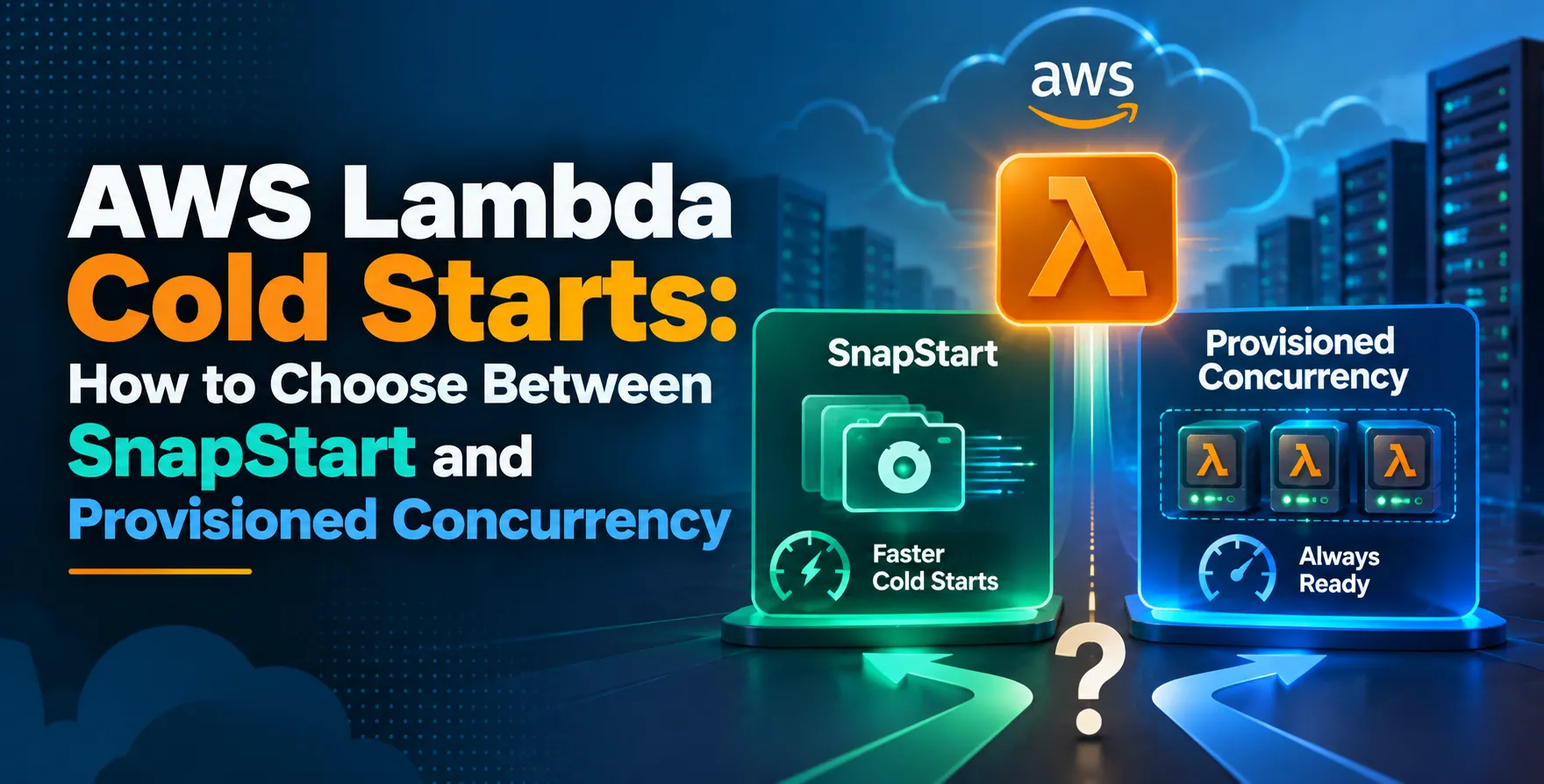
Provisioned Concurrency keeps a specified number of execution environments ready to serve requests immediately. It essentially pre-warms your functions so they are always in a hot state.
When a request hits a provisioned function, it skips the initialization phase entirely. This provides consistent, predictable performance even under sudden traffic spikes.
This approach effectively eliminates cold starts for the allocated capacity. It is a powerful tool for mission-critical services that cannot afford any downtime.
- Consistent response times
- Predictable performance for spikes
- Instant execution for traffic
When to Use Provisioned Concurrency
Provisioned Concurrency is best suited for applications with steady or predictable traffic patterns. If your business relies on rapid response times, this feature is worth the investment.
Large, complex microservices often benefit from this approach. It ensures that the heavy lifting of framework startup does not happen during the request cycle.
When you evaluate your cloud architecture, consider whether the cost of keeping environments warm justifies the performance gains. It is a classic trade-off between expenditure and latency.
What Is SnapStart?
SnapStart is a specialized feature designed to improve start times for Java-based functions. It takes a snapshot of the initialized environment and caches it for future use.
Instead of running the entire initialization sequence, AWS restores the function from the saved snapshot. This drastically cuts down on the time required to handle the first request.
This technology is currently optimized for Java runtimes. It is a game-changer for developers who prefer Java but were previously deterred by long startup times.
How SnapStart Works
Snapshot Creation
During deployment, AWS executes your initialization code once. It then saves the state of the memory and disk to a persistent, encrypted cache.
- Code compilation
- Dependency injection completion
- Static variable initialization
This cached state is then used to resume the execution environment instantly. It bypasses the repetitive setup steps entirely.
Resumption Process
When an invocation request arrives, the Lambda service retrieves the snapshot. It restores the environment state and proceeds to execute your handler logic.
- Snapshot retrieval
- State restoration
- Immediate request handling
This process reduces the startup time from seconds to milliseconds. It allows for much faster scaling than traditional cold starts.
Comparing Key Performance Indicators
Both methods aim to reduce latency, but they achieve this through different underlying mechanisms. Provisioned Concurrency relies on active resource allocation, while SnapStart uses cached snapshots.
The choice between them depends on your runtime and your specific cost constraints. You must analyze your traffic patterns to see which fits your needs best.
Monitoring your performance metrics is vital. Without proper data, you cannot determine if your chosen strategy is actually meeting your latency requirements.
Lambda SnapStart vs Provisioned Concurrency Comparison
| Feature |
Provisioned Concurrency |
SnapStart |
| Primary Use |
General purpose |
Java runtimes |
| Cost Model |
Hourly charge |
Free of charge |
| Traffic Handling |
High throughput |
Burst readiness |
| Setup Complexity |
Configuration required |
Simple enablement |
Choosing the Right Strategy for Your Workload
When deciding how to choose between SnapStart and Provisioned Concurrency, first check your runtime. If you are not using Java, SnapStart may not be available for your specific use case.
For Java developers, SnapStart is usually the first choice due to its lack of additional cost. It provides a significant boost without requiring you to pay for idle execution environments.
However, if you have non-Java runtimes or need absolute guarantees for extreme traffic bursts, Provisioned Concurrency remains the industry standard. It offers more control over how your resources are allocated.
AWS Lambda cold start optimization Strategies
Beyond choosing a platform feature, you should focus on general performance improvements. Smaller deployment packages are always faster to load and initialize.
Avoid heavy frameworks if your application does not strictly require them. Lightweight alternatives often perform better in serverless environments by design.
Finally, keep your code modular. By isolating logic, you can ensure that only the necessary code is loaded into the initial execution environment.
- Minimize package size
- Avoid heavy framework overhead
- Use lazy loading for libraries
- Optimize your initialization code
Managing Cloud Costs Effectively
Provisioned Concurrency can become expensive if not managed carefully. Always use Auto Scaling to adjust your concurrency levels based on actual demand.
Cloud Cost Optimization requires constant vigilance. Review your metrics regularly to ensure you are not paying for capacity that goes unused during off-peak hours.
FinOps for Engineering Teams is increasingly important in serverless environments. Aligning your technical choices with financial goals prevents runaway cloud bills.
Best Practices for Serverless Architecture
Serverless development requires a shift in mindset. You must design for ephemerality, meaning your code should handle the lifecycle of containers gracefully.
Effective deployment services enable you to manage these configurations via infrastructure as code. This ensures consistency across your development, staging, and production environments.
Always maintain clear documentation for your chosen strategies. When team members understand why a specific approach was taken, they can make better decisions during future updates.
When to Consider Alternatives
Sometimes, neither feature is the right answer. If your latency requirements are not extremely stringent, standard Lambda execution might be sufficient.
If you find that your requirements exceed what serverless can offer, consider moving to container-based solutions. Kubernetes for microservices might provide more control over the underlying environment.
Always evaluate your architecture periodically. What was the right choice a year ago might not be the most efficient solution for your current scale.
Conclusion
Addressing initialization delays is a key component of building professional serverless applications. Whether you use SnapStart or Provisioned Concurrency, the goal is consistent performance.
Java developers should prioritize SnapStart for its efficiency and cost-effectiveness. Those using other runtimes or requiring extreme scalability should look toward Provisioned Concurrency.
Keep your code lean and monitor your performance metrics closely. By making informed decisions, you ensure your applications remain fast and reliable for your users.


 In collaboration with