Table of Contents
- Introduction
- What Are LLM Guardrails?
- How LLM Guardrails Work
- Core Types of AI Guardrails
- Input Guardrails vs Output Guardrails
- Key Benefits of LLM Safety Guardrails
- Risks of Running LLMs Without Protection
- Common Architectures for AI Application Guardrails
- Evaluating Guardrail Performance
- Popular Open-Source Frameworks
- Implementation Best Practices
- Challenges in Guardrail Deployment
- Conclusion
Introduction
Generative AI models are transforming how businesses automate processes and interact with users. However, deploying raw foundational models directly into production introduces significant operational risks.
Unchecked language models can produce inaccurate facts, reveal confidential data, or respond to malicious prompts. To solve these critical challenges, developers implement structured controls around model interactions.
Understanding LLM Guardrails is essential for any engineering team building scalable enterprise products. These protective frameworks bridge the gap between experimental AI prototypes and secure production systems.
What Are LLM Guardrails?
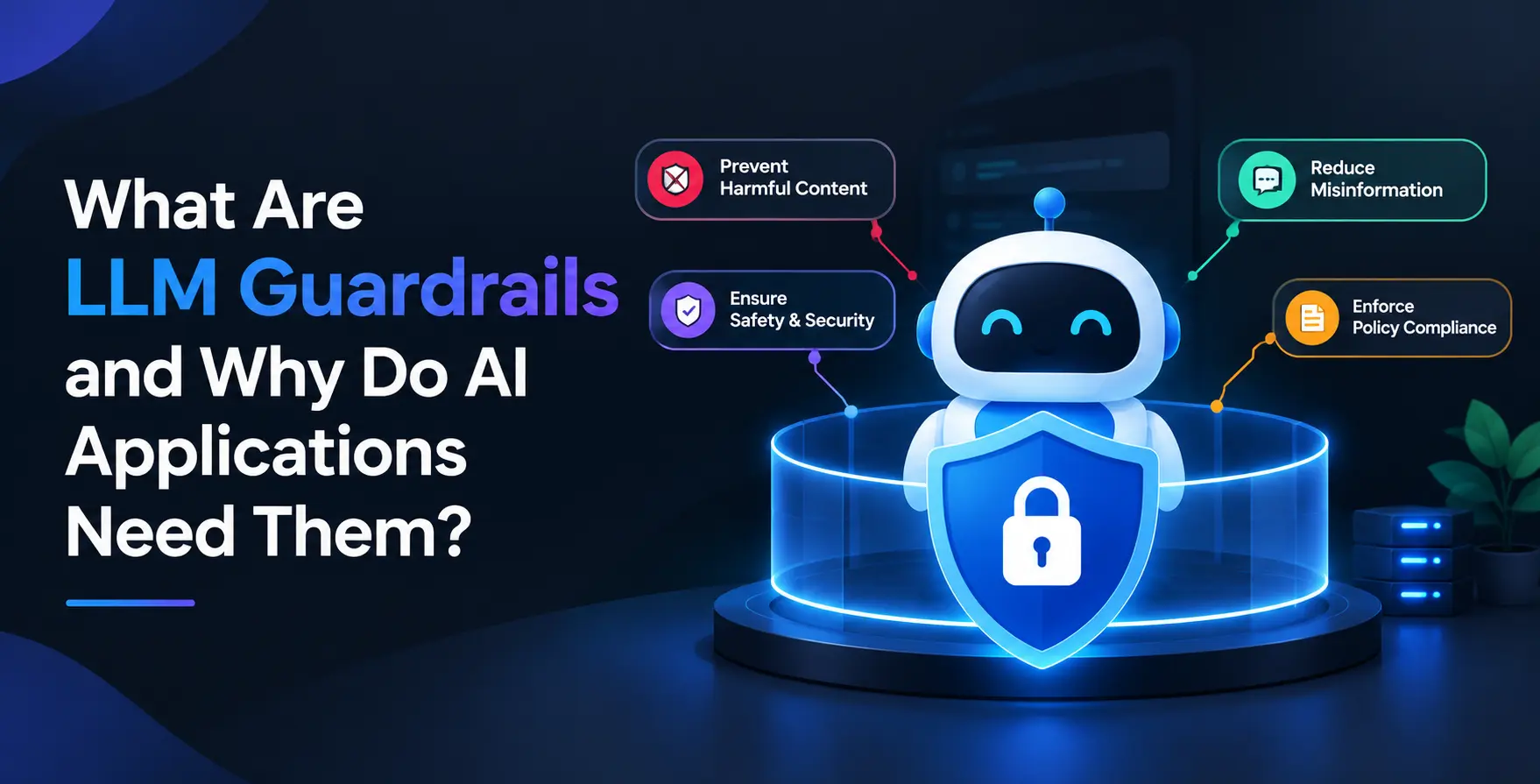
In modern enterprise software, LLM Guardrails act as programmable safety barriers placed around large language models. They analyze incoming user prompts and outgoing model responses in real time.
Rather than relying solely on base model training for safety, guardrails enforce deterministic rules and secondary classifiers. This layered defense mechanism prevents undesirable behavior before it reaches end users.
Deploying robust protective layers provides several core safety capabilities:
- Prevents toxic output generation
- Blocks malicious prompt injections
- Filters sensitive customer data
- Enforces strict business logic
- Ensures regulatory compliance rules
By enforcing these automated checks, organizations can deploy foundation models with confidence across enterprise applications.
How LLM Guardrails Work
At their core, AI Guardrails intercept communication between the user interface and the underlying language model. When a request arrives, the system passes the prompt through a sequence of lightweight evaluation checks.
If the input passes inspection, the model generates a response that undergoes a similar screening process. If any violation is detected, the framework modifies the request or triggers a safe fallback message.
The guardrail architecture operates primarily across two distinct validation checkpoints:
- Evaluates inputs before processing
- Scans outputs before delivery
This dual-stage pattern guarantees end-to-end security throughout the entire execution pipeline.
Core Types of AI Guardrails
To establish full coverage, modern production systems separate defensive policies into specialized operational layers. Each layer targets distinct threat vectors and operational requirements.
Input Validation
Input validation scrutinizes user prompts before they reach the language model interface. It identifies harmful intent, off-topic requests, and adversarial prompt structures designed to bypass system rules.
- Detects prompt injection attempts
- Filters off-topic user queries
- Redacts personally identifiable information
Filtering bad input protects downstream model context and lowers unnecessary token costs.
Output Filtering
Output filtering checks the raw text generated by the model before displaying it to end users. It ensures responses remain accurate, respectful, and fully compliant with corporate policies.
- Catches model hallucination errors
- Blocks inappropriate language generation
- Verifies structured formatting compliance
Sanitizing model output prevents brand damage and maintains user trust across digital touchpoints.
Input Guardrails vs Output Guardrails
While both validation layers are necessary, they focus on different parts of the inference lifecycle. Understanding their differences helps software architects allocate engineering resources effectively.
| Feature |
Input Guardrails |
Output Guardrails |
| Execution Timing |
Before model inference |
After model inference |
| Primary Focus |
Prompt security and scope |
Response quality and safety |
| Target Threat |
Jailbreaks and toxic input |
Hallucinations and data leakage |
| Latency Impact |
Minimal initial delay |
Additional post-processing time |
| Action on Failure |
Block or sanitize prompt |
Regenerate or return fallback |
Combining both approaches establishes a comprehensive security boundary for production applications.
Key Benefits of LLM Safety Guardrails
Implementing LLM Safety Guardrails transforms unpredictable generative models into reliable enterprise assets. Engineering teams can enforce predictable behavior without modifying underlying model weights.
Organizations adopting automated guardrail solutions gain multiple technical and business advantages:
- Protects brand reputation online
- Prevents costly data leaks
- Maintains consistent user experiences
- Mitigates legal liability risks
- Reduces manual moderation overhead
- Accelerates enterprise AI adoption
These safeguards allow product teams to ship intelligent features faster while maintaining strict risk controls.
Risks of Running LLMs Without Protection
Deploying raw language models directly to end users exposes systems to significant security and operational vulnerabilities. Adversaries constantly develop jailbreak techniques to manipulate model responses and exploit system prompts.
Without guardrails, a model might leak proprietary corporate secrets or confirm false information as truth. Such incidents cause severe financial losses and erode customer trust immediately.
Additionally, regulatory bodies increasingly hold businesses accountable for harmful outputs generated by automated tools. Unprotected deployments put companies at high risk of non-compliance fines and litigation.
Common Architectures for AI Application Guardrails
Building secure pipelines requires integrating AI Application Guardrails into existing cloud infrastructure smoothly. Most enterprise teams adopt standardized architectural patterns based on performance and latency requirements.
Architects typically choose from several established deployment patterns:
- Gateway proxy pattern implementations
- Middleware validation layers
- In-model alignment checks
- Asynchronous monitoring pipelines
Selecting the right pattern depends on whether your priority is sub-millisecond execution speed or deep semantic checking.
Evaluating Guardrail Performance
Measuring guardrail effectiveness requires tracking both accuracy metrics and latency overhead closely. Guardrails must block harmful content effectively without frustrating legitimate users with false alarms.
High false-positive rates degrade user experience by blocking safe prompts unnecessarily. Conversely, low detection rates expose the platform to safety breaches and system exploitation.
Engineering teams should benchmark validation speed alongside model inference times to maintain smooth application responsiveness.
Popular Open-Source Frameworks
The open-source ecosystem offers powerful libraries for defining and enforcing safety policies in software applications. These tooling choices accelerate implementation and provide standardized rule engines.
Leading frameworks used by modern engineering teams include:
- NeMo Guardrails by NVIDIA
- Guardrails AI validation engine
- Llama Guard safety model
- Guidance structured output library
Implementation Best Practices
Successful guardrail integration requires a balanced approach between rigorous security policies and optimal system performance. Overly restrictive filters create poor user interactions, while loose rules fail to prevent harm.
Following proven operational practices ensures reliable protection across production workloads:
- Define explicit safety policies
- Latency optimized validation pipelines
- Continuous monitoring of bypasses
- Layered security control checks
- Fallback response mechanisms design
Iterative policy refinement based on real usage data keeps security boundaries effective over time.
Challenges in Guardrail Deployment
While safety controls are essential, adding validation layers introduces structural engineering trade-offs. Teams must navigate these trade-offs during initial design and ongoing maintenance.
Developers frequently encounter several common operational hurdles:
- Added inference latency delay
- High false positive rate
- Complex rule configuration management
Addressing these friction points requires automated testing pipelines and lightweight detection models.
Conclusion
Integrating guardrails is no longer optional for organizations building enterprise AI solutions. They provide the safety, compliance, and reliability required to operate foundation models safely at scale.
By implementing dual-stage validation and continuous monitoring, developers can deliver innovative features while mitigating core operational risks effectively.


 In collaboration with