Table of Contents
- Introduction to Vibe Coding
- What is Vibe Coding?
- The Shift from Manual Syntax to Intent
- Core Philosophy of Vibe Coding
- Primary Drivers Behind the Vibe Coding Movement
- How Vibe Coding Transforms Daily Workflow
- Impact on Developer Roles
- Traditional Coding vs Vibe Coding
- Crucial Skills for the Vibe Era
- Operational Risks and Architecture Blindspots
- Overcoming Quality Challenges
- Best Practices for Developers
- Conclusion
Introduction to Vibe Coding
Software creation is undergoing its biggest transformation in decades. Developers are moving away from manual line-by-line syntax writing toward high-level direction and intent guidance.
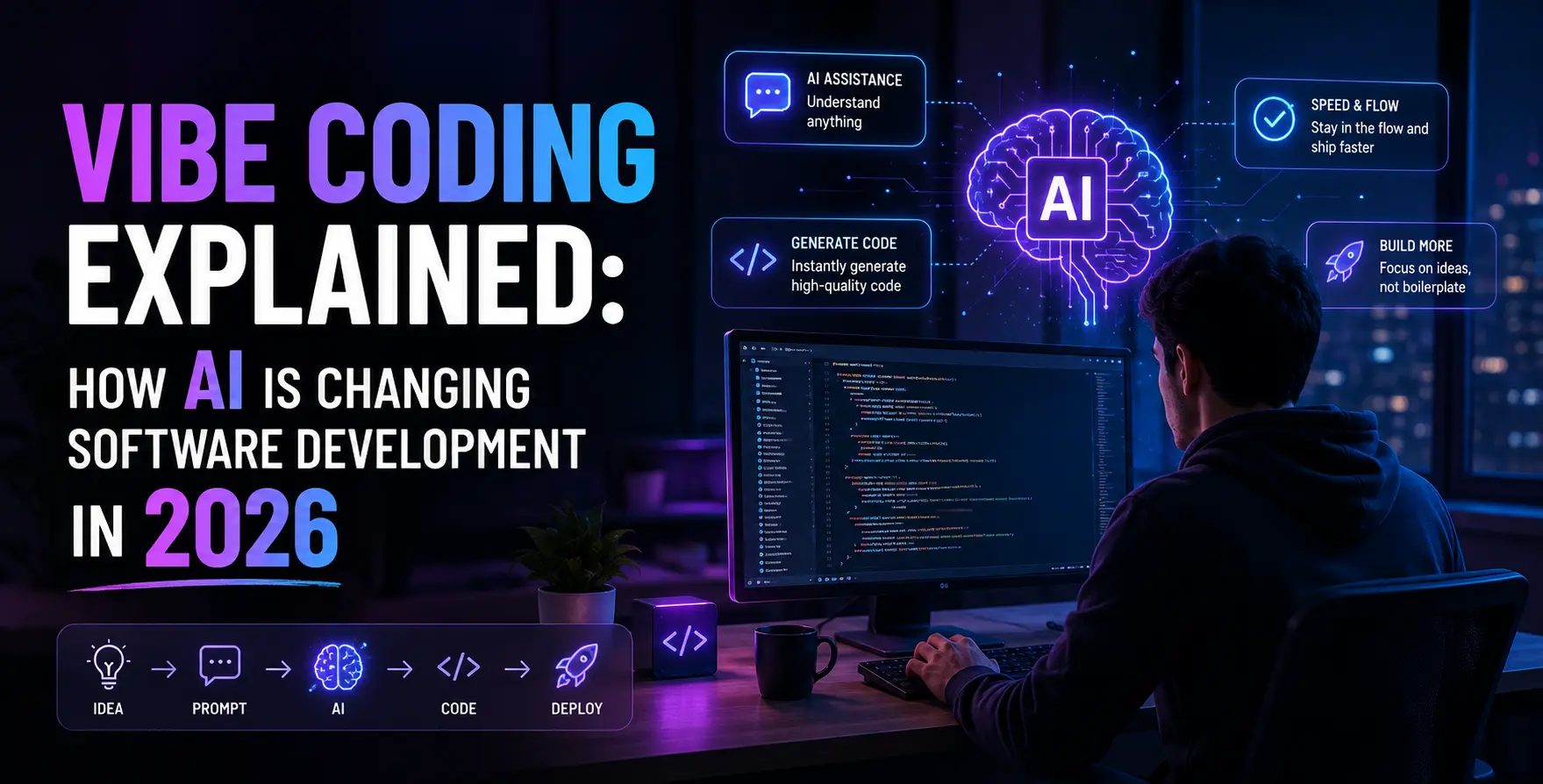
This shift has introduced Vibe coding, a modern development approach where engineers guide intelligent systems to write, refactor, and deploy code seamlessly.
Modern software development is moving faster than ever before. Developers no longer spend hours hunting down missing semicolons or reading boilerplate documentation.
Instead, prompt-driven building and automated code generation are becoming the standard way to build applications.
- Accelerates overall project delivery
- Shifts focus to product architecture
This new paradigm allows engineers to focus on big-picture strategy rather than syntax mechanics.
What is Vibe Coding?
Vibe coding describes a style of software construction where the developer acts more like a conductor than a writer. The software engineer sets the direction, specifies requirements in plain language, and lets automated models generate the underlying implementations.
In this paradigm, the developer feels the "vibe" of the architecture and flow rather than getting bogged down in implementation details. Modern AI software development relies heavily on this conversational and iterative feedback loop.
Rather than writing raw functions from scratch, engineers review, test, and steer continuous streams of generated code until the feature works perfectly.
The Shift from Manual Syntax to Intent
For decades, programming required deep memorization of syntax rules, system APIs, and framework boilerplate. Today, modern LLMs handle syntax generation effort gracefully.
- Reduces repetitive syntax writing
- Encourages rapid prototyping
- Democratizes feature experimentation
- Lowers technical entry barriers
- Speeds up initial MVP validation
By prioritizing user intent over strict syntax rules, teams deliver features in hours rather than weeks.
Core Philosophy of Vibe Coding
At its heart, this development philosophy assumes that high-level operational logic and context matter more than manual code construction. Writing software becomes a creative conversation between human intuition and machine execution.
Developers guide the outcome by defining system constraints, user stories, and acceptance criteria. The computer handles the heavy lifting of mapping those inputs into functional code structures.
This mindset treats source code as an ephemeral asset that can be easily regenerated whenever design requirements change.
Primary Drivers Behind the Vibe Coding Movement
Several technological advancements have aligned to make this intuitive programming approach practical for production systems in 2026.
- Increased context window sizes
- Better reasoning capabilities
- Integration into local IDEs
- Faster code generation models
Together, these technologies eliminate friction and enable developers to work at the speed of thought.
How Vibe Coding Transforms Daily Workflow
Planning Phase
Engineers sketch requirements directly into modern context window tools to map early architecture.
- Generates initial database schemas
- Outlines primary API endpoints
This saves hours of manual configuration during project initialization.
Execution Phase
During execution, developers leverage advanced AI coding tools to build components seamlessly.
- Automates unit test creation
- Refactors legacy code structures
- Fixes runtime errors instantly
- Writes interface integration code
- Translates pseudocode into functions
- Generates inline technical documentation
This flow reduces context switching and keeps developers focused on core business logic.
Impact on Developer Roles
As automation handles routine implementation, engineering job roles are shifting toward higher-level system engineering and product thinking.
- Increased focus on system design
- Greater emphasis on security audit
- Rise of prompt engineering skills
- Enhanced focus on domain knowledge
The modern programmer is becoming a product manager who happens to understand software architecture.
Traditional Coding vs Vibe Coding
Understanding the difference between legacy programming methods and modern vibe-based development is essential for engineering leaders.
| Aspect |
Traditional Coding |
Vibe Coding |
| Focus Area |
Syntax and manual implementation |
System design and prompt intent |
| Development Speed |
Slow and methodical |
Rapid and iterative |
| Error Resolution |
Manual debugging and stack traces |
Automated diagnosis and correction |
| Boilerplate Handling |
Written or copied manually |
Generated instantly on demand |
| Role of Developer |
Code builder and maintainer |
System architect and evaluator |
This shift allows teams to spend less time on repetitive tasks and more time solving core business challenges.
Crucial Skills for the Vibe Era
While syntax memorization is becoming less vital, technical foundation skills are more important than ever. Developers must evaluate generated code critically to ensure performance, security, and scalability.
Effective engineers excel at framing problems, specifying precise edge cases, and breaking complex software systems down into modular components. Relying on AI for programmers still requires strong architectural understanding.
Without deep domain knowledge, developers risk approving code that introduces subtle security flaws or unoptimized database queries.
Operational Risks and Architecture Blindspots
Adopting vibe-based practices without proper governance can create hidden risks for engineering organizations.
- Accumulation of unexamined technical debt
- Security vulnerabilities in generated code
- Lack of deep team codebase ownership
- Inconsistent code style across modules
- Over-reliance on external model availability
Organizations must establish clear code review standards to catch automated errors early.
Overcoming Quality Challenges
To mitigate potential risks, modern development teams combine automated code generation with rigorous automated testing and CI/CD pipelines.
- Mandatory unit test coverage requirements
- Automated security scanning tools
- Strict peer code review protocols
- Comprehensive integration test suites
These safeguards ensure that rapid development speeds do not compromise production stability.
Best Practices for Developers
To succeed with this modern approach, software engineers should adopt specific operational habits.
- Break prompts into small tasks
- Always review generated pull requests
- Maintain comprehensive automated unit tests
- Focus heavily on architecture design
- Document system context for models
By following these guidelines, engineers maximize productivity while maintaining complete system control.
Conclusion
Vibe coding represents a fundamental shift in how software is conceptualized, designed, and delivered. By moving away from manual syntax writing and embracing intent-driven development, software engineers can ship features faster than ever before.
However, successful adoption requires combining AI speed with human engineering discipline, system oversight, and rigorous quality controls.
Embracing these tools responsibly empowers developers to transform creative ideas into robust software solutions at unprecedented speeds.


 In collaboration with