Table of Contents
- Introduction
- Understanding the Code of Practice
- Scope of the Guidance
- Secure Development Lifecycles
- Managing Software Supply Chain Security
- Vulnerability Disclosure Policies
- Identity and Access Management
- Data Protection and Privacy
- Compliance and Accountability
- Testing and Validation
- Ongoing Monitoring and Updates
- Integration with Existing Standards
- Conclusion
Introduction
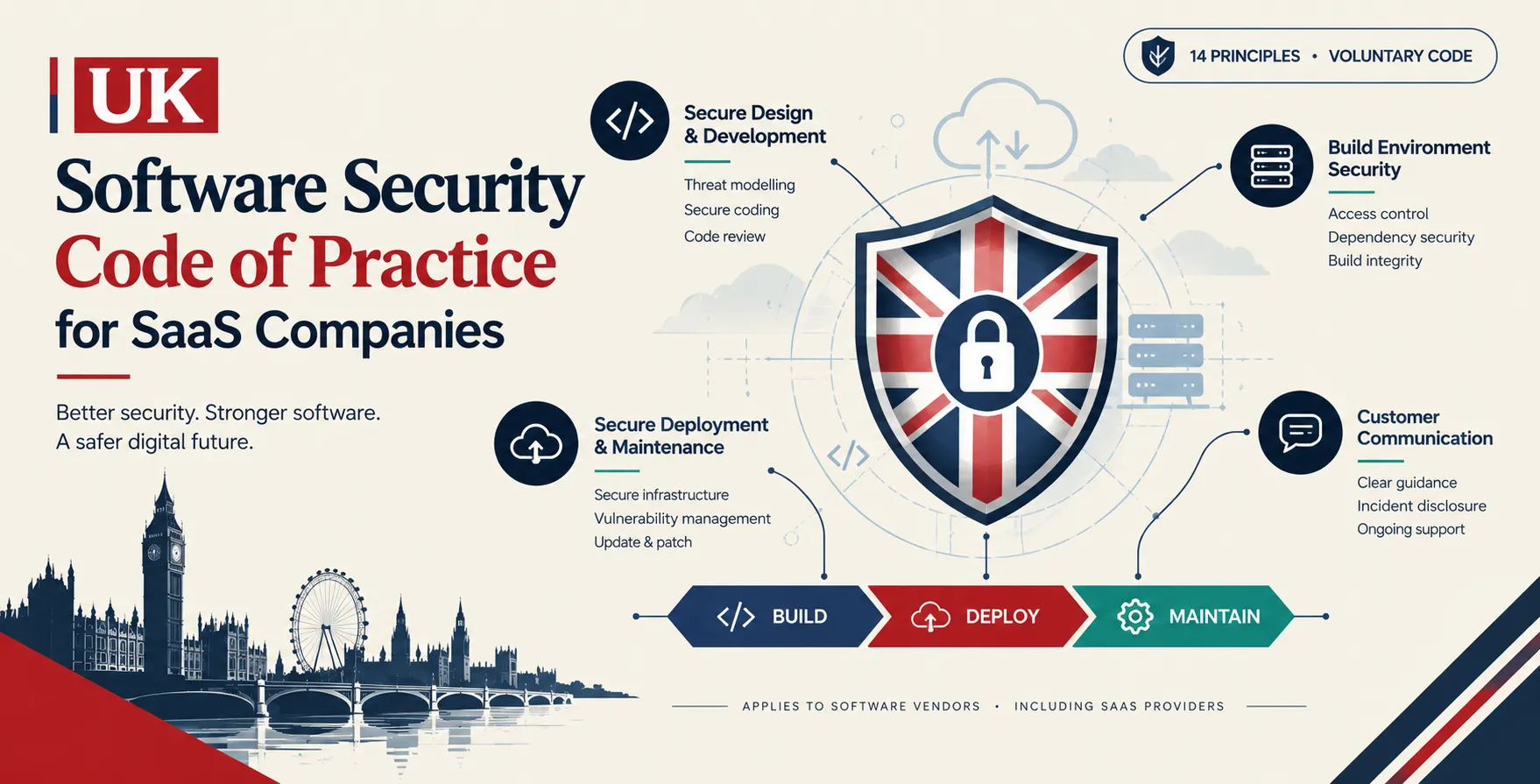
The digital landscape is shifting as regulators place greater emphasis on protecting end-users. For providers operating in the region, the UK Software Security Code of Practice for SaaS companies has become a foundational document for building trust.
Adhering to these guidelines is no longer just a recommendation for mature organizations. It is becoming a necessary baseline for anyone involved in professional SaaS development.
Understanding the Code of Practice
The Software Security Code of Practice serves as a set of principles designed to ensure that products are secure by design and by default. It moves away from the reactive security models of the past toward a proactive, lifecycle-oriented approach.
By prioritizing security at the earliest stages of development, companies can significantly reduce their attack surface. This framework encourages transparency, accountability, and continuous improvement across the entire software ecosystem.
- Promotes security at the design phase
- Encourages proactive risk management
- Facilitates better communication with users
- Supports robust incident response strategies
- Aligns with international security best practices
Scope of the Guidance
The guidance applies to organizations that develop and maintain software products for public or private use. While it focuses on the software itself, the operational environment is equally critical to the overall security posture.
SaaS providers must ensure that their cloud infrastructure meets the same rigorous standards as their application code. This holistic view prevents silos where code is secure but the deployment environment remains vulnerable.
Secure Development Lifecycles
Implementing a secure development lifecycle requires embedding security checks into every phase of the sprint. Developers cannot treat security as an afterthought or a final gateway before deployment.
Automated Security Controls
Automated tools provide the consistency needed to maintain high standards throughout the development cycle. They catch common errors before they reach production environments.
- Static application security testing
- Dynamic application security testing
- Container vulnerability scanning
- Infrastructure as code analysis
These tools act as a safety net, allowing teams to move quickly without compromising safety.
Developer Training
Human error remains a primary source of vulnerabilities in modern applications. Continuous training ensures that teams understand the latest threats and mitigation techniques.
- Secure coding workshops
- Threat modeling training
- Incident response drills
Empowered developers are the first line of defense against sophisticated cyber threats.
Managing Software Supply Chain Security
Modern applications rely heavily on third-party libraries, frameworks, and APIs. Securing the software supply chain security UK standards requires visibility into every dependency pulled into your build process.
If a foundational library contains a vulnerability, your application inherits that risk immediately. Maintaining an accurate Software Bill of Materials is essential for tracking components and managing potential exposures.
- Automated dependency auditing
- Vetting third-party components
- Locking versioning for builds
- Regular scanning of repositories
Proactive management of these dependencies is a critical component of maintaining a secure platform.
Vulnerability Disclosure Policies
Transparency is a core pillar of the current security landscape. Companies are expected to maintain clear, accessible channels for security researchers to report potential flaws.
A well-defined vulnerability disclosure policy signals to your users that you take their security seriously. It provides a structured path for identifying and resolving issues before they are exploited in the wild.
Identity and Access Management
Access control is the gatekeeper of your SaaS application. Strong authentication and authorization policies prevent unauthorized users from accessing sensitive customer data or internal infrastructure.
| Mechanism |
Primary Benefit |
Best Practice |
| MFA |
Prevents credential theft |
Enforce globally |
| RBAC |
Limits blast radius |
Apply least privilege |
| SSO |
Centralizes management |
Use secure protocols |
| JWT |
Stateless sessions |
Rotate signing keys |
| OAuth2 |
Delegated access |
Validate scopes |
Data Protection and Privacy
Data security must be integrated into the application's architecture from day one. Encryption at rest and in transit provides the baseline protection required by modern compliance mandates.
Furthermore, managing how data is collected and processed is vital for maintaining user trust. Privacy by design ensures that data minimization is a default setting, not an option.
Compliance and Accountability
While the code of practice provides a framework, accountability rests with the leadership of the SaaS company. Documenting your security practices is just as important as implementing them.
Regular audits and internal reviews help keep the organization aligned with evolving UK software security requirements. This documentation becomes vital during external assessments or when proving security maturity to enterprise clients.
Testing and Validation
Regular security testing is the only way to confirm that your controls are functioning as intended. Relying on automated scans is insufficient without periodic manual penetration testing.
- Regular penetration testing
- Automated security regression suites
- Red team exercises
Simulating real-world attacks provides deep insights into how your system handles complex threats.
Ongoing Monitoring and Updates
Security is not a static state, but a process of continuous improvement. Monitoring production environments for suspicious activity is essential for detecting breaches early.
Patch management strategies should prioritize critical vulnerabilities while maintaining operational stability. A swift response to new threats distinguishes mature platforms from their competitors.
Integration with Existing Standards
Many SaaS companies already operate under various ISO or SOC2 frameworks. The UK guidance should be viewed as a complementary layer that enhances existing security programs rather than a replacement.
By mapping the code of practice to your existing controls, you can streamline compliance efforts. This creates a unified security posture that satisfies both regulatory expectations and customer demands.
Conclusion
Adhering to the UK Software Security Code of Practice is an investment in the longevity and reliability of your SaaS platform. It forces a disciplined approach to development that naturally results in higher-quality software.
By focusing on secure design, supply chain integrity, and proactive vulnerability management, companies can build lasting trust with their users. Start by assessing your current maturity level and identifying the most critical areas for immediate improvement.


 In collaboration with