Table of Contents
- Introduction to CSS Frameworks
- What is Tailwind CSS?
- What is Bootstrap?
- Comparison of Tailwind CSS and Bootstrap
- Benefits of Using Tailwind CSS
- Benefits of Using Bootstrap
- Challenges in Using Tailwind CSS
- Challenges in Using Bootstrap
- Choosing the Best CSS Framework for React
- Modern CSS Frameworks in 2026
- Alternatives to Bootstrap
- Conclusion
Introduction to CSS Frameworks
CSS frameworks are essential for web app development. They help in creating responsive and consistent UI.
Two popular frameworks are Tailwind CSS and Bootstrap. Each has its strengths and weaknesses.
Choosing the right framework is crucial for a successful web app.
What is Tailwind CSS?
Tailwind CSS is a utility-first framework. It provides low-level classes for styling.
It’s highly customizable and works well with React.
Tailwind CSS is known for its simplicity and flexibility.
- Utility-first approach
- Highly customizable
- Works well with React
What is Bootstrap?
Bootstrap is a component-based framework. It provides pre-designed UI components.
It’s easy to use and has a large community of developers.
Bootstrap is a popular choice for web app development.
- Component-based approach
- Easy to use
- Large community of developers
- Pre-designed UI components
Comparison of Tailwind CSS and Bootstrap
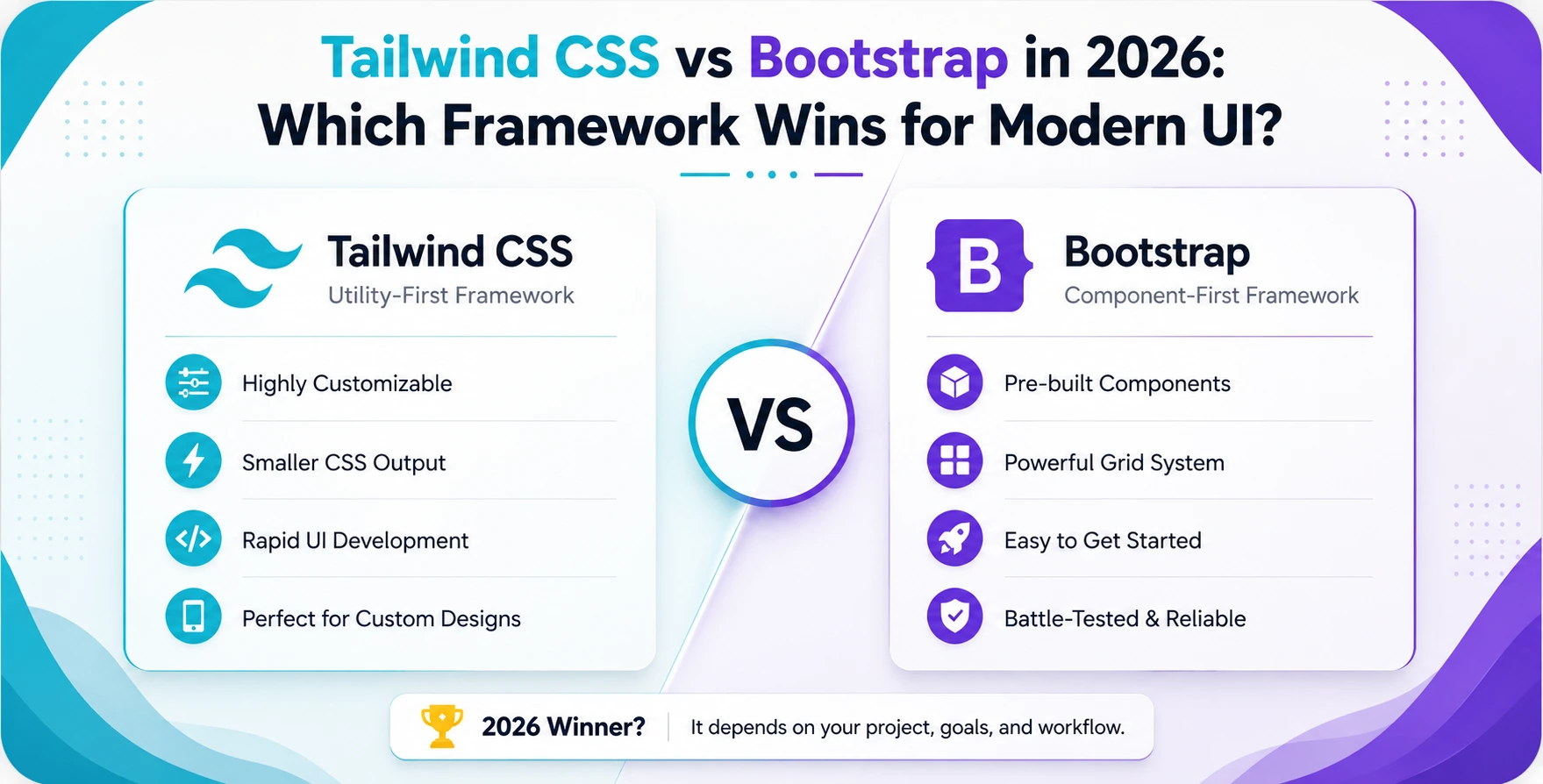
Tailwind CSS and Bootstrap have different approaches to styling.
Tailwind CSS is more flexible, while Bootstrap is easier to use.
The choice between them depends on the project’s requirements.
| Tailwind CSS |
Bootstrap |
| Utility-first approach |
Component-based approach |
| Highly customizable |
Pre-designed UI components |
| Works well with React |
Easy to use |
Benefits of Using Tailwind CSS
Tailwind CSS offers several benefits. It’s highly customizable and works well with React.
It’s also easy to learn and has a growing community of developers.
Tailwind CSS is a good choice for complex web apps.
- Highly customizable
- Works well with React
- Easy to learn
- Growing community of developers
- Good for complex web apps
Benefits of Using Bootstrap
Bootstrap has its own set of benefits. It’s easy to use and has a large community of developers.
It provides pre-designed UI components and is a good choice for simple web apps.
Bootstrap is also widely used and has a lot of resources available.
- Easy to use
- Large community of developers
- Pre-designed UI components
- Good for simple web apps
- Widely used and has a lot of resources
Challenges in Using Tailwind CSS
Tailwind CSS has some challenges. It has a steep learning curve and requires a good understanding of CSS.
It’s also not as widely used as Bootstrap, which can make it harder to find resources.
Tailwind CSS requires more effort to set up and configure.
- Steep learning curve
- Requires a good understanding of CSS
- Not as widely used as Bootstrap
- Requires more effort to set up and configure
Challenges in Using Bootstrap
Bootstrap also has its own set of challenges. It can be inflexible and difficult to customize.
It’s also not suitable for complex web apps and can be bloated.
Bootstrap has a lot of pre-designed components, which can make it harder to create a unique design.
- Inflexible and difficult to customize
- Not suitable for complex web apps
- Bloated
- Pre-designed components can make it harder to create a unique design
Choosing the Best CSS Framework for React
Choosing the best CSS framework for React depends on the project’s requirements.
Tailwind CSS is a good choice for complex web apps, while Bootstrap is better for simple web apps.
Consider the trade-offs between customization, ease of use, and community support.
Modern CSS Frameworks in 2026
In 2026, modern CSS frameworks like Tailwind CSS and Bootstrap continue to evolve.
New frameworks and technologies emerge, offering new possibilities for web app development.
The Best CSS framework for React will depend on the specific needs of the project.
Alternatives to Bootstrap
There are several alternatives to Bootstrap, including Tailwind CSS and other modern CSS frameworks.
These alternatives offer different approaches to styling and can be more suitable for certain projects.
Considering Bootstrap alternatives can help you find the best fit for your web app development needs.
Conclusion
In conclusion, the choice between Tailwind CSS and Bootstrap depends on the project’s requirements.
Consider the trade-offs between customization, ease of use, and community support when choosing a CSS framework.
By understanding the strengths and weaknesses of each framework, you can make an informed decision and create a successful web app.


 In collaboration with