Table of Contents
- Introduction
- Understanding REST API Architecture
- Understanding GraphQL Architecture
- Understanding gRPC Architecture
- Core Architectural Comparison
- Performance and Data Transport Dynamics
- Best Use Cases for REST APIs
- Best Use Cases for GraphQL
- Best Use Cases for gRPC in Microservices
- API Security Considerations
- API Testing and Developer Tooling
- Decision Matrix: Architectural Choice
- Future Trends in API Architecture
- Conclusion
Modern software systems rely heavily on robust network communication layers between services and client applications. Choosing the right API pattern determines your application scalability, development speed, and maintenance overhead.
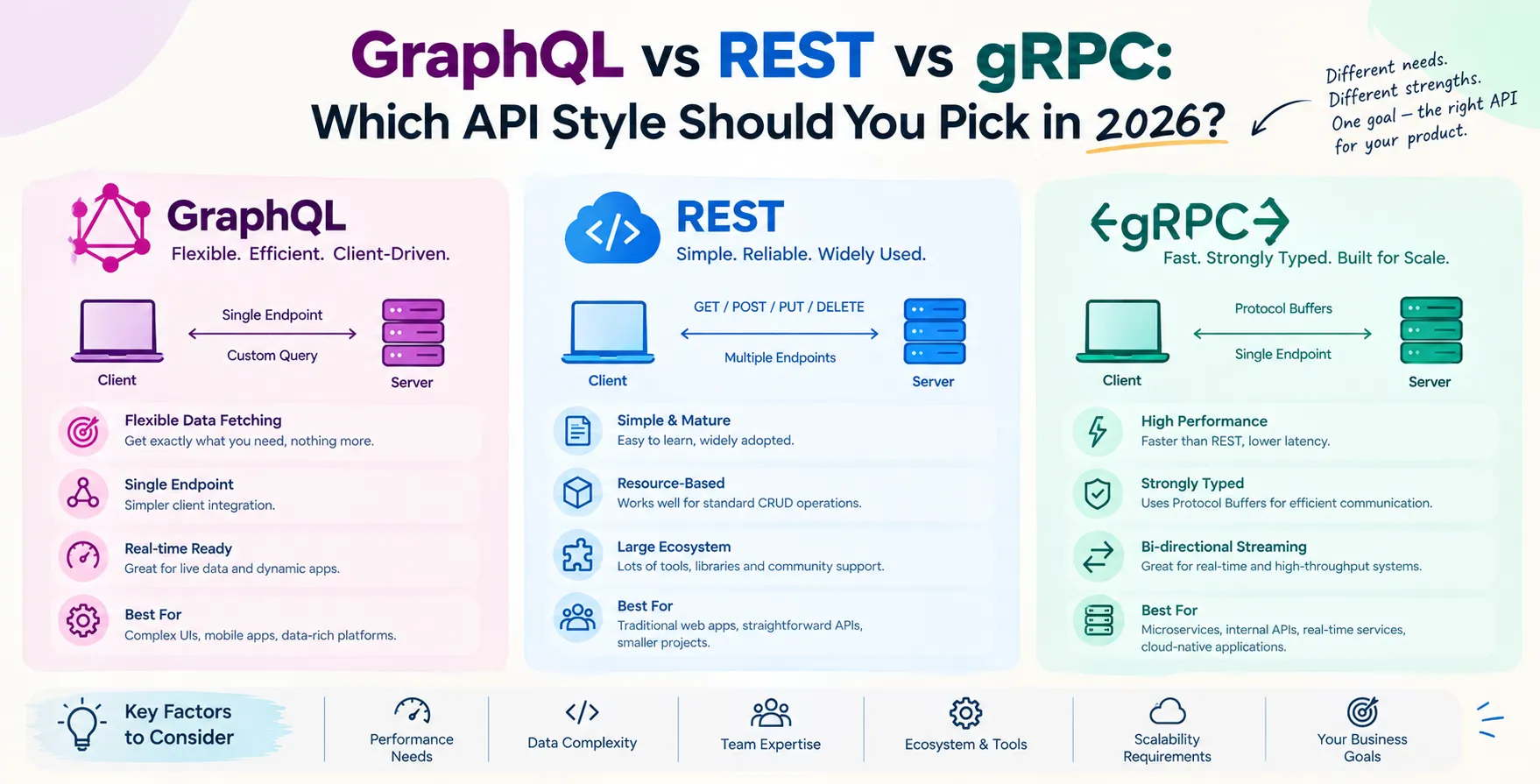
In 2026, developers primarily choose between three dominant communication paradigms: REST, GraphQL, and gRPC. Evaluating GraphQL vs REST vs gRPC requires analyzing payload sizes, latency requirements, and system complexity.
Understanding REST API Architecture
REST remains the architectural baseline for web services today. It relies on standard stateless HTTP operations to manipulate resource-based URIs.
Because REST leverages standard HTTP status codes and caching header mechanisms, web browsers integrate seamlessly with it. Developers understand its resource-oriented concepts without needing steep learning curves.
Adhering to proper REST API design ensures predictable endpoints across web platforms. Horizontal scaling remains simple because backend servers process incoming requests statelessly.
Understanding GraphQL Architecture
GraphQL redefines client-server interactions by placing data fetching control directly in the client application's hands. Clients execute declarative queries against a single server endpoint to retrieve precise data structures.
This approach eliminates server-side over-fetching and under-fetching issues completely. Front-end teams can adjust UI data components without waiting for backend engineers to build custom endpoints.
- Eliminates unnecessary data transfers
- Provides strongly typed schema contracts
Understanding gRPC Architecture
gRPC is an open-source, high-performance framework originally designed by Google for low-latency communication. It uses HTTP/2 for transport and Protocol Buffers as its interface definition language and binary serialization mechanism.
By default, gRPC enforces strict contract-first development between connected systems. Distributed services exchange compact binary payloads rather than human-readable text formats.
This reliance on HTTP/2 enables multiplexed connections, streaming data capabilities, and significantly reduced serialization overhead.
Core Architectural Comparison
Comparing these three technologies highlights trade-offs between serialization format, protocol requirements, and coupling flexibility.
| Feature |
REST |
GraphQL |
gRPC |
| Protocol |
HTTP/1.1 or HTTP/2 |
HTTP/1.1 or HTTP/2 |
HTTP/2 exclusively |
| Data Format |
JSON, XML, Plain Text |
JSON |
Protocol Buffers (Binary) |
| Data Fetching |
Fixed server endpoints |
Declarative client queries |
Strict remote procedure calls |
| Network Style |
Request-Response |
Request-Response, Subscriptions |
Unary, Client/Server/Bi-directional Streaming |
| Contract Style |
Optional (OpenAPI/Swagger) |
Mandatory Schema (GraphQL SDL) |
Mandatory Contract (.proto files) |
Performance and Data Transport Dynamics
When evaluating GraphQL vs REST API performance, data payload sizes and network transport protocols play crucial roles. Text-based JSON formats used in REST and GraphQL incur parsing overhead on CPU-bound applications.
gRPC avoids JSON parsing costs entirely by encoding messages into compact binary payloads. Furthermore, multiplexed HTTP/2 streams allow gRPC to handle hundreds of concurrent calls over a single TCP connection.
- Binary serialization drastically cuts raw byte overhead
- HTTP/2 multiplexing reduces TCP connection congestion
- GraphQL minimizes network round-trips via unified requests
- REST endpoints cause multiple sequential network calls
- Protobuf deserialization executes significantly faster than JSON
Best Use Cases for REST APIs
Despite newer alternatives, REST remains the ideal choice for public APIs and third-party developer integrations. Its reliance on simple HTTP primitives ensures universal compatibility across all browser environments.
Additionally, standard web infrastructure components like HTTP caches, edge proxies, and API gateways handle REST traffic natively.
- Public web APIs for third-party developer access
- Standard CRUD applications with simple entity models
- Applications relying heavily on HTTP edge caching
- Projects prioritizing fast initial setup and broad tooling
Best Use Cases for GraphQL
GraphQL excels in data-rich applications where client devices demand varied data views from aggregated backend services. Mobile apps operating on constrained networks benefit greatly from fetching exact data fields in single queries.
Frontend developers can iterate rapidly on complex user interfaces without backend teams continually modifying API response payloads.
- Mobile applications running on variable mobile networks
- Dashboard applications requiring multi-source data consolidation
- Rapidly evolving frontend interfaces with varying data demands
- Microservice aggregation layers serving disparate web clients
- Minimizing network battery consumption on handheld devices
- Real-time event subscriptions over WebSockets
Best Use Cases for gRPC in Microservices
When evaluating gRPC vs REST vs GraphQL for microservice architecture, gRPC offers massive efficiency gains for internal service communication. Distributed microservices demand microsecond latency, strict schema validation, and high throughput.
Using gRPC for internal East-West traffic keeps serialization light while enforcing compile-time safety across multi-language backend repositories. Preventing software architecture decay becomes easier when contracts are strictly specified in binary format.
Reducing technical debt in software development requires selecting strong serialization tools that prevent breaking changes across service boundaries.
API Security Considerations
Securing network communication requires strict application of api security best practices regardless of your selected protocol format. Each API style introduces unique security boundaries that development teams must actively defend.
For instance, GraphQL requires strict query depth limits and cost analysis to protect servers against malicious, deeply nested queries. REST relies on proven OAuth2 protocols, while gRPC mandates HTTP/2 transport-layer encryption alongside mutual TLS authentication.
- REST utilizes standardized JWT token validation patterns
- GraphQL requires field-level authorization and depth limiting
- gRPC mandates strict transport security and channel encryption
API Testing and Developer Tooling
Developing reliable software systems requires leveraging dedicated api testing tools to validate payloads and edge cases. Mocking endpoints and inspecting network payloads varies significantly depending on your chosen API architecture.
REST benefits from decades of community mature tooling like Postman and OpenAPI generators. GraphQL offers interactive browser-based IDEs like GraphiQL, whereas gRPC testing requires specialized gRPC reflection tools to inspect binary Protobuf messages.
- Postman simplifies HTTP and REST API contract testing
- GraphiQL provides instant schema discovery and query linting
- BloomRPC enables intuitive binary gRPC payload inspection
- Automated CI testing tools prevent contract regression bugs
Decision Matrix: Architectural Choice
Choosing between a REST vs GraphQL vs gRPC API strategy depends on your primary integration boundary and client audience.
Public Web Interfaces
Choose REST when building public integration surfaces designed for third-party developers across the web ecosystem.
- Universal HTTP tooling support
- Built-in CDN caching capabilities
Complex Client Applications
Select GraphQL when modern web and mobile frontends require flexible data aggregation across multiple internal microservices.
- Flexible client-side query capabilities
- Unified schema stitching features
Future Trends in API Architecture
Engineering teams increasingly embrace hybrid architecture strategies rather than forcing a single protocol across their entire stack. Modern architectures routinely deploy gRPC for low-latency internal microservices while running GraphQL or REST gateways for external clients.
Automated code generation tools now enable seamless protocol transcoding between incoming REST HTTP requests and backend gRPC RPC calls automatically.
- Automated REST-to-gRPC gateway transcoding pipelines
- WebAssembly proxies enabling direct browser gRPC communication
- Unified schema generators mapping Protobuf to GraphQL SDL
- AI-assisted API schema optimization and breaking-change detection
Conclusion
No single protocol dominates the modern web landscape when choosing between REST, GraphQL, and gRPC in 2026. Every API style offers distinct advantages depending on network constraints, team structures, and system performance goals.
REST remains unmatched for simple public APIs, GraphQL provides supreme flexibility for complex frontend applications, and gRPC powers high-speed microservices. Choosing the right tool for each specific communication layer ensures your software systems remain resilient, fast, and maintainable.


 In collaboration with