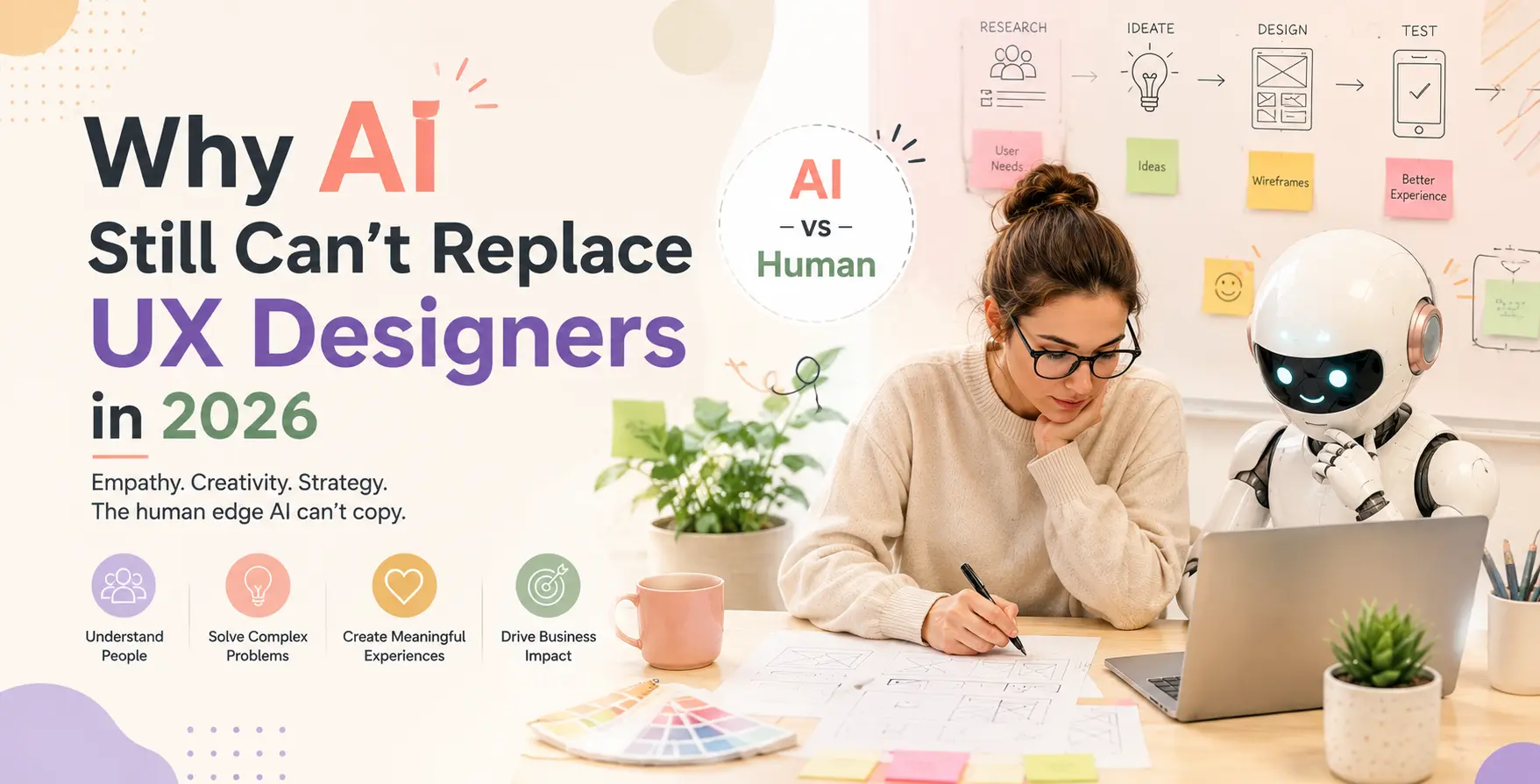
Why AI Still Can't Replace UX Designers in 2026
Table of Contents
- Introduction
- What is AI UX Design?
- Real-Life Example of AI in UX
- How AI UX Design Tools Work
- What Makes Human Designers Unique
- AI vs Human Designers: A Detailed Comparison
- UX Design in the Age of AI
- Limitations of AI in UX Design
- Can AI Replace UX Designers?
- How UX Designers Can Use AI as a Tool
- Future of UX Design
- Conclusion
Introduction
Artificial intelligence is reshaping almost every industry, and design is no exception. In 2026, AI UX Design tools have become more powerful, accessible, and widely adopted than ever before. They can generate wireframes, suggest color palettes, and produce entire user interfaces within seconds.
This speed has triggered a big debate in the design community. Can AI replace UX designers? Many professionals, students, and business owners are genuinely asking whether human designers will remain relevant as AI tools grow more capable.
The short answer is no — and this guide explains exactly why. We will look at how AI works in design, where it truly falls short, and what makes human designers irreplaceable in 2026 and beyond.
- AI tools are advancing rapidly across design workflows
- Human creativity and empathy remain critical to great UX
- Understanding both helps you navigate the future confidently
What is AI UX Design?
AI UX Design refers to the use of artificial intelligence tools to assist or automate parts of the user experience design process. These tools analyze patterns from thousands of existing interfaces, generate layout suggestions, and help designers move faster from concept to prototype.
Popular tools in this category include Figma AI, Adobe Sensei, Uizard, and Galileo AI. Each one targets different parts of the workflow — some help with early-stage ideation, others assist with accessibility checks or content generation.
Despite these capabilities, AI UX Design is best understood as a design assistant, not a designer. It handles volume and speed, but it does not replace the thinking and strategy that drives meaningful user experiences.
- Automates repetitive layout and visual tasks
- Generates multiple design variations quickly
- Supports data analysis and usability testing
Real-Life Example of AI in UX
Here is a practical example to make this concrete. A product team needs to redesign a mobile banking app. They use an AI tool that generates twelve layout options within a few minutes based on common patterns in finance apps.
The AI analyzes existing user data, identifies frequently-used navigation structures, and produces options that look clean and professional. The team saves hours of initial exploration work.
But when the human UX designer reviews these outputs, she immediately spots a problem. The app's primary users are small business owners in their 50s and 60s who are not comfortable with complex dashboards. The AI had no way of knowing this because it was not present in the user research sessions. Every design it generated was technically valid but wrong for this specific audience.
- AI accelerates early-stage design exploration efficiently
- Human context and empathy correct what data alone misses
- User research insight cannot be automated
How AI UX Design Tools Work
AI UX Design tools function by learning from massive datasets of existing interfaces. They identify visual patterns, layout conventions, and interaction models, then use those learnings to generate or suggest new designs.
Most tools rely on machine learning models that improve as more design data is fed into them. Over time, their suggestions become more refined and context-aware within the boundaries of what they have been trained on.
Beyond visual generation, some AI tools also perform automated usability scanning, sentiment analysis on user feedback, and journey mapping based on behavioral data. These features give design teams faster access to insights that would otherwise take significant manual effort.
- Machine Learning: Learns design patterns from large datasets
- Generative AI: Creates visuals and layouts on demand
- Analytics: Processes behavioral and feedback data automatically
What Makes Human Designers Unique
The most important quality that separates human UX designers from AI tools is empathy. Human designers sit with users, listen to their frustrations, observe their behavior, and read emotional cues. This understanding shapes design decisions in ways that no dataset can capture.
Human designers also bring ethical and cultural judgment. They consider who might be left out of a design, whether an interface could cause harm, and how cultural differences affect user expectations. These are nuanced, contextual decisions that require lived human experience.
Beyond empathy and ethics, human designers navigate complex organizational dynamics. They align stakeholders, communicate trade-offs, push back on misaligned requirements, and make judgment calls when data is incomplete. These are deeply human skills that AI tools are not equipped to perform.
- Empathy through direct user observation and interviews
- Ethical and culturally sensitive design judgment
- Stakeholder communication and strategic alignment
- Creative problem-solving beyond known patterns
AI vs Human Designers: A Detailed Comparison
Looking at AI vs Human Designers side by side reveals exactly where each one excels and where each one falls short. Both have real value, but they contribute in fundamentally different ways.
AI is fast, consistent, and tireless. It can process thousands of data points and generate dozens of design variations within minutes. For tasks that involve scale and repetition, AI outperforms humans every time.
Human designers bring strategic depth, emotional intelligence, and the ability to navigate ambiguity. When the brief is unclear, the user's needs are complex, or the ethical stakes are high, human designers are not just helpful — they are essential.
| AI Designers |
Human Designers |
| Fast layout and visual generation |
Strategic and empathetic thinking |
| Pattern-based design output |
Creative problem-solving in new contexts |
| Data-driven suggestions at scale |
Qualitative user research and interviews |
| Consistent and tireless performance |
Cultural, ethical, and inclusive judgment |
| Limited to trained design patterns |
Adapts to entirely new and unknown situations |
UX Design in the Age of AI
UX Design in the Age of AI is not a story of humans vs machines. It is a story of humans using machines to do their best work more efficiently.
In 2026, designers who embrace AI tools are becoming significantly more productive. They spend less time on mechanical tasks like creating multiple layout variations or analyzing raw user data. This frees up their energy for the work that truly matters: understanding users, defining problems clearly, and designing with purpose.
The role of a UX designer is evolving in this environment. Rather than being pure executors of visual design, they are becoming orchestrators of AI-assisted workflows. This shift requires new skills — understanding how to prompt AI tools, evaluate their outputs critically, and know when to trust them and when to override them.
- AI handles mechanical and data-heavy parts of the process
- Humans focus on research, strategy, and meaningful decisions
- The best outcomes come from human and AI collaboration
Limitations of AI in UX Design
Despite impressive capabilities, AI has clear and consistent limitations in UX design. The most significant is the inability to conduct qualitative research. User interviews, contextual observation, and empathy mapping require a human presence that AI tools simply cannot substitute.
AI also lacks genuine creativity in the sense of inventing something new. It generates designs by recombining patterns it has learned from existing work. Human designers, by contrast, can break conventions, challenge assumptions, and create experiences that have no precedent.
Another limitation is handling ethical complexity. AI tools do not understand social context, systemic bias, or the downstream consequences of design decisions. Human designers catch these issues because they bring awareness and responsibility that comes from being part of society.
- Cannot conduct qualitative or empathetic user research
- Generates from patterns rather than inventing truly new ideas
- Lacks the ethical and cultural awareness for sensitive decisions
- Struggles with ambiguous or entirely novel design challenges
Can AI Replace UX Designers?
Let's answer this directly. Can AI replace UX designers? No — not in any meaningful sense, and certainly not in 2026.
AI can generate, iterate, and analyze. It can help designers move faster and test more ideas. But great UX is not measured by the number of screens produced. It is measured by how well a product serves real people with real needs in real contexts. That standard requires human understanding, judgment, and accountability.
What AI will do — and is already doing — is change what UX designers spend their time on. Designers who adapt will find that AI removes the tedious parts of their work and amplifies their highest-value contributions. Designers who resist this shift may find their role becoming smaller, not because AI replaced them, but because they chose not to evolve.
- AI cannot replace human empathy or strategic thinking
- The best UX requires judgment that AI does not have
- Designers who adapt to AI will grow stronger, not weaker
How UX Designers Can Use AI as a Tool
The most practical question for any UX designer today is not whether AI is a threat, but how to use it effectively. There are several clear areas where AI genuinely enhances the design workflow without replacing human value.
AI is excellent for rapid prototyping. Instead of spending hours building wireframes manually, a designer can use AI to generate a starting point and then apply human judgment to refine and improve it. This approach dramatically shortens the time from idea to testable concept.
AI is also useful for analyzing large volumes of user feedback or behavioral data. Rather than reading through hundreds of session recordings manually, designers can use AI to surface key patterns — then apply their own expertise to interpret what those patterns actually mean for the product.
- Use AI for fast wireframing and early-stage exploration
- Let AI process large datasets while you interpret the insights
- Combine AI-generated options with your own creative judgment
- Stay curious and build familiarity with new AI design tools
Future of UX Design
The future of UX design is not a world without designers. It is a world where designers are more capable because they have AI as a partner in their process.
Companies will continue to need human designers who can understand messy and complex problems, communicate clearly with business stakeholders, and take responsibility for the experiences they create. AI will handle the mechanical work while humans lead the vision and the values behind it.
The designers who will thrive are those who combine technical fluency with strong human skills. Empathy, communication, critical thinking, and ethical awareness will become even more valuable as AI tools take over the parts of design that can be automated. The human element in design is not a weakness — it is the most durable competitive advantage a designer can have.
- Designer roles will evolve and expand, not disappear
- Demand for human creativity and empathy will increase
- AI will elevate great designers and raise the overall bar
Conclusion
After exploring every dimension of this topic, the answer is clear. AI UX Design tools are genuinely transforming how designers work — making them faster, more data-informed, and able to explore more ideas. That is a real and positive shift.
But when it comes to AI vs Human Designers, each has a role that the other cannot fill. AI handles speed, scale, and pattern recognition. Humans bring empathy, ethics, strategy, and the ability to navigate the unexpected. Great UX requires both working together.
UX Design in the Age of AI belongs to designers who embrace change without losing sight of what makes design matter: understanding people and solving real problems for them. AI is a powerful tool, but the designer behind it is still the most important part of the equation.
So if you are a UX designer wondering where you stand in 2026, the answer is simple. Learn the tools, keep your empathy sharp, and design with purpose. The future is yours.


 In collaboration with