Table of Contents
- Introduction
- What is Multimodal AI?
- Unimodal AI vs Multimodal AI
- Why Multimodal AI Matters Today
- How Multimodal AI Works
- Primary Input Modalities
- Core Architectural Components
- Real-World Multimodal AI Examples
- Multimodal AI Examples in Enterprise
- Implementation Challenges
- Engineering Best Practices
- Ethical Considerations
- Conclusion
Introduction
Traditional machine learning models processed a single data stream, such as text documents or standalone images. Modern systems now blend visual, textual, and audio data into a unified cognitive architecture.
This shift opens up powerful possibilities for building intelligent software applications. Developers can now deploy software that analyzes complex operational context across multiple sensory inputs simultaneously.
- Processes visual audio and textual context together
- Enables natural machine human interactions
What is Multimodal AI?
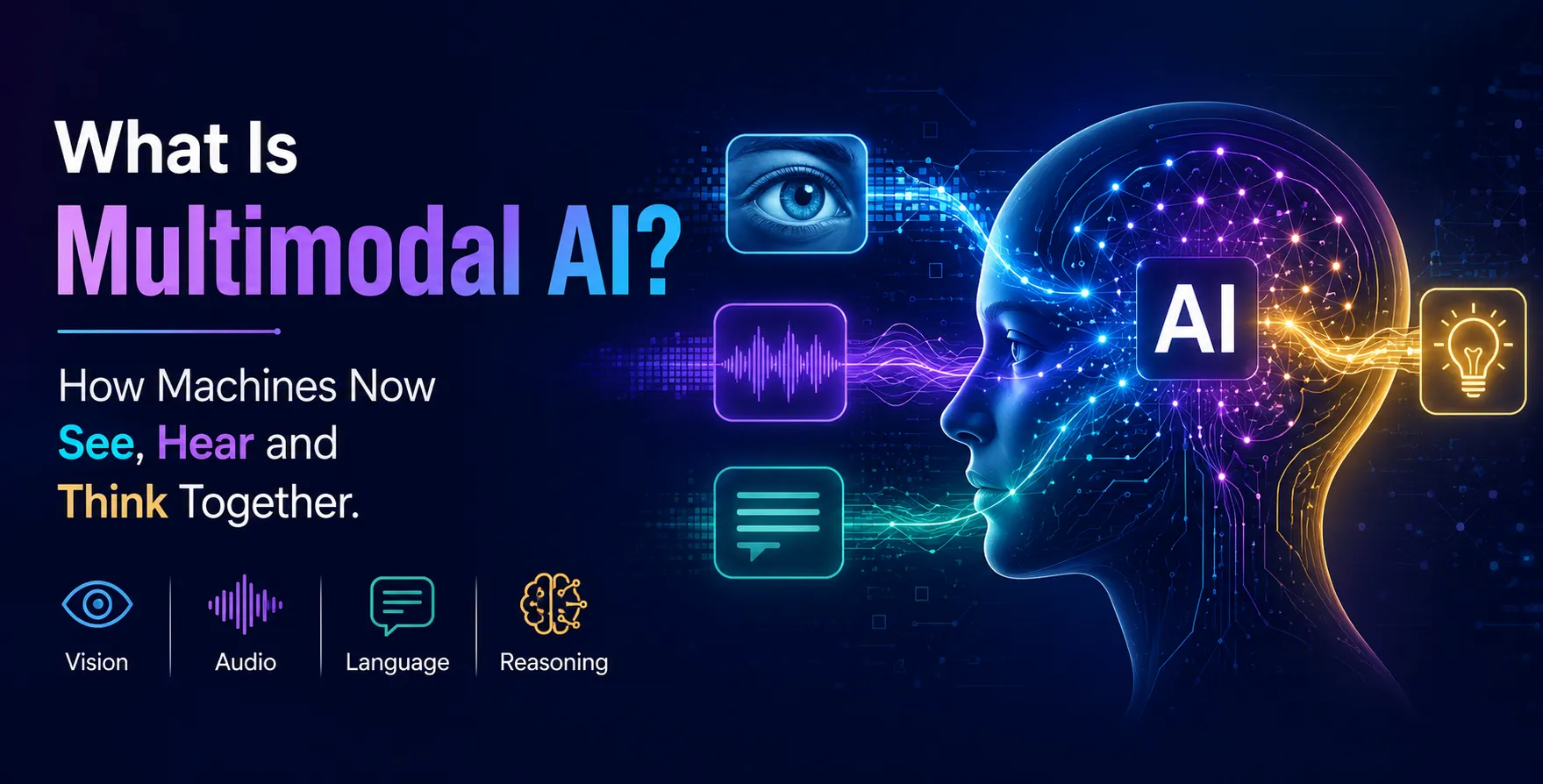
If you ask What is Multimodal AI, it refers to systems built to process and synthesize multiple sensory inputs. Unlike older models, these platforms combine image, text, audio, and sensor data to establish deep contextual context.
Human intelligence relies on multiple senses working together to understand the physical world. Multimodal AI mirrors this natural approach by mapping distinct data sources into a shared mathematical space.
This unified vector space allows software applications to process complex real-world scenarios naturally.
- Combines text visual and audio data
- Maps sensory streams into shared embeddings
- Improves contextual understanding across domains
- Reduces ambiguity in complex data processing
Unimodal AI vs Multimodal AI
Comparing single-input models with multi-input systems highlights why software architecture is evolving rapidly. Unimodal models struggle when critical context lives in a different sensory channel.
| Dimension |
Unimodal AI |
Multimodal AI |
| Data Inputs |
Single modality text or image |
Multiple combined modalities |
| Context Depth |
Limited to one format |
Rich cross modal context |
| Ambiguity Handling |
Prone to misinterpretation |
Resolves ambiguity using extra signals |
| System Complexity |
Lower engineering overhead |
Higher infrastructure demands |
| Accuracy Rate |
Moderate in complex tasks |
High across complex workflows |
| Use Case Range |
Niche single purpose tools |
Broad enterprise platforms |
Why Multimodal AI Matters Today
Modern enterprises generate massive volumes of unstructured data across diverse formats every single day. Cross-modal reasoning enables software systems to extract actionable intelligence from these scattered data silos without human manual effort.
Single-stream processing models often fail when interpreting real-world business workflows. Customer support tickets, medical records, and industrial logs contain screenshots, voice clips, and text that must be processed together for accurate decisions.
How Multimodal AI Works
Understanding How Multimodal AI works requires looking at how raw sensory inputs travel through neural pipelines. Raw inputs undergo preprocessing before reaching deep learning encoders built for specific data types.
- Raw data streams undergo channel specific encoding
- Vectors get projected into shared embedding space
- Attention mechanisms align features across modalities
- Decoders generate final output actions or predictions
This structured pipeline allows models to weigh inputs based on signal clarity. If visual data is noisy, the system relies more heavily on text or audio streams.
Primary Input Modalities
Architects design systems to ingest distinct types of data depending on business needs. Modality fusion relies on combining these individual sensory streams effectively.
- Textual documents and conversational scripts
- High resolution images and video frames
- Speech audio and environmental soundscapes
- Structured tabular metric time series data
- Spatial depth and sensor telemetry vectors
Combining these distinct modalities creates resilient production systems capable of handling real-world chaos.
Core Architectural Components
Building scalable systems requires robust neural network designs. Encoder networks handle early feature extraction for each input type.
Early Fusion Architectures
Early fusion combines raw features right after initial extraction. This approach works best when data streams are perfectly synchronized.
- Merges raw vectors immediately
- Requires tight input synchronization
However early fusion increases training complexity when dealing with missing data channels.
Late Fusion Architectures
Late fusion processes each modality independently through specialized neural sub-networks. Individual predictions are then combined at decision time.
- Processes streams in isolated branches
- Handles missing modalities gracefully
- Simplifies model debugging and maintenance
- Offers modular scaling across infrastructure
Late fusion remains the preferred pattern for complex production software platforms.
Real-World Multimodal AI Examples
Examining Multimodal AI examples shows how these systems transform real business operations today. Companies combine visual recognition with natural language processing to automate high-friction operational tasks.
- Automated medical diagnostic report generation systems
- Autonomous vehicle navigation and hazard detection
- Ecommerce visual search with text filtering
- Real time video content moderation analysis
- Industrial robotics with tactile visual feedback
- Smart security cameras with audio event detection
These implementations demonstrate how multi-sensory intelligence solves complex real-world operational problems.
Multimodal AI Examples in Enterprise
Enterprise platforms leverage these capabilities to overhaul internal workflows and customer-facing products. Enterprise automation gains a massive efficiency boost when systems parse mixed document types seamlessly.
- Claims processing combining damage photos and text
- Contract analysis matching signature images with text
- Customer support routing using voice and chat
- Quality control using thermal imaging and logs
Organizations adopting these patterns significantly reduce manual document processing bottlenecks.
Implementation Challenges
Deploying multi-sensory models into production introduces significant technical hurdles for software engineering teams. Latency management becomes critical when inference pipelines must process heavy video streams alongside text payloads in real time.
Data alignment presents another massive obstacle during dataset preparation and training phases. Audio tracks, video frames, and text timestamps must align perfectly to prevent neural network hallucination or inaccurate vector projections.
Engineering Best Practices
Senior developers follow established design patterns to maintain stable production environments. Model optimization ensures low-latency execution across distributed cloud networks.
- Implement asynchronous data ingestion pipelines
- Apply quantization to lower memory overhead
- Utilize late fusion for modular maintenance
- Cache frequent vector embeddings at edge nodes
- Establish fallback unimodal branches for resilience
Following these best practices keeps production pipelines resilient under heavy system loads.
Ethical Considerations
Multi-sensory models raise unique governance and privacy concerns that engineering teams must address directly. Biometric protection requires strict safeguards when handling combined voice, face, and text data streams.
Deepfake generation risks increase when models master synthetic video and voice generation simultaneously. Security teams must implement watermark verification and origin tracking to mitigate potential malicious misuse of multi-modal tools.
Conclusion
Multi-sensory artificial intelligence represents a fundamental shift in how software interacts with human environments. By processing visual, textual, and audio data in parallel, software applications achieve unprecedented contextual accuracy.
Building these platforms requires thoughtful architecture, robust data pipelines, and strong governance frameworks. Engineering teams that master these skills today will shape the next decade of intelligent software engineering.


 In collaboration with