Table of Contents
- Understanding Software Supply Chain Security
- The Role of npm Package Provenance
- Why JavaScript Supply Chain Security Matters
- How Provenance Attestations Work
- Verifying Packages in Your CI/CD Pipeline
- Benefits of Using Provenance
- Common Risks in Dependency Management
- Mitigating Risks with Build Information
- Setting Up Provenance for Your Own Packages
- Comparing Manual vs Automated Verification
- Best Practices for Secure Dependency Management
- Tools for Supply Chain Visibility
- Conclusion
Understanding Software Supply Chain Security
Modern software development relies heavily on open-source libraries to speed up delivery. While this practice is efficient, it introduces significant risks if your dependencies are compromised. A single malicious package can compromise your entire infrastructure.
We must treat third-party code as a potential attack vector. By implementing robust JavaScript software supply chain security, teams can gain confidence in the integrity of the code they pull into their projects. It is no longer enough to trust that a package is safe simply because it is popular.
Security teams are increasingly looking for ways to verify where code came from. This shift is critical for maintaining high standards of quality and safety in production environments.
- Reduces risk of malicious injection
- Increases trust in third-party libraries
- Ensures code integrity
- Supports internal security audits
The Role of npm Package Provenance
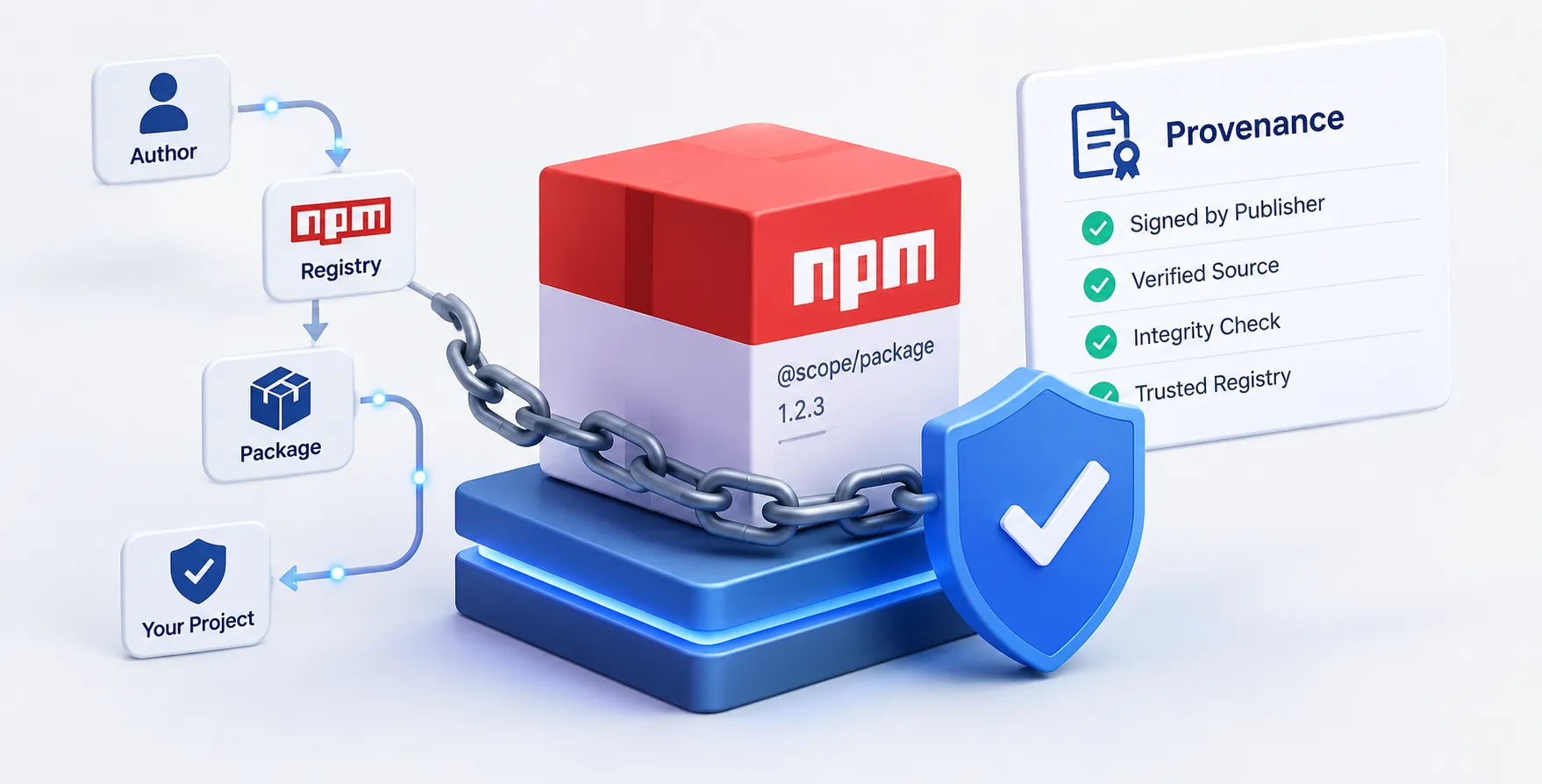
The core concept behind npm package provenance is to provide a verifiable link between a package version and the CI/CD workflow that built it. It acts as a digital proof of origin. Without this, you are effectively installing code without knowing if it was tampered with after being built.
These attestations are cryptographically signed. They allow users to verify that a specific version of a package was produced by a trusted build pipeline, not a developer's local machine. This is a massive leap forward for the ecosystem.
When you verify these claims, you ensure that the code you run in production matches the code that was officially built. This prevents attackers from publishing malicious versions of legitimate packages.
- Cryptographic verification of build origins
- Prevention of local-build tampering
- Increased transparency for consumers
- Automatic validation in supported tools
Why JavaScript Supply Chain Security Matters
JavaScript projects often pull in thousands of transitive dependencies. Managing this complexity is a major challenge for modern engineering teams. If even one of those packages is compromised, the impact can be devastating to your application.
Attackers often target popular packages to distribute malicious payloads. By compromising a build pipeline, they can inject code that goes unnoticed by maintainers. This is why verifying the entire pipeline is essential for enterprise security.
Ignoring these threats is no longer an option. As the landscape evolves, relying on simple version numbers is insufficient. We need deeper insights into the provenance of every single dependency.
Types of Supply Chain Attacks
Attackers use various methods to compromise projects. Understanding these vectors helps in planning your defense strategy.
- Dependency confusion attacks
- Typosquatting in public registries
- Compromised developer credentials
- Malicious CI/CD pipeline access
Each of these threats requires a different detection approach. A layered defense is always the most effective strategy.
How Provenance Attestations Work
At a technical level, npm provenance attestations leverage technologies like Sigstore. When a package is published, the build platform generates a signed document containing the build source and provenance details. This document is linked to the specific package version on the npm registry.
Developers can use the npm CLI to verify these attestations automatically. If a package lacks valid provenance, the CLI can be configured to warn or fail the installation process. This creates a gatekeeper for your dependencies.
The system is designed to be transparent and auditable. You do not need to trust the maintainer blindly anymore. You can verify the claims against a public transparency log.
Verifying Packages in Your CI/CD Pipeline
Integrating security checks into your automated workflows is the best way to scale. You should configure your CI/CD pipeline to reject any dependencies that do not provide verifiable provenance. This ensures that every build is consistent and secure.
Modern testing workflows can automate this validation step. By making it part of your standard process, you remove the burden of manual verification from individual developers. It becomes a standard quality gate.
Consistency across your projects is vital. Ensure that every environment uses the same strict policies for dependency validation. This prevents security gaps between development, staging, and production environments.
- Block unsigned or unverified packages
- Log all verification failures for auditing
- Standardize security policies across teams
- Use automated alerts for missing attestations
Benefits of Using Provenance
Implementing these security measures provides clear advantages. It reduces the likelihood of shipping malicious code to your customers. It also simplifies the compliance process by providing a clear audit trail of where your code originated.
Developers also benefit from a more predictable ecosystem. Knowing exactly what was built and how it was built removes ambiguity. This leads to faster debugging and more reliable release cycles.
Ultimately, this technology shifts the responsibility of security from the consumer to the producer. It empowers maintainers to prove the legitimacy of their work. This fosters a healthier open-source community.
| Feature |
Traditional npm Install |
Verified Provenance |
| Verification |
Registry check only |
Cryptographic attestation |
| Trust Model |
Blind trust |
Verifiable proof |
| Security |
Low |
High |
| Build Source |
Unknown |
Known CI/CD pipeline |
| Tamper Proofing |
None |
Built-in |
Common Risks in Dependency Management
Dependency management is filled with hidden dangers. Even with tools to check for known vulnerabilities, zero-day threats in the build pipeline remain a major concern. Attackers are constantly finding new ways to exploit the trust developers place in registries.
Many teams fail to audit their dependencies regularly. This leads to "dependency bloat" and increased attack surfaces. Every package you add is a liability that you must manage and monitor over its entire lifecycle.
Keeping dependencies updated is not enough. You must also ensure that the updates themselves are legitimate. Provenance is the key to closing this specific gap in your security posture.
Mitigating Risks with Build Information
Information is your best weapon against supply chain threats. By having access to build metadata, you can perform better risk analysis on your dependencies. This data allows you to make informed decisions about which packages to include in your stack.
You should treat build information as part of your overall security documentation. Knowing the provenance of your dependencies is essential for responding to incidents quickly. If a vulnerability is found, you know exactly where to look.
This level of detail is also useful for maintaining compliance. It provides evidence that you are taking active steps to secure your application. This is especially important for teams subject to external audits.
- Maintains clear audit logs
- Provides context for security incidents
- Simplifies compliance reporting
- Enhances overall risk visibility
Setting Up Provenance for Your Own Packages
If you are a package maintainer, publishing with provenance is a service to your users. You can enable this by using GitHub Actions or other supported CI platforms. It is a straightforward process that adds immediate value to your project.
Once enabled, your future releases will be automatically signed. This signals to your consumers that you take security seriously. It helps build trust and increases adoption rates for your software.
Take the time to document your build process. Transparency helps your users understand the measures you are taking to protect them. It is a win-win for everyone involved.
Comparing Manual vs Automated Verification
Manual verification is prone to human error and simply does not scale. You cannot expect developers to manually audit the provenance of dozens of dependencies every time they run an install command. Automation is mandatory.
Automated tools can run as part of your local development environment and your remote CI/CD pipelines. They act as a silent guard, ensuring that only trusted code makes it into your project. This allows your team to focus on building features.
Choosing the right approach depends on the size of your team and your security requirements. However, automation should always be the end goal for any serious project. It provides consistent enforcement of your security policies.
Best Practices for Secure Dependency Management
Security is a continuous process that requires vigilance. Establish clear policies for how dependencies are added, updated, and removed from your projects. Document these policies and ensure everyone on the team understands them.
Regularly prune your dependency tree to remove unused packages. The fewer dependencies you have, the smaller your attack surface. This reduces the work required to maintain and verify your software supply chain.
Stay informed about the latest security developments in the ecosystem. New tools and standards emerge frequently. Being proactive rather than reactive is the hallmark of a mature engineering team.
- Regularly update your dependencies
- Implement automated security scanning
- Use lockfiles for consistency
- Audit dependencies for unused code
- Enforce provenance verification globally
Tools for Supply Chain Visibility
Several tools exist to help you gain visibility into your dependencies. Use them to identify which of your packages support provenance and which do not. This will highlight where your current security gaps are.
Don't rely on a single tool. Use a combination of scanners, dependency managers, and registry analysis tools. This multi-layered approach ensures that you have a comprehensive view of your project's health.
Your security strategy must include these tools as a foundational element. Without them, you are flying blind in an increasingly complex and hostile digital landscape. Invest in the right infrastructure today.
Conclusion
Securing your supply chain is an essential responsibility for every modern developer. By leveraging npm package provenance, you can ensure the integrity of your code and protect your users from malicious actors. The shift towards verifiable build attestations is a significant improvement for the JavaScript ecosystem.
Start by auditing your current dependencies and implementing automated checks in your CI/CD pipelines. Remember that security is not a one-time setup but a continuous commitment to best practices. Use the tools available to you and stay informed about the latest developments.
As we move forward, the ability to verify the origins of our code will become a standard requirement. By taking action now, you position your team ahead of the curve. Keep your dependencies secure, transparent, and verifiable.


 In collaboration with