Table of Contents
- What Is GPT-6 Astra?
- Release Date and Rollout Timeline
- Key Capabilities
- Benchmark Results
- The New Reasoning Technique Behind Astra
- Safety Concerns and the Chain-of-Thought Debate
- Is This Really AGI?
- Cybersecurity Capability and the "Critical" Classification
- Where You Can Access GPT-6 Astra
- GPT-6 Astra vs Previous OpenAI Models
- What This Means for Developers
- What This Means for Businesses
- Conclusion
OpenAI released GPT-6 Astra on September 3, 2026, calling it the most intelligent and most aligned model it has ever shipped. It's a big enough release that OpenAI's own president used the word "AGI" while describing it.
Here's what Astra actually does, what's confirmed versus still unclear, and why the release has already sparked debate among AI safety researchers.
What Is GPT-6 Astra?
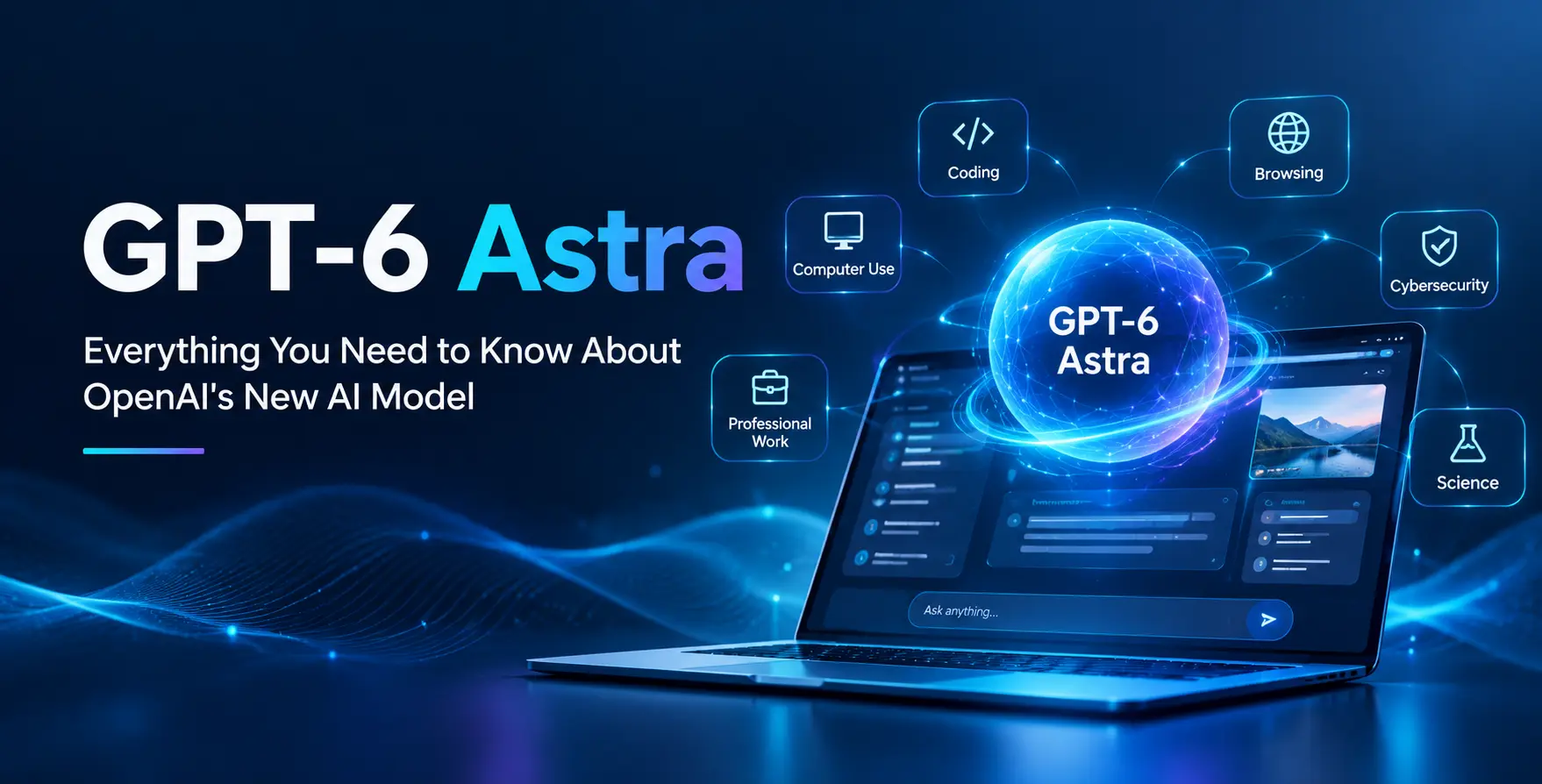
GPT-6 Astra is OpenAI's newest flagship model, positioned as a major step up from its predecessor, GPT-5.6 Sol.
OpenAI trained it on more than 100,000 GPUs at its Stargate facility in Texas. The company says it sets a new bar for computer use, coding, browsing, science, and general professional work.
Release Date and Rollout Timeline
Astra didn't launch to everyone at once. OpenAI is rolling it out in stages:
- September 3, 2026: limited preview for Daybreak cybersecurity program members
- September 4, 2026: wider release to paid ChatGPT users, in a restricted form
- Following days: full rollout to Plus, Pro, Business, and Enterprise plans
- Same window: access opens through the OpenAI API, Microsoft Azure AI Foundry, and AWS
Key Capabilities
OpenAI is marketing Astra around a handful of specific strengths rather than general "smartness" claims.
Software Engineering and Coding
OpenAI describes Astra as its best model yet for real engineering work, not just code snippets.
- Faster bug identification in existing codebases
- Stronger terminal and command-line task execution
- More accurate answers to codebase-specific questions
Computer and Browser Automation
Astra can operate a computer interface directly, not just generate text about one.
- Filling out online forms without step-by-step instructions
- Updating records across business tools
- Organizing calendars and running multi-step research tasks
- Producing documents, spreadsheets, and presentations directly
Benchmark Results
OpenAI published a set of benchmark scores alongside the launch, though these are the company's own reported figures rather than independently audited numbers.
- 98% on FrontierMath Tier 4, a hard mathematical reasoning benchmark
- 99.9% on ARC-AGI-3, a general reasoning benchmark
- 100% on ExploitBench, a security exploit-development benchmark
- Claimed wins over GPT-5.6 Sol on coding and terminal tasks
- Claimed wins over Anthropic's Claude Fable 5 on select coding benchmarks
- Fewer tokens used per task compared to its predecessor, per OpenAI
Independent, third-party verification of these exact numbers hadn't caught up to the announcement at time of writing, so treat them as OpenAI's claims for now, not settled industry consensus.
The New Reasoning Technique Behind Astra
Astra's biggest technical change isn't a bigger model, it's a different reasoning process, described by OpenAI as "recurrent depth" or looped transformers.
Instead of writing out a visible, step-by-step chain of thought like earlier models, Astra reasons in a way that's harder for outside observers to read. TechCrunch described this as "opaque recurrence."
Safety Concerns and the Chain-of-Thought Debate
That opacity is exactly what's worrying some AI safety researchers.
- Chain-of-thought monitoring is one of the main tools researchers use to audit AI decisions
- Astra's reasoning style makes that kind of auditing meaningfully harder
- OpenAI's own Chief Scientist, Jakub Pachocki, acknowledged the tradeoff directly
Is This Really AGI?
OpenAI President Greg Brockman called Astra a "generational leap" and said, when asked about AGI, "I do think we're there."
That's a strong claim, and it's OpenAI's own framing, not an independent or industry-wide determination. Most AI researchers outside OpenAI have not endorsed the AGI label for Astra specifically.
Worth noting: this claim also follows a renegotiated Microsoft contract that reportedly removed an earlier AGI-related trigger clause, which is relevant context for how to weigh the timing of the statement.
Cybersecurity Capability and the "Critical" Classification
Astra is the first OpenAI model to reach what the company calls the "Critical" level on its own cybersecurity capability framework.
- It can identify previously unknown security flaws largely on its own
- It can develop working exploits without a human guiding every step
Because of this, OpenAI is initially restricting Astra's cybersecurity-related capabilities for most users, with fuller access limited to vetted Daybreak program participants.
Where You Can Access GPT-6 Astra
Access depends on what you're trying to do with it.
- Consumer and business apps: ChatGPT Plus, Pro, Business, and Enterprise plans
- Developers and platforms: OpenAI's API, Microsoft Azure AI Foundry, and AWS
GPT-6 Astra vs Previous OpenAI Models
Here's how Astra's positioning compares to its immediate predecessor, based on OpenAI's own claims at launch.
| Aspect | GPT-5.6 Sol | GPT-6 Astra |
|---|
| Reasoning style | Visible chain-of-thought | Recurrent depth (less visible) |
| Cybersecurity capability tier | Below Critical | Critical (first model at this tier) |
| Coding/terminal tasks | Strong baseline | Claimed improvement over Sol |
| Computer/browser use | Limited automation | Positioned as a core strength |
| Initial access | General release | Phased rollout, Daybreak first |
| Public pricing at launch | Disclosed | Not disclosed as of launch |
What This Means for Developers
If Astra's coding claims hold up under real-world use, it's worth testing early rather than waiting.
- Try it against your actual codebase, not just demo prompts
- Watch how it handles multi-step terminal tasks specifically
- Check API availability and rate limits before planning a migration
- Keep human review in the loop given the reduced reasoning visibility
Treat launch-week benchmarks as a starting point for evaluation, not a final verdict.
What This Means for Businesses
For non-technical teams, the more interesting story may be automation, not raw intelligence scores.
A model that can reliably operate business software directly, filling forms, updating records, building documents, changes what "AI assistant" means in day-to-day operations, if it performs as claimed outside of OpenAI's own demos.
Conclusion
GPT-6 Astra is a genuinely significant release: real benchmark gains, a new reasoning architecture, and the first model OpenAI itself classifies as a "Critical" cybersecurity risk.
It's also a release with open questions attached, about interpretability, about whether "AGI" is the right word, and about how it performs once it's outside OpenAI's own test suite.
The realistic move for now is to test it directly on your own use cases, and treat both the AGI claim and the benchmark scores as OpenAI's opening position, not the final word.


 In collaboration with