Table of Contents
- Understanding Recent Django Security Updates
- The Importance of Patching
- Analyzing the Latest CVE Fixes
- Django 6.1.2 Release Details
- Django 6.0.9 Release Details
- Django 5.2.18 Release Details
- Django Security Upgrade Checklist
- Testing Your Infrastructure Post-Upgrade
- Common Challenges During Security Upgrades
- Why Timely Maintenance Matters
- Best Practices for Ongoing Security
- Verifying Your Patch Success
- Engaging Professional Maintenance Teams
- Conclusion
Understanding Recent Django Security Updates
Software security is a moving target that requires constant vigilance. The Django team recently published critical patches to address newly discovered vulnerabilities across multiple supported versions.
These updates are essential for any team maintaining production-grade applications. Ignoring these fixes exposes your infrastructure to potential exploitation and data integrity risks.
The Importance of Patching
Security patches are not optional for enterprise-grade software. When a known vulnerability is disclosed, bad actors quickly work to weaponize that knowledge.
Applying a Django security release promptly is the best defense against automated attacks. These patches are carefully engineered to minimize disruption while maximizing your defensive posture.
- Prevents unauthorized data access
- Mitigates common injection vulnerabilities
- Ensures compliance with industry standards
- Maintains system stability
- Protects against session hijacking
Analyzing the Latest CVE Fixes
The Django CVE fixes October 2026 address specific weaknesses in request handling and data processing. By understanding these vulnerabilities, developers can better secure their application layers.
These fixes are bundled into the latest versions to ensure that all supported environments remain hardened. Always check the official release notes for specific technical details regarding the impact of these changes.
Django 6.1.2 Release Details
The 6.1.2 release is a targeted effort to improve the security of the newest branch. It incorporates fixes that were identified during recent audits of the framework core.
Developers working with the bleeding edge of the framework should prioritize this update immediately. It provides stability and security improvements without requiring major architecture shifts.
- Patching internal request sanitization
- Addressing edge cases in validation
- Improving overall framework hardening
Django 6.0.9 Release Details
The 6.0.9 release provides critical backports for users of the stable 6.0 branch. It ensures that the security improvements found in newer versions are applied to stable production environments.
Maintaining your codebase with this release is a non-negotiable step for teams relying on 6.0. Always verify your current version before executing the upgrade commands.
Django 5.2.18 Release Details
The 5.2.18 release demonstrates the project's commitment to long-term support. Even as newer versions emerge, security remains the top priority for all active branches.
If you are still running 5.2.x, this release is mandatory to ensure your application does not fall behind on known security fixes. It is a stable, reliable patch designed for minimal deployment friction.
Django Security Upgrade Checklist
A structured approach to patching prevents common deployment errors. Following a strict sequence allows you to roll back if unforeseen issues arise during the process.
- Backup your database and static assets
- Review the official release notes for breaking changes
- Update your requirements file with the latest version
- Run your entire test suite to ensure compatibility
- Deploy to a staging environment before production
- Monitor application performance logs after the rollout
Testing Your Infrastructure Post-Upgrade
Automated testing is your safety net after any framework update. You must ensure that your existing business logic remains intact after the new dependencies are installed.
Focus on authentication flows and data input validation during your verification phase. These areas are often the primary targets for the vulnerabilities being patched in these updates.
| Action |
Standard Procedure |
Security Priority |
| Environment Update |
Development first |
Staging verification |
| Dependency Audit |
Check version constraints |
Audit for vulnerabilities |
| Regression Testing |
Run unit tests |
Validate security patches |
| Deployment |
Blue-green deployment |
Immediate rollout |
| Post-Flight Check |
Monitor error rates |
Review security logs |
Common Challenges During Security Upgrades
Dependencies often cause friction when updating core frameworks. You might find that a third-party package relies on an older, incompatible version of Django.
Careful version management is required to resolve these conflicts. Do not compromise security by delaying an upgrade just because a minor package needs a configuration tweak.
- Dependency version conflicts
- Breaking changes in minor releases
- Custom authentication backends
- Legacy database migrations
- Environment configuration mismatches
Why Timely Maintenance Matters
Proactive maintenance is a core tenet of robust software engineering. Treating your application as a living entity that requires regular care prevents long-term technical debt.
Neglected systems are significantly harder to upgrade when a critical security event occurs. Consistent, incremental updates are always safer than massive, emergency migrations performed under pressure.
Best Practices for Ongoing Security
Security is a culture rather than a single task. Implement regular automated scans of your dependencies to stay ahead of known vulnerabilities in your stack.
Ensure your team is signed up for official security announcements. Being informed allows you to schedule maintenance before the public disclosure of a high-risk exploit.
Verifying Your Patch Success
Once you have deployed the patch, verify that your environment is running the intended version. Use standard CLI tools to confirm the package version in your production shell.
Checking the environment ensures that your deployment pipeline did not silently fail to update the dependencies. A simple verification step provides significant peace of mind.
Engaging Professional Maintenance Teams
Sometimes the complexity of an enterprise application makes manual upgrades risky. Experienced developers can streamline the process while ensuring zero downtime for your users.
Leveraging external expertise is a smart way to offload the burden of regular maintenance. This allows your internal team to focus on building new features rather than managing infrastructure health.
Conclusion
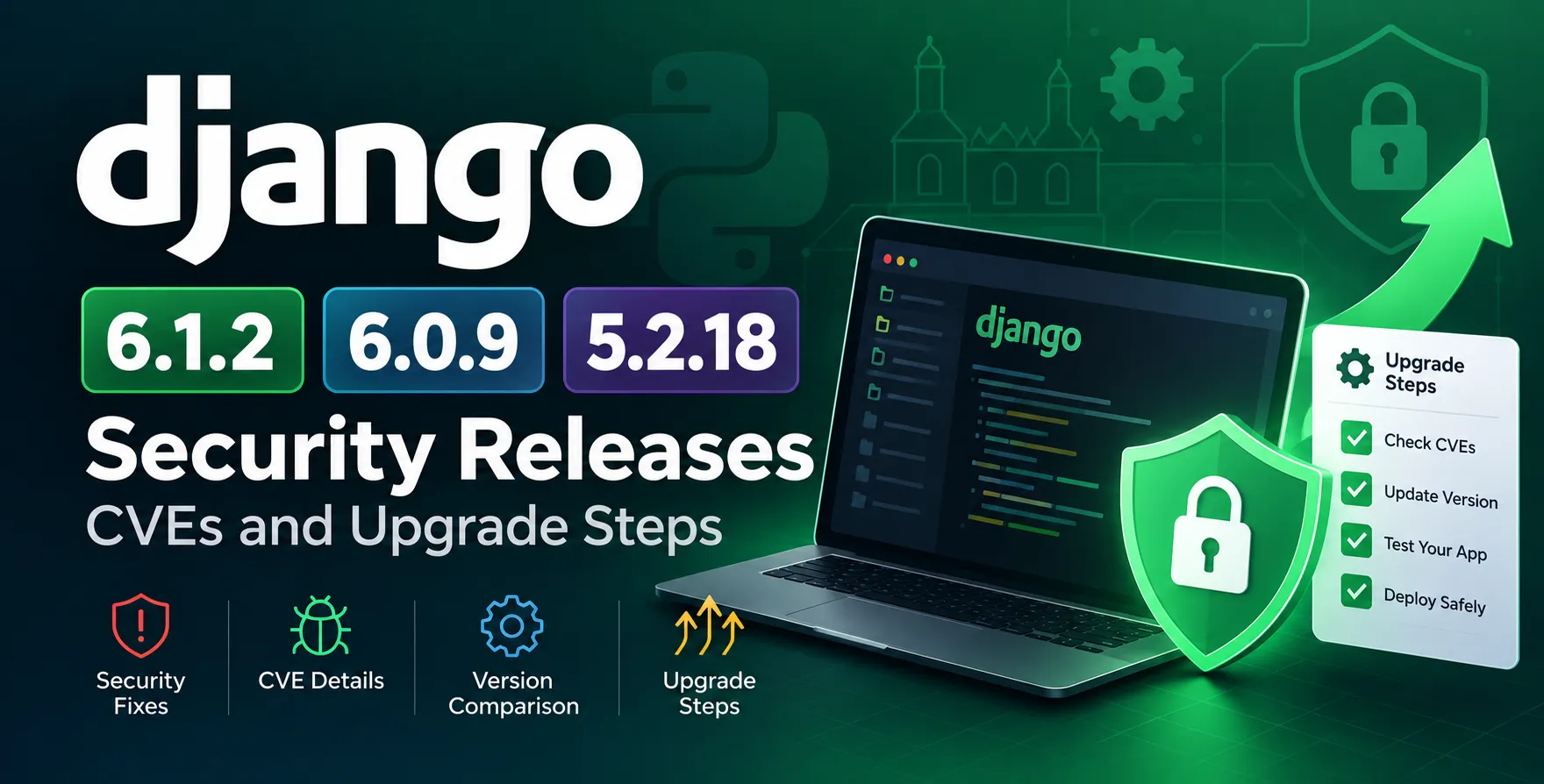
The latest Django 6.1.2, 6.0.9, and 5.2.18 security releases are essential for every developer. By following a clear upgrade path, you protect your application from modern threats while maintaining system stability.
Prioritize these updates in your development schedule to ensure your infrastructure remains secure. When in doubt, utilize a structured checklist to guide your team through a seamless and successful deployment process.


 In collaboration with