Table of Contents
- Introduction to Custom Software and SaaS
- Understanding Custom Software Development
- What are SaaS Solutions?
- Key Benefits of Custom Software
- Advantages of SaaS Solutions
- Custom Software vs SaaS: A Comparison
- Choosing the Right Option for Your Business
- Real-Life Examples of Custom Software and SaaS
- Common Mistakes to Avoid
- Future Trends in Custom Software and SaaS
- Conclusion
- Final Thoughts on Custom Software and SaaS
Introduction to Custom Software and SaaS
Every business is unique, with its own set of challenges and requirements. When it comes to software solutions, businesses have two primary options: custom software development for business and SaaS solutions for businesses.
Custom software is designed to meet the specific needs of a business, while SaaS provides a more generic solution that can be used by multiple businesses.
The choice between custom software and SaaS depends on various factors, including the business's size, budget, and specific requirements.
Understanding Custom Software Development
Custom software development for business involves creating a tailored solution that meets the specific needs of a business. This approach provides businesses with a high degree of flexibility and control over the software development process.
With custom software, businesses can ensure that their software solution is aligned with their overall business strategy and goals.
However, custom software development can be time-consuming and expensive, requiring significant resources and investment.
- High degree of flexibility and control
- Aligned with business strategy and goals
- Can be time-consuming and expensive
What are SaaS Solutions?
SaaS solutions for businesses provide a convenient and cost-effective way to access software applications over the internet. With SaaS, businesses can avoid the upfront costs and complexities associated with custom software development.
SaaS solutions are typically scalable, secure, and easy to use, making them an attractive option for businesses of all sizes.
However, SaaS solutions may not provide the same level of customization and control as custom software.
- Convenient and cost-effective
- Scalable, secure, and easy to use
- Limited customization and control
Key Benefits of Custom Software
Custom software development for business offers several benefits, including increased efficiency, improved productivity, and enhanced competitiveness.
With custom software, businesses can automate manual processes, streamline workflows, and gain real-time insights into their operations.
Additionally, custom software can be integrated with existing systems and applications, providing a seamless user experience.
- Increased efficiency and productivity
- Improved competitiveness
- Streamlined workflows and automation
- Integration with existing systems
- Real-time insights and reporting
Advantages of SaaS Solutions
SaaS solutions for businesses offer several advantages, including reduced upfront costs, faster deployment, and lower maintenance requirements.
With SaaS, businesses can quickly access software applications and start using them immediately, without the need for extensive setup and configuration.
Additionally, SaaS solutions are typically updated and maintained by the provider, freeing up internal resources for more strategic initiatives.
- Reduced upfront costs
- Faster deployment and implementation
- Lower maintenance requirements
- Automatic updates and maintenance
- Scalability and flexibility
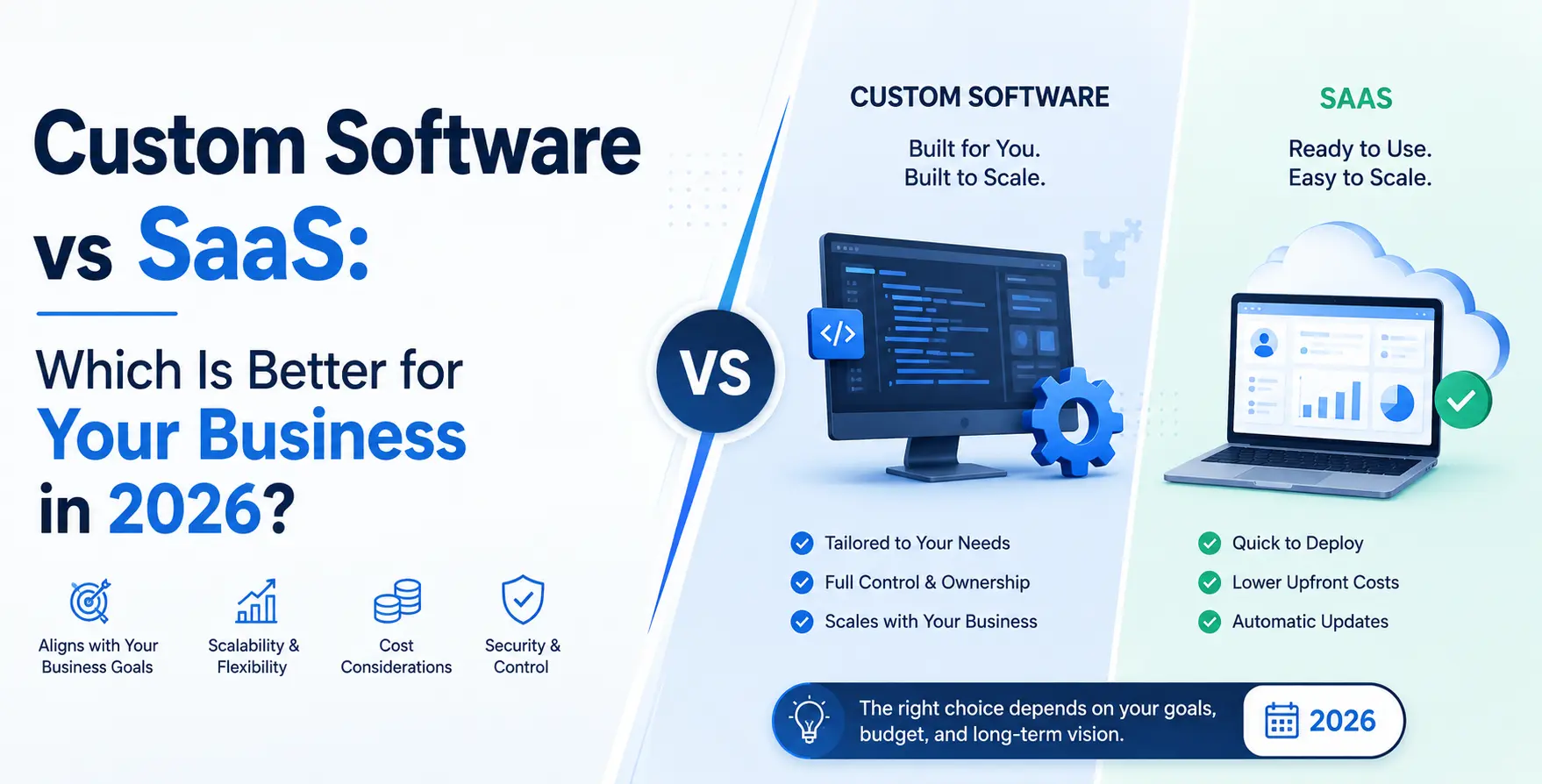
Custom Software vs SaaS: A Comparison
| Custom Software |
SaaS Solutions |
| High degree of customization and control |
Limited customization and control |
| Time-consuming and expensive to develop |
Reduced upfront costs and faster deployment |
| Can be integrated with existing systems |
Typically updated and maintained by the provider |
Choosing the Right Option for Your Business
When choosing between custom software development for business and SaaS solutions for businesses, it's essential to consider the specific needs and requirements of your business.
Custom software may be the better option if you need a high degree of customization and control, while SaaS may be more suitable if you're looking for a convenient and cost-effective solution.
Ultimately, the choice between custom software and SaaS depends on your business's unique needs and priorities.
Real-Life Examples of Custom Software and SaaS
Many businesses have successfully implemented custom software and SaaS solutions to improve their operations and competitiveness.
For example, a company might use custom software to automate its supply chain management, while another company might use SaaS to streamline its customer relationship management.
By understanding the benefits and drawbacks of each option, businesses can make informed decisions about which approach to take.
- Automating supply chain management with custom software
- Streamlining customer relationship management with SaaS
- Improving operational efficiency with custom software
- Enhancing customer experience with SaaS
- Reducing costs and increasing productivity with custom software
Common Mistakes to Avoid
When choosing between custom software and SaaS, businesses should avoid common mistakes that can lead to poor outcomes.
These mistakes include failing to define clear requirements, underestimating the complexity of the project, and neglecting to consider scalability and maintenance needs.
By being aware of these potential pitfalls, businesses can make more informed decisions and ensure a successful implementation.
- Failing to define clear requirements
- Underestimating the complexity of the project
- Neglecting to consider scalability and maintenance needs
- Insufficient testing and quality assurance
- Poor communication and project management
Future Trends in Custom Software and SaaS
The custom software and SaaS landscapes are constantly evolving, with new trends and technologies emerging all the time.
Some of the key trends to watch include the increasing adoption of cloud computing, the growing importance of artificial intelligence and machine learning, and the rising demand for mobile and web applications.
By staying up-to-date with these trends, businesses can stay ahead of the curve and ensure they're getting the most out of their software investments.
- Increasing adoption of cloud computing
- Growing importance of artificial intelligence and machine learning
- Rising demand for mobile and web applications
- Greater emphasis on cybersecurity and data protection
- More focus on user experience and customer engagement
Conclusion
In conclusion, the choice between custom software development for business and SaaS solutions for businesses depends on a variety of factors, including the business's size, budget, and specific requirements.
By understanding the benefits and drawbacks of each option, businesses can make informed decisions about which approach to take.
Whether you choose custom software or SaaS, the key is to find a solution that meets your business's unique needs and helps you achieve your goals.


 In collaboration with